
计算溶液所需的质量、体积或浓度。
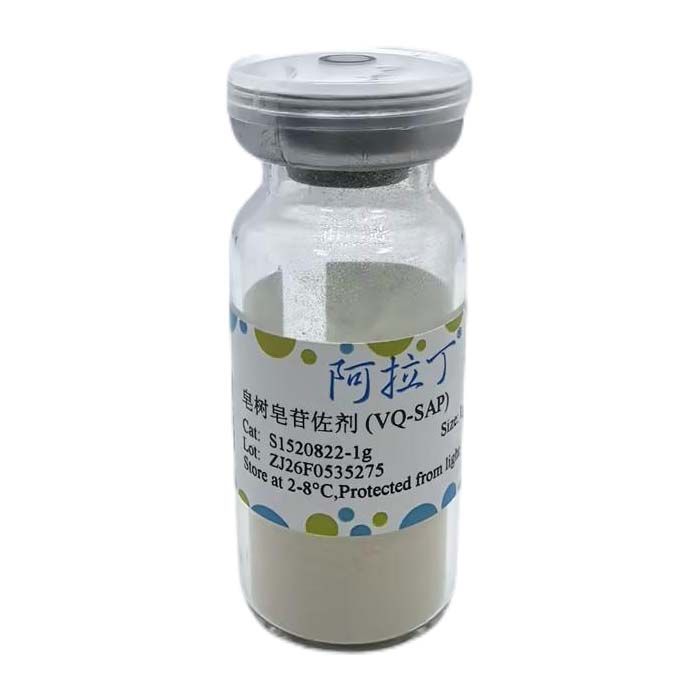
皂树皂苷佐剂 (VQ-SAP)
有货
BioReagent,无菌 级 提供 ≥90% 纯度,适用于对基线干扰要求严格的色谱和分析工作流程。
2-8°C储存,避光。低温运输 。请查阅批次 COA 获取详细规格。
SDS、COA、产品数据表及规格说明书均可下载。可通过批号查询获取批次 COA。
在色谱分析、有机合成和交叉偶联反应领域已被 0 篇同行评审文献引用。
| 项目 | 说明 | 备注 |
| 来源 | 南美皂皮树树皮提取 | |
| 皂苷纯度 | ≥90% (HPLC面积归一化法) | 《中国药典》2020版 |
| 关键组分 | QS-21、QS-7 | HPLC |
| 内毒素控制 | ≤5 EU/mg | 鲎试剂法(动态浊度法) |
| 有效期 | 2年 (5~25℃避光保存) | 加速稳定性试验数据 |
| 疾病领域 | 疫苗案例 | 效果数据 |
| 口蹄疫 | 猪O型FMDV灭活疫苗+皂苷 | 抗体GMT值提升2.8倍 (VS传统铝胶佐剂) |
| PRRSV | 美国AMERCAV疫苗+皂苷 | 攻毒后病毒载量降低99% (qPCR检测) |
| 片吸虫病 | 羊用多表位肽疫苗+皂苷 | 粪便虫卵数减少83% (Kato-Katz法) |
| 弓形虫病 | SAG1重组蛋白疫苗+皂苷 | 脑部包囊形成率下降76% (组织病理学评分) |
宠物疫苗
1、猫杯状病毒 (FCV):抗体阳性率从68%提升至94% (ELISA法)。
2、犬细小病毒 (CPV):存活率提高40% (攻毒保护实验)。
六、质量优势与合规
质量控制体系
1、原料端:
(1) 树皮分级标准 (厚度≥3mm,皂苷含量≥10%)。
(2) 重金属控制 (As≤2ppm,Hg≤0.2ppm,符合USP<232>)。
(3) 农药残留控制 (符合中国药典标准)。
2、生产端:
(1) 全流程可追溯 (批次记录关联树皮来源、提取参数)。
(2) 冻干工艺保留皂苷活性 (活性回收率>95%)。
七、推荐应用方案
适配疫苗类型
| 病原体类型 | 推荐适应症 | 建议添加比例 |
| 病毒 | 猫白血病病毒 (FeLV)、牛呼吸道合胞病毒 | 抗原量的1:1~1:50 |
| 细菌 | 曼氏杆菌疫苗、Q热疫苗 | 抗原量的1:1~1:50 |
| 寄生虫 | 牛巴贝斯虫、羊肝片吸虫 | 抗原量的1:1~1:100 |
剂型建议
水性佐剂:直接与抗原混合。
| Item | Specification | Remarks |
| Source | Extracted from the bark of Quillaja saponaria | — |
| Saponin Purity | ≥90% (HPLC area normalization method) | Chinese Pharmacopoeia 2020 Edition |
| Key Components | QS‑21, QS‑7 | Determined by HPLC |
| Endotoxin Control | ≤5 EU/mg | Limulus amebocyte lysate (kinetic turbidimetric method) |
| Shelf Life | 2 years (stored at 5–25 °C, protected from light) | Based on accelerated stability test data |
III. Preparation Instructions
Stock Solution (10 mg/mL)
1. Weigh 100 mg of VQ‑SAP adjuvant into a clean container.
2. Add 10 mL of distilled water.
3. Stir magnetically until completely dissolved.
4. Immediately after dissolution, filter the solution through a 0.22 μm membrane into a sterile container under an A‑level laminar flow hood in a B‑grade environment.
5. The filtered solution must be stored frozen; aliquoting is recommended to avoid repeated freeze‑thaw cycles.
6. Due to the risk of alkaline hydrolysis, the solution pH must not exceed 8.5.
Route of Administration
For subcutaneous or intramuscular injection only.Intraperitoneal injection is prohibited, as the surfactant property of saponin molecules may cause chemical peritonitis and fibrous adhesions between peritoneal organs.
IV. Mechanism of Action
Dual Pathway Immune Activation
1. Innate Immune Activation
(1) QS‑21 mediates the MyD88‑dependent signaling pathway via the TLR4/MD‑2 receptor, rapidly inducing dendritic cell maturation and upregulating CD80/CD86 expression.
(2) Activates the NLRP3 inflammasome, promotes the secretion of IL‑1β and IL‑18, and enhances Th1‑type immune responses.
2. Adaptive Immune Enhancement
(1) Forms nanoscale micelles with antigens, facilitating antigen uptake by APCs and cross‑presentation to MHC class I molecules, thereby activating CTLs.
(2) When combined with adjuvants such as 3D‑MPLA, antibody titers increase ≥3‑fold (measured by ELISA).
VQ‑SAP is a saponin‑based adjuvant whose product consistency and immunostimulatory activity are ensured through proprietary purification processes. It is widely used in various veterinary vaccines and holds significant value in both human and veterinary immunological research.
Extracted from the water‑soluble saponin fraction of Quillaja saponaria Molina, VQ‑SAP belongs to triterpenoid saponins with a common triterpene backbone structure. It exerts potent adjuvant effects on both T‑cell‑dependent and T‑cell‑independent antigens, significantly enhances CD8⁺ cytotoxic lymphocyte responses, and boosts mucosal antigen immune responses.
When combined with cholesterol and phospholipids to form immune‑stimulating complexes (ISCOMs), VQ‑SAP adjuvant simultaneously activates cellular and humoral immune responses, eliciting broad‑spectrum immunity against viral, bacterial, parasitic, and tumor antigens.
Safety Advantages
1. Low‑Toxicity Design: Highly allergenic impurities such as polysaccharides, polyphenols, and tannins are removed (removal rate ≥95%).
2. Acute Oral Toxicity (Rat): LD₅₀ > 5000 mg/kg b.w., EPA Toxicity Category IV.
3. Acute Dermal Toxicity (Rat): LD₅₀ > 4000 mg/kg b.w.
V. Verified Application Scenarios
Veterinary Vaccines
| Disease Area | Vaccine Example | Efficacy Data |
| Foot‑and‑Mouth Disease | Swine type O FMDV inactivated vaccine + saponin | 2.8‑fold increase in antibody GMT vs. conventional aluminum gel adjuvant |
| PRRSV | US AMERCAV vaccine + saponin | 99% reduction in viral load after challenge (detected by qPCR) |
| Fascioliasis | Multiepitope peptide vaccine for sheep + saponin | 83% reduction in fecal egg count (Kato‑Katz method) |
| Toxoplasmosis | SAG1 recombinant protein vaccine + saponin | 76% decrease in brain cyst formation rate (histopathological scoring) |
| Pathogen Type | Recommended Indications | Suggested Addition Ratio |
| Virus | Feline Leukemia Virus (FeLV), Bovine Respiratory Syncytial Virus | 1:1 to 1:50 relative to antigen dosage |
| Bacteria | Mannheimia haemolytica vaccine, Q fever vaccine | 1:1 to 1:50 relative to antigen dosage |
| Parasite | Babesia bovis, Fasciola hepatica in sheep | 1:1 to 1:100 relative to antigen dosage |
通过匹配包装上的批号来查找并下载产品的 COA,每批产品都进行了严格的验证,您可放心使用!
| 批号(Lot Number) | 证书类型 | 货号 |
|---|---|---|
 ZJ26F0535275 |
分析证书 | S1520822 |


 危险品化学品经营许可证(带存储)