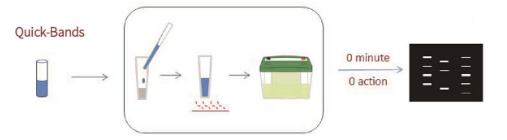
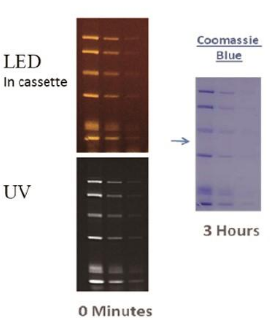
本产品是一种可用于蛋白SDS-PAGE凝胶电泳的条带显示剂。本品的特点是方便、灵敏,无需增加特殊的处理步骤,只需与使用普通的上样缓冲液一样处理您的蛋白样品,电泳结束后即可直接使用凝胶成像仪的紫外光源或者LED灯观察电泳结果,并且其染色灵敏度每条带可达0.1ng,与银染相当。
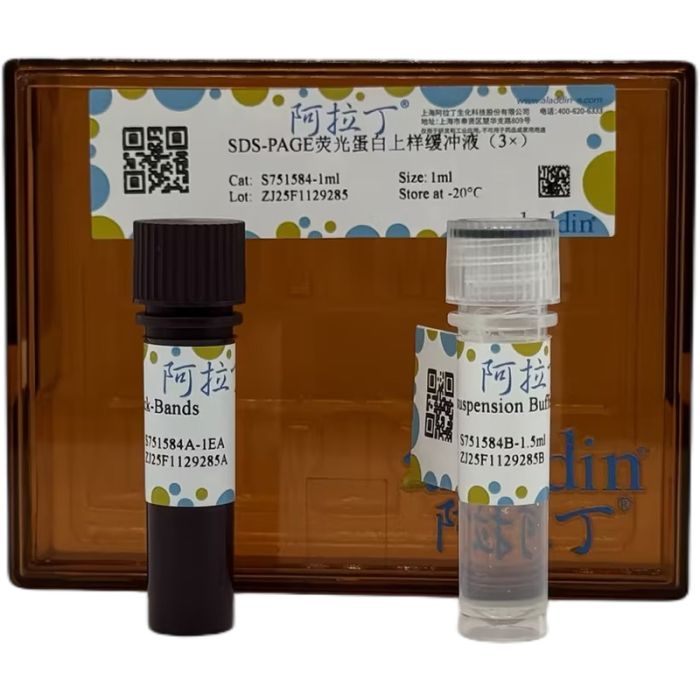
组分表
S751584
| Component | 1 mL | Storage |
S751584A
| Quick-Bands
| 1EA | -20℃. Store in the dark. |
S751584B
| Resuspension Buffer
| 1.5 mL | -20℃. Store in the dark. |
使用方法
1、请在使用前根据棕色管管壁标签上的体积加入Resuspension Buffer重悬,得到Quick-Bands蛋白样品处理液。
注:Resuspension buffer在4℃可能会有沉淀产生,室温下放置至沉淀消失。
2、将上述Quick-Bands蛋白样品处理液与待电泳蛋白样品1:2混合。比如,3μL Quick-Bands蛋白样品处理液+6μL蛋白样品。
3、90-100°C加热上述处理的样品混合液5分钟。细胞或组织样品,加热时间延长至10分钟。确保加热温度>90°C使样品充分受热。大部分预制胶(Bis-Tris体系除外)可以直接进行第4步。Bis-Tris体系的预制胶(如Life Technology),需加入20%已处理样品体积的Enhancing buffer。比如,10μL已处理的样品需加入2μL Enhancing buffer。(Enhancing buffer需要单独购买)。
4、样品上样进行电泳(无需再加Loading Buffer处理)。如果需要marker,一个孔上3μL即用型荧光marker。
5、电泳结束后,将凝胶放至透射仪上进行观察和拍照。透射仪可以是紫外灯,蓝光LED灯或其它凝胶成像系统。如果光源在可见光波长范畴的无需剥胶,因为可见波长范围内的光可以穿透玻璃或塑料材质的胶板。
6.(可选)如有需要,经Quick-Bands蛋白样品处理液处理的凝胶仍可进行考染。按标准的考染步骤进行即可。
使用技巧
1、经Quick-Bands染色的胶仍可进行常规的考马斯亮蓝染色。
2、如果凝胶为玻璃面板成像拍照时,请勿使用UV,仅能使用反射绿光,曝光时间6S,玻璃不透UV。
3、Quick-Bands与Western Blot兼容,不影响后续的抗原抗体反应。转膜后,胶和膜均可在UV或LED灯下直接观察,从而有效掌控转膜效果。
4、Quick-Bands适合于用SDS-PAGE凝胶电泳检验蛋白表达,判断蛋白纯度,在纯化中跟踪目标蛋白,在Western Blot实验中用于对照样品的显色,还可以进行免疫沉淀结果的检测。
5、Quick-Bands不适合用于以蛋白测序、质谱分析或抗体制备为目的的切胶纯化。
6、您可以使用荧光标记的蛋白分子量标准,也可以使用经Quick-Bands处理未经其他loading buffer处理的蛋白分子量标准。
产品储存及稳定性
1、收到产品后请立即置于-20℃避光保存。
2、Quick-Bands可于-20°C储存12个月,4°C储存8周,室温下储存1周。
3、如果Quick-Bands在室温下保存超过一周,请新增加终浓度为20mM的DTT。
影响因素
1、pH的影响:低pH有可能会降低Quick-Bands染色的效率,如果样品的pH低于5,建议将pH调整至7以上。
2、常规实验条件下Quick-Bands染色不会受到影响。
3、会影响Quick-Bands染色效果的试剂有:大于20%的Glycerol,大于8M的Urea,大于50mM的DTT,大于0.5M的L-Arg。
常见问题及解答
Q:为什么无法用Quick-Bands对购买的蛋白分子量标准进行染色?
A:大多数的即用型的蛋白分子量标准与Quick-Bands并不兼容,请勿使用Quick-Bands处理这些样品。您可以从我司购买荧光标记的蛋白分子量标准,也可以使用Quick-Bands处理未经其他loading buffer处理的蛋白分子量标准(如冻干的粉末型分子量标准)。
Q:Quick-Bands的稳定性如何?
A:Quick-Bands本身是稳定的,但是由于体系中还原剂(如DTT)的失效,一些蛋白条带会变得没有那么清晰和明亮,通常Quick-Bands可在室温放置1周,如超过1周可添加新的DTT,蛋白条带会重新变得清晰和明亮。添加DTT的终浓度不要超过20mM。
Q:翻译后的蛋白修饰是否会影响Quick-Bands?
A:不会。
Q:为什么有时候蛋白条带变得不够清晰明亮?
A:由于蛋白被氧化了,可向体系中添加还原剂(如DTT),添加DTT的终浓度不要超过20mM
Q:Quick-Bands处理后的样品是否可以做Western Blot?
A:根据我们做的大量测试表明Quick-Bands对Western Blot实验没有干扰。
Q:4°C贮存的Quick-Bands为什么会有沉淀析出?
A:沉淀是SDS,将Quick-Bands平衡至室温即可溶解。
实验数据展示

This product is a dye reagent for visualizing protein bands in SDS-PAGE gel electrophoresis. It offers convenience and high sensitivity, comparable to silver staining (detection limit: 0.1 ng/band), without requiring additional special steps. Simply treat your protein samples as you would with standard loading buffer. After electrophoresis, results can be directly visualized using a gel imager's UV or LED light source.
Protocol
1. Reconstitution: Before use, resuspend the contents of the brown tube with the specified volume of Resuspension Buffer (provided on the tube label) to prepare the Quick-Bands Protein Sample Treatment Solution.
Note: Resuspension Buffer may form precipitates at 4°C. Allow it to warm to room temperature until precipitates dissolve completely.
2. Sample Mixing: Mix the prepared Quick-Bands Protein Sample Treatment Solution with your protein sample at a 1:2 ratio (e.g., 3 µL Quick-Bands + 6 µL protein sample).
3. Heat Denaturation: Heat the mixed sample at 90-100°C for 5 minutes. For cell or tissue samples, extend the heating time to 10 minutes. Ensure the temperature exceeds 90°C for proper denaturation.
Note for Precast Gels: Most precast gels (except Bis-Tris system gels) can proceed directly to step 4. For Bis-Tris system precast gels (e.g., from Life Technologies), add Enhancing Buffer to a final concentration of 20% of the treated sample volume (e.g., add 2 µL Enhancing Buffer to 10 µL treated sample). Enhancing Buffer must be purchased separately.
4. Electrophoresis: Load the processed samples directly onto the gel for electrophoresis (no additional Loading Buffer is required). If needed, load 3 µL of a ready-to-use fluorescent protein marker per well.
5. Visualization & Imaging: After electrophoresis, place the gel on a transilluminator for observation and photography. Compatible light sources include UV lamps, blue LED lights, or other gel imaging systems. If using a visible light source, the gel does not need to be removed from its plastic/glass plates, as visible light can penetrate them.
6. Optional Coomassie Staining: Gels treated with Quick-Bands can subsequently be stained with Coomassie Blue if desired, following standard Coomassie staining protocols.
Usage Tips
1. Gels stained with Quick-Bands can still undergo conventional Coomassie Blue staining.
2. For imaging gels between glass plates, do not use UV light. Use reflected green light only with an exposure time of 6 seconds, as glass blocks UV transmission.
3. Quick-Bands is compatible with Western Blotting and does not interfere with subsequent antigen-antibody reactions. After transfer, both the gel and the membrane can be directly visualized under UV or LED light to assess transfer efficiency.
4. Quick-Bands is suitable for: checking protein expression via SDS-PAGE, assessing protein purity, tracking target proteins during purification, visualizing control samples in Western Blot experiments, and detecting immunoprecipitation results.
5. Quick-Bands is NOT suitable for excising gel bands intended for protein sequencing, mass spectrometry analysis, or antibody production.
6. You can use either fluorescently labeled protein molecular weight standards or protein molecular weight standards treated with Quick-Bands (and not pre-treated with other loading buffers).
Storage & Stability
1. Upon receipt, store the product immediately at -20°C protected from light.
2. Quick-Bands can be stored at -20°C for 12 months, at 4°C for 8 weeks, or at room temperature for 1 week.
3. If Quick-Bands is stored at room temperature for over one week, add DTT to a final concentration of 20 mM.
Factors Affecting Performance
1. pH: Low pH may reduce the staining efficiency of Quick-Bands. If the sample pH is below 5, adjust it to pH 7 or higher.
2. Staining with Quick-Bands is generally unaffected under standard experimental conditions.
3. Reagents that can interfere with Quick-Bands staining include: Glycerol (>20%), Urea (>8 M), DTT (>50 mM), L-Arg (>0.5 M).
Frequently Asked Questions (FAQ)
Q: Why can't I stain my purchased protein molecular weight standard with Quick-Bands?
A: Most ready-to-use protein markers are not compatible with Quick-Bands. Do not treat these markers with Quick-Bands. You can purchase fluorescent protein markers from our company or use Quick-Bands to treat protein marker powders (e.g., lyophilized markers) not pre-treated with other loading buffers.
Q: How stable is Quick-Bands?
A: Quick-Bands itself is stable. However, the deterioration of reducing agents (like DTT) in the system over time can cause some protein bands to become less sharp and bright. Typically, Quick-Bands can be stored at room temperature for 1 week. If stored longer, adding fresh DTT (final concentration not exceeding 20 mM) can restore band sharpness and intensity.
Q: Do post-translational protein modifications affect Quick-Bands?
A: No.
Q: Why do protein bands sometimes appear less sharp and bright?
A: This is likely due to protein oxidation. Add a reducing agent (e.g., DTT) to the system. The final concentration of DTT should not exceed 20 mM.
Q: Can samples treated with Quick-Bands be used for Western Blotting?
A: Based on extensive testing, Quick-Bands does not interfere with Western Blot experiments.
Q: Why does Quick-Bands stored at 4°C sometimes form a precipitate?
A: The precipitate is SDS. Warm the solution to room temperature to dissolve it.
Experimental Data Presentation

 ZJ25F1129285


 危险品化学品经营许可证(带存储)