
计算溶液所需的质量、体积或浓度。
有货
BioReagent 级 提供 ≥99% 纯度,适用于对基线干扰要求严格的色谱和分析工作流程。
室温。DG运输 。请查阅批次 COA 获取详细规格。
SDS、COA、产品数据表及规格说明书均可下载。可通过批号查询获取批次 COA。
在色谱分析、有机合成和交叉偶联反应领域已被 474 篇同行评审文献引用。
Electrochemical treatment of organic pollutants in landfill leachate using a three-dimensional electrode system.</strong>: This study explores the electrochemical treatment of landfill leachate using a three-dimensional electrode system. Sodium persulfate is used as an oxidizing agent to degrade organic pollutants effectively, providing a potential method for waste management and environmental protection (Yu et al., 2020).</li><li><strong>The Box-Benkhen experimental design for the optimization of the electrocatalytic treatment of wastewaters with high concentrations of phenol and organic matter.</strong>: This paper discusses the optimization of electrocatalytic treatment processes for wastewater containing high levels of phenol and organic matter using sodium persulfate. The study provides valuable insights for improving wastewater treatment efficiency (GilPavas et al., 2009).</li><li><strong>Reaction of pectin and glycidyl methacrylate and ulterior formation of free films by reticulation.</strong>: This research involves the chemical modification of pectin with glycidyl methacrylate followed by cross-linking using sodium persulfate, leading to the formation of free-standing films. These films have potential applications in pharmaceuticals and food packaging (Maior et al., 2008).</li></ul>
<ul>
<li><strong>Electrochemical treatment of organic pollutants in landfill leachate using a three-dimensional electrode system.</strong>: This study explores the electrochemical treatment of landfill leachate using a three-dimensional electrode system. Sodium persulfate is used as an oxidizing agent to degrade organic pollutants effectively, providing a potential method for waste management and environmental protection (Yu et al., 2020).</li>
<li><strong>The Box-Benkhen experimental design for the optimization of the electrocatalytic treatment of wastewaters with high concentrations of phenol and organic matter.</strong>: This paper discusses the optimization of electrocatalytic treatment processes for wastewater containing high levels of phenol and organic matter using sodium persulfate. The study provides valuable insights for improving wastewater treatment efficiency (GilPavas et al., 2009).</li>
<li><strong>Reaction of pectin and glycidyl methacrylate and ulterior formation of free films by reticulation.</strong>: This research involves the chemical modification of pectin with glycidyl methacrylate followed by cross-linking using sodium persulfate, leading to the formation of free-standing films. These films have potential applications in pharmaceuticals and food packaging (Maior et al., 2008).</li>
</ul>
分类树(Taxonomy Tree)
| 界(kingdom) | 无机化合物 |
|---|---|
| 超类(Superclass) | 混合金属/非金属化合物 |
| 类(Class) | 碱金属含氧阴离子化合物 |
| 亚类(Subclass) | 碱金属过硫酸盐 |
| 中间层级节点(Intermediate Tree Nodes) | 暂无 |
| 直接上位类(Direct Parent) | 碱金属过硫酸盐 |
| 其他上位类(Alternative Parents) | 无机钠盐 无机氧化物 |
| 分子骨架(Molecular Framework) | 暂无 |
| 取代基(Substituents) | 碱金属过二硫酸盐 - 无机氧化物 - 无机盐 - 无机钠盐 |
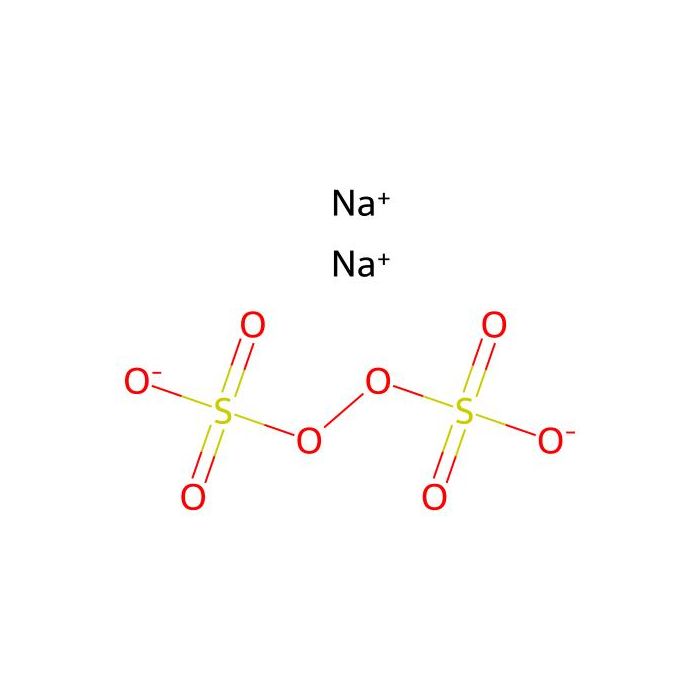
| 描述(Description) | 该化合物属于无机化合物中的碱金属过二硫酸盐类。这类化合物中最大的氧阴离子为过二硫酸根,且非氧阴离子中最重的原子为碱金属。 |
| 外部描述符(External Descriptors) | 暂无 |
H272: 可能加剧火灾; 氧化剂
H302: 吞食有害
H317: 可能引起皮肤过敏反应
H334: 吸入可能引起过敏或哮喘病症状或呼吸困难
H335: 可能引起呼吸道刺激
H402: 对水生生物有害
H315+H320: 引起皮肤和眼睛刺激
P210: 远离热源,热表面,火花,明火和其他点火源。 - 禁止抽烟。
P220: 远离衣物和其他可燃物。
P221: 采取一切预防措施,避免与可燃物/ ...混合。
P261: 避免吸入灰尘/烟雾/气体/雾/蒸汽/喷雾
P264: 处理后要彻底洗手。
P270: 使用本产品时,请勿进食、饮水或吸烟。
P271: 仅在室外或通风良好的地方使用。
P272: 被污染的工作服不允许离开工作场所
P273: 避免释放到环境中。
P280: 戴防护手套/穿防护服/戴防护眼罩/戴防护面具。
P284: 如果通风不良,请佩戴呼吸防护装置。
P302+P352: 如皮肤沾染:用水充分清洗。
P305+P351+P338: 如进入眼睛:用水小心冲洗几分钟。如戴隐形眼镜并可方便地取出,取出隐形眼镜。继续冲洗。
P333+P313: 如发生皮肤刺激或皮疹:求医/就诊。
P337+P313: 如仍觉眼刺激:求医/就诊。
P342+P311: 如有呼吸系统病症:呼叫急救中心/医生。
P370+P378: 火灾时:使用干砂、干粉或抗醇泡沫灭火。
P405: 密闭存放
P403+P233: 存放在通风良好的地方。保持容器密闭。
P501: 将内容物/容器处理到。。。
P301+P312+P330: 如误吞咽:如感觉不适,呼叫急救中心/医生。漱口
P304+P340+P312: 如误吸入:将人转移到空气新鲜处,保持呼吸舒适体位。如感觉不适,呼叫急救中心/医生。


 危险品化学品经营许可证(带存储)