活性氧(Reactive oxygen species, ROS)主要包括羟基自由基、超氧自由基和过氧化氢。在细胞或组织的正常生理代谢过程中会产生活性氧,同时一些环境因子例如紫外照射、γ射线照射、吸烟、环境污染等也可以诱导活性氧的产生。活性氧产生后,可以导致细胞内脂、蛋白和DNA等的氧化损伤,诱发氧化应激(Oxidative stress),继而导致各种肿瘤、动脉粥样硬化、风湿性关节炎、糖尿病、肝损伤、以及中枢神经系统疾病等。机体中存在多种抗氧化物,包括抗氧化大分子、抗氧化小分子和酶等,可以清除体内产生的各种活性氧,以阻止活性氧诱导的氧化应激(oxidative stress)的产生。一个体系内的各种抗氧化大分子、抗氧化小分子和酶的总的水平即体现了该体系内的总抗氧化能力。因此测定血浆、血清、尿液、唾液等各种体液,细胞或组织等裂解液中的总抗氧化能力具有非常重要的生物学意义。
ABTS在适当的氧化剂作用下氧化成绿色的ABTS˙⁺,在抗氧化物存在时的产生会被抑制,在414 nm测定的吸光度即可测定并计算出样本中的总抗氧化能力。Trolox 是一种维生素E的类似物,具有和维生素E相近的抗氧化能力,用作其他抗氧化物总抗氧化能力的参考。例如,Trolox 的总抗氧化能力为 1,相同浓度情况下,其他物质的总抗氧化能力用其抗氧化能力和Trolox相应的倍数来表示。本试剂盒适用于检测血清(浆)等液体样本、动植物组织、细胞等样本中的总抗氧化能力。
| 储运单元货号 | 储运单元名称 | 组分货号 | 组分名称 | 物理外观 | 100T | 储存 | 单次测试使用量 | | T1508390WT | 总抗氧化能力快速检测试剂盒 (ABTS, 微量法)
(2-8℃组分) | T1508390A | 缓冲液 | 液体 | 24 mL | 2-8℃ | 152 μL |
|
| T1508390B | ABTS溶液 | 液体 | 1 mL | 2-8℃. 避光保存 | 10 μL |
|
| T1508390C | 过氧化氢溶液 | 液体 | 0.5 mL | 2-8℃. | 按需 |
|
| T1508390D | 过氧化物酶 | 液体 | 0.2 mL | 2-8℃. | 2 μL | | T1508390DT | 总抗氧化能力快速检测试剂盒 (ABTS, 微量法)
(-20℃组分) | T1508390E | Trolox 标准品 (5mM) | 液体 | 0.6 mL | -20℃. 避光保存 | 按需 |
注: 发货时各组分依据储存温度(2-8°C/-20℃)独立包装,差异化温控运输以保障产品性能。同一订单含多温区物料可能分批次送达,请以实际收货为准。收货后按组分表标注温度分类存放,有效期自生产之日起 12个月。 |
所需自备物品
仪器:酶标仪(405-425 nm)
试剂:双蒸水、PBS或HBSS溶液。
使用方法
1. 过氧化氢溶液和过氧化物酶的稀释,以及ABTS工作液的配制:
1.1 用双蒸水把过氧化氢溶液稀释800倍。例如取1 μL过氧化氢溶解,加入到799 μL双蒸水中,混匀即为1/800过氧化氢溶液。
1.2 根据待测样品的数量,取适量过氧化物酶用缓冲液稀释10倍。例如取20μL过氧化物酶,加入到180 μL缓冲液中,混匀后即可配制成200 μL过氧化物酶工作液。过氧化物酶工作液宜新鲜配制使用。
1.3 参考下表,根据待测定样品的数量(含标准曲线)配制适量的ABTS工作液
| 成分 | 1个检测 | 5个检测 | 10个检测 | 20个检测 | | 缓冲液 | 152 μL | 760 μL | 1520 μL | 3040 μL | | ABTS溶液 | 10 μL | 50 μL | 100 μL | 200 μL | | 1/800过氧化氢溶液 | 8 μL | 40 μL | 80 μL | 160 μL | | ABTS工作液 | 170 μL | 850 μL | 1700 μL | 3400 μL |
|
注:ABTS工作液配制后,室温避光保存,宜在30分钟内使用完毕。如果检测时标准品浓度为零时的吸光度值偏低,提示过氧化氢可能部分降解,此时可以考虑把过氧化氢的稀释倍数调整为500倍或更低的倍数。
2. 待测样品的准备
2.1 血清(浆)等液体样本:血清(浆)等液体样本每个样品需要10 μL,都可以直接用于测定。
2.2 细胞样品,收集约100万个细胞(不必精确计数,直接刮下,不宜使用胰酶和EDTA消化),放置在200 μL冰冷的PBS或HBSS溶液中,匀浆或超声以充分破碎细胞并释放其中的抗氧化物,4℃,12000g离心5分钟,取上清用于后续测定。
2.3 组织样品,每10 mg组织加入100 μL冰冷的PBS或HBSS溶液,匀浆或超声以充分破碎组织并释放其中的抗氧化物,4℃,12000g离心5分钟,取上清用于后续测定。以上所有操作均需在4℃或冰上操作。
注1:血浆制备时可以使用肝素或柠檬酸钠抗凝,不宜使用EDTA抗凝。
注2:血清(浆)等液体样本或制备好的细胞或组织样品的上清如果不立即用于测定,可以在-80℃冻存。-80℃冻存的样品至少在一个月内所测定获得的数据没有显著变化。
注3:细胞或组织样品在测定总抗氧化能力时需同时测定蛋白浓度,推荐使用阿拉丁BCA蛋白定量试剂盒 (B665595)。 最后测定获得的总抗氧化能力通常表示为每mg蛋白重量中的总抗氧化能力,表示单位为μmol/mg。
3. 样品稀释
3.1 正式检测前,为确保样品数值在线性范围(0.04-1 mM)内,建议进行预实验将样品设置多个稀释倍数,以确定样品中总抗氧化能力的大致数值,如果数值不在线性范围内,请调整样品的稀释倍数。
3.2 样本如需要稀释,血清 (浆)等液体样本的稀释建议使用蒸馏水或PBS稀释,而对于细胞和组织样本的稀释建议使用用于细胞或组织匀浆的溶液稀释。
4. 标准曲线测定的准备
用蒸馏水或样品配制溶液稀释标准品。对于血清、血浆、唾液或尿液样品直接用蒸馏水或PBS稀释标准品,对于细胞或组织样品,用于细胞或组织匀浆的溶液稀释标准品。参考下表稀释标准品,把5 mM Trolox标准溶液稀释成0.1、0.2、0.3、0.4、0.6、0.8和1 mM。
| 编号 | 1 | 2 | 3 | 4 | 5 | 6 | 7 | | 标准品浓度(mmol/L) | 0.1 | 0.2 | 0.3 | 0.4 | 0.6 | 0.8 | 1 | | 5 mmol/L 标准品(μL) | 4 | 8 | 12 | 16 | 24 | 32 | 40 | | 稀释液(μL) | 196 | 192 | 188 | 184 | 176 | 168 | 160 |
|
5. 样品测定
5.1 96孔板的每个检测孔中加入20 μL过氧化物酶工作液。
5.2 空白对照孔中加入10 μL蒸馏水或PBS等适当溶液;标准曲线检测孔内加入10 μL各种浓度的Trolox标准溶液;样品检测孔内加入10 μL各种样品。轻轻混匀。
5.3 每个孔内加入170 μL ABTS工作液,轻轻混匀。
5.4 室温孵育6分钟后测定A414。如果测定A414有困难,也可以在405~425 nm范围内进行测定。
6. 结果计算
6.1 标准曲线的绘制:空白孔的OD值记为A空白,标准品孔的OD值记为A标准,测定样品孔的OD值记为A测定。计算:ΔA测定= A空白 - A测定,Δ A标准 = A空白 - A标准。以标准品浓度为x轴,Δ A标准 为 y 轴,绘制标准曲线,得到标准方程,将 ΔA测定 代入方程得到测定样品孔总抗氧化能力 T-AOCₛₐₘₚₗₑ (mmol/L)。
6.2 总抗氧化能力的计算
6.2.1 血清(浆)等液体样本:总抗氧化能力 (mmol/L) = T-AOCₛₐₘₚₗₑ × f;
6.2.2 细胞和组织样本:总抗氧化能力 (μmol/mg 蛋白) = T-AOCₛₐₘₚₗₑ × f ÷ Cₚᵣ
注:
f:样本加入检测体系前的稀释倍数;
Cₚᵣ:样本蛋白质浓度,mg/mL。
注意事项:
1. 样品中不能添加DTT、巯基乙醇等影响氧化还原反应的物质,也不宜添加Tween、Triton和NP-40等去垢剂。
2. 测定时需可以测定A414的酶标仪一台(测405~425nm也可以)或可以测定微量样品的分光光度计一台。
3. 如果检测时标准品浓度为零时的吸光度值偏低 (例如低于1.5),提示过氧化氢可能部分降解,此时可以考虑把过氧化氢的稀释倍数调整为500倍或更低的倍数。
4. ABTS对人体有刺激性,操作时请小心,并注意适当防护以避免直接接触人体或吸入体内。
5. 本制品仅限于专业人员的科学研究用,不得用于临床诊断或治疗,不得用于食品或药品,不得存放于普通住宅内。
6. 为了您的安全和健康,请穿实验服并戴一次性手套操作。
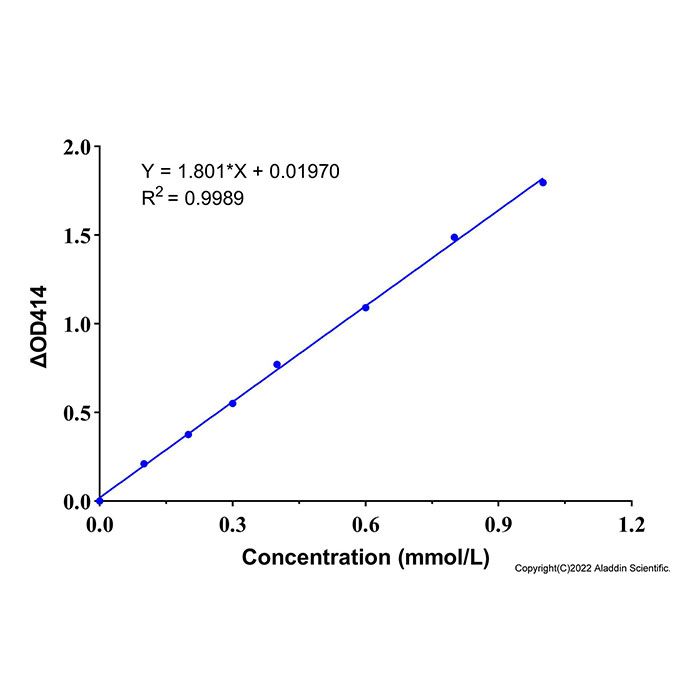
结果展示
典型标准曲线:

Reactive oxygen species (ROS) mainly include hydroxyl radicals, superoxide radicals, and hydrogen peroxide. ROS are produced during normal physiological metabolism in cells or tissues, and can also be induced by certain environmental factors such as UV irradiation, γ‑ray irradiation, smoking, and environmental pollution. Once generated, ROS can cause oxidative damage to intracellular lipids, proteins, and DNA, inducing oxidative stress, which in turn leads to various tumors, atherosclerosis, rheumatoid arthritis, diabetes, liver injury, and central nervous system diseases. The body contains a variety of antioxidants, including antioxidant macromolecules, small‑molecule antioxidants, and enzymes, which can scavenge various ROS generated in vivo to prevent ROS‑induced oxidative stress. The total level of all these antioxidant macromolecules, small‑molecule antioxidants, and enzymes in a system reflects the total antioxidant capacity of that system. Therefore, measuring the total antioxidant capacity in various biological fluids such as plasma, serum, urine, and saliva, as well as in cell or tissue lysates, is of great biological significance.
Under the action of a suitable oxidant, ABTS is oxidized to the green‑colored ABTS•⁺. Its formation is inhibited in the presence of antioxidants. The total antioxidant capacity of the sample can be determined and calculated by measuring the absorbance at 414 nm. Trolox is an analog of vitamin E with antioxidant capacity similar to that of vitamin E, and is used as a reference for the total antioxidant capacity of other antioxidants. For example, the total antioxidant capacity of Trolox is defined as 1; at the same concentration, the total antioxidant capacity of other substances is expressed as the corresponding multiple of their antioxidant capacity relative to that of Trolox. This kit is suitable for detecting total antioxidant capacity in liquid samples such as serum (plasma), as well as in animal and plant tissues, cells, and other samples.
| Storage Unit No. | Storage Unit Name | Component No. | Component Name | Appearance | 100T | Storage | Quantity Per Test | | T1508390WT | Total Antioxidant Capacity Rapid Detection Kit (ABTS, Micro Method)
(2-8℃ Components) | T1508390A | Buffer Solution | liquid | 24 mL | 2-8℃ | 152 μL |
|
| T1508390B | ABTS Solution | liquid | 1 mL | 2-8℃. Protect from light | 10 μL |
|
| T1508390C | H₂O₂ Solution | liquid | 0.5 mL | 2-8℃. | As needed |
|
| T1508390D | Peroxidase | liquid | 0.2 mL | 2-8℃. | 2 μL | | T1508390DT | Total Antioxidant Capacity Rapid Detection Kit (ABTS, Micro Method)
(-20℃ Components) | T1508390E | Trolox Standard (5mM) | liquid | 0.6 mL | -20℃. Protect from light | As needed |
Notes: Each component is individually packaged according to its storage temperature (2-8°C /-20°C)upon shipment, with differentiated temperature-controlled transportation to quarantee product performance Orders containing materials requiring multiple temperature zones may be delivered in separate batches: please refer to the actual received goods.Upon receipt, store components separately at the temperatures specified in the component list, The shelf-life is 12 months from the date of manufacture. |
Materials Required (Not Provided)
Instrument: Microplate reader (405-425 nm)
Reagents: Double-distilled water, PBS, or HBSS solution.
Protocol
1. Dilution of Hydrogen Peroxide Solution and Peroxidase, and Preparation of ABTS Working Solution
1.1 Dilute the hydrogen peroxide solution 800‑fold with double‑distilled water. For example, take 1 μL of hydrogen peroxide solution and add it to 799 μL of double‑distilled water; mix well to obtain a 1/800 hydrogen peroxide solution.
1.2 According to the number of samples to be tested, dilute an appropriate amount of peroxidase 10‑fold with Buffer Solution. For example, take 20 μL of peroxidase and add it to 180 μL of Buffer Solution; mix well to prepare 200 μL of Peroxidase Working Solution. The Peroxidase Working Solution should be prepared fresh before use.
1.3 Refer to the table below and prepare an appropriate amount of ABTS Working Solution according to the number of samples to be tested (including the standard curve).
| Component | 1 assay | 5 assays | 10 assays | 20 assays | Buffer Solution
| 152 μL | 760 μL | 1520 μL | 3040 μL | | ABTS Solution | 10 μL | 50 μL | 100 μL | 200 μL | | 1/800 H₂O₂ Solution | 8 μL | 40 μL | 80 μL | 160 μL | | ABTS Working Solution | 170 μL | 850 μL | 1700 μL | 3400 μL |
|
Note: After preparation, the ABTS Working Solution should be stored at room temperature protected from light and used within 30 minutes. If the absorbance value of the zero standard is low during detection, it indicates that the hydrogen peroxide may have partially degraded. In this case, the dilution factor of hydrogen peroxide can be adjusted to 500‑fold or lower.
2. Preparation of Samples to Be Tested
2.1 Liquid samples such as serum (plasma): Each sample requires 10 μL and can be used directly for measurement.
2.2 Cell samples: Collect approximately 1 × 10⁶ cells (accurate counting is not necessary; cells can be scraped directly, and trypsin or EDTA digestion should be avoided). Place the cells in 200 μL of ice‑cold PBS or HBSS solution, and homogenize or sonicate to thoroughly disrupt the cells and release antioxidants. Centrifuge at 12,000 × g for 5 minutes at 4 °C, and collect the supernatant for subsequent measurement.
2.3 Tissue samples: Add 100 μL of ice‑cold PBS or HBSS solution per 10 mg of tissue, and homogenize or sonicate to thoroughly disrupt the tissue and release antioxidants. Centrifuge at 12,000 × g for 5 minutes at 4 °C, and collect the supernatant for subsequent measurement. All the above operations must be performed at 4 °C or on ice.
Note 1: For plasma preparation, heparin or sodium citrate can be used as anticoagulant; EDTA is not recommended.
Note 2: If the supernatant of liquid samples such as serum (plasma) or prepared cell or tissue samples is not used immediately, it can be stored at –80 °C. Samples stored at –80 °C show no significant change in measured data for at least one month.
Note 3: When measuring the total antioxidant capacity of cell or tissue samples, the protein concentration should also be determined. Aladdin’s BCA Protein Assay Kit (B665595) is recommended. The final total antioxidant capacity obtained is usually expressed as total antioxidant capacity per mg of protein, with the unit μmol/mg.
3. Sample Dilution
3.1 Before formal testing, to ensure that the sample values fall within the linear range (0.04–1 mM), it is recommended to perform a preliminary experiment with multiple dilution factors to determine the approximate total antioxidant capacity of the sample. If the values are not within the linear range, adjust the dilution factor accordingly.
3.2 If sample dilution is required, serum (plasma) and other liquid samples are recommended to be diluted with distilled water or PBS, while cell and tissue samples are recommended to be diluted with the solution used for cell or tissue homogenization.
4. Preparation for Standard Curve Determination
Dilute the standard with distilled water or the sample preparation solution. For serum, plasma, saliva, or urine samples, dilute the standard directly with distilled water or PBS. For cell or tissue samples, dilute the standard with the solution used for cell or tissue homogenization. Refer to the table below to dilute the standard: dilute the 5 mM Trolox standard solution to 0.1, 0.2, 0.3, 0.4, 0.6, 0.8, and 1 mM.
| Number | 1 | 2 | 3 | 4 | 5 | 6 | 7 | | Standard Concentration (mmol/L) | 0.1 | 0.2 | 0.3 | 0.4 | 0.6 | 0.8 | 1 | | 5 mmol/L Standard (μL) | 4 | 8 | 12 | 16 | 24 | 32 | 40 | | Diluent (μL) | 196 | 192 | 188 | 184 | 176 | 168 | 160 |
|
5. Sample Measurement
5.1 Add 20 μL of Peroxidase Working Solution to each detection well of a 96‑well plate.
5.2 Add 10 μL of distilled water, PBS, or another appropriate solution to the blank control wells; add 10 μL of Trolox standard solutions at various concentrations to the standard curve wells; add 10 μL of each sample to the sample wells. Mix gently.
5.3 Add 170 μL of ABTS Working Solution to each well and mix gently.
5.4 Incubate at room temperature for 6 minutes and then measure A414. If measurement at A414 is difficult, it can also be measured within the range of 405–425 nm.
6. Calculation of Results
6.1 Preparation of the standard curve
Record the OD value of the blank well as Abₗₐₙₖ, the OD value of standard well as Aₛₜₐₙdₐᵣd, and the OD value of sample well as Aₛₐₘₚₗₑ. Calculate: ΔAₛₐₘₚₗₑ = Abₗₐₙₖ – Aₛₐₘₚₗₑ, ΔAₛₜₐₙdₐᵣd = Abₗₐₙₖ – Aₛₜₐₙdₐᵣd. Plot the standard curve using the standard concentrations as the x‑axis and the corresponding ΔAₛₜₐₙdₐᵣd values as the y‑axis. Obtain the linear regression equation, and then substitute ΔAₛₐₘₚₗₑ into the equation to obtain the total antioxidant capacity (T‑AOCₛₐₘₚₗₑ ) of the sample well (in mmol/L).
6.2 Calculation of total antioxidant capacity:
6.2.1 For liquid samples such as serum/plasma: Total antioxidant capacity (mmol/L) = T‑AOCₛₐₘₚₗₑ × f
6.2.2 For cell and tissue samples: Total antioxidant capacity (μmol/mg protein) = T‑AOCₛₐₘₚₗₑ × f ÷ Cₚᵣ
Notes:
f: dilution factor of the sample before addition to the assay system;
Cₚᵣ : protein concentration of the sample (mg/mL).
Precautions
1. Do not add substances that affect redox reactions, such as DTT or β‑mercaptoethanol, to the samples. Detergents such as Tween, Triton, and NP‑40 should also be avoided.
2. A microplate reader capable of measuring A414 (or 405–425 nm) or a spectrophotometer suitable for micro‑volume samples is required for the measurement.
3. If the absorbance value of the zero standard is low (e.g., below 1.5), it indicates that the hydrogen peroxide may have partially degraded. In this case, the dilution factor of hydrogen peroxide can be adjusted to 500‑fold or lower.
4. ABTS is irritating to the human body. Handle with care and take appropriate protective measures to avoid direct contact with the body or inhalation.
5. This product is for research use by professionals only. It must not be used for clinical diagnosis or treatment, nor for food or pharmaceutical products, and must not be stored in ordinar
Results Presentation
Typical standard curve:



 危险品化学品经营许可证(带存储)