
计算溶液所需的质量、体积或浓度。
| 活性类型 | 活性值-log(M) | 作用机制 | 期刊 | 参考文献(PubMed IDs) |
|---|
提供 ≥99% 纯度,适用于对基线干扰要求严格的色谱和分析工作流程。
-20°C储存。超低温运输 。请查阅批次 COA 获取详细规格。
SDS、COA、产品数据表及规格说明书均可下载。可通过批号查询获取批次 COA。
在色谱分析、有机合成和交叉偶联反应领域已被 0 篇同行评审文献引用。
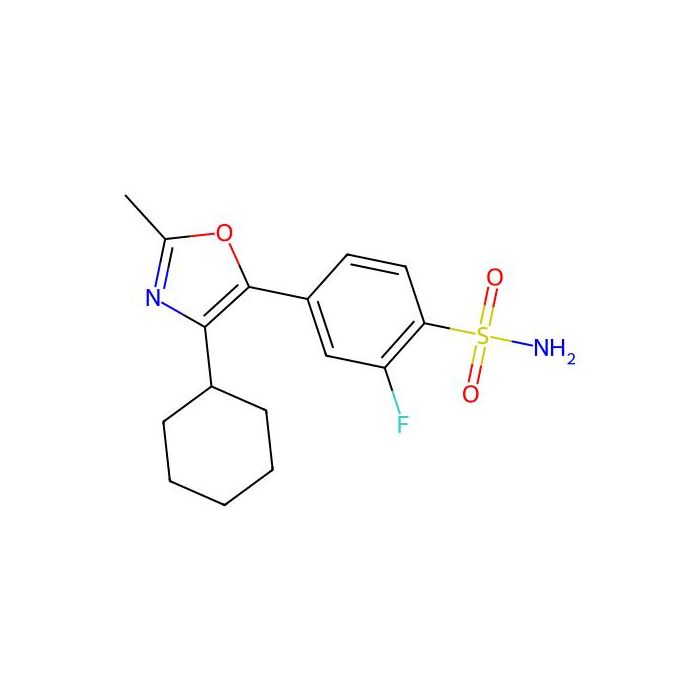
Tilmacoxib (JTE522) is a highly selective, time-dependent and irreversible human COX-2 inhibitor with an IC 50 of 85 nM in an enzyme assay.
In Vitro
Inhibitory activity and the mechanism of action of Tilmacoxib (JTE-522), a novel selective cyclooxygenase (COX)-2 inhibitor, on human COX-1 and COX-2 are investigated and compared with those of reference compounds. In an enzyme assay, Tilmacoxib inhibits yeast-expressed human recombinant COX-2 with an IC 50 of 0.085 μM. In contrast, Tilmacoxib does not inhibit human COX-1 prepared from human platelets at concentrations up to 100 μM. In a cell-based assay, Tilmacoxib diminishes lipopolysaccharide-induced prostaglandin E2 production in human peripheral blood mononuclear cells (COX-2) (IC 50 =15.1 nM). On the other hand, Tilmacoxib is less potent at inhibiting calcium ionophore-induced thromboxane B2 production in washed human platelets (COX-1) (IC 50 =6.21 μM). Tilmacoxib shows highly selective inhibition of human COX-2, and its activity is more selective than that of other COX-2 inhibitors (NS-398 and SC-58635). Human recombinant COX-2 activity is attenuated by Tilmacoxib in a dose-dependent and time-dependent manner. Inhibition of proliferation of gastric epithelial cells by a cyclooxygenase 2 inhibitor, Tilmacoxib (JTE522), is also mediated by a PGE 2 -independent pathway Combination of Tilmacoxib and Arachidonic acid results in a marked retardation of wound healing compared to the control, but Tilmacoxib does not completely suppress the increase in cellular PGE 2 content following the addition of arachidonate. MCE has not independently confirmed the accuracy of these methods. They are for reference only.
In Vivo
The present experiment is designed to assess the potential chemopreventive properties of Tilmacoxib (JTE-522), a new selective cyclooxygenase-2 inhibitor, on the induction of 1,2-dimethylhydrazine (DMH)-induced colonic aberrant crypt foci (ACF), a marker of rat colon carcinogenesis. A total of 80 male F344 rats are treated with 3 or 10 mg/kg of body weight Tilmacoxib or vehicle by oral gavage five times weekly from the start of the experiment. One week later, rats receive s.c. injections of saline or 20 mg/kg of body weight DMH once weekly for four successive weeks. At the end of 12 weeks after the start of experiment, all rats are sacrificed and colons are evaluated for ACF. 10 mg/kg Tilmacoxib significantly suppresses the total ACF/colon. No inhibitory effect is observed in the 3 mg/kg Tilmacoxib treatment group. Administration of 10 mg/kg Tilmacoxib significantly suppresses ACF formation with a 30% reduction in total ACF/colon (p<0.01). Furthermore, the data on crypt multiplicity show that 10 mg/kg Tilmacoxib significantly reduces the formation of foci containing 1-3 crypts but not foci containing four crypts or more. Administration of the low dose of Tilmacoxib (3 mg/kg) has no inhibitory effects on either the total ACF or crypt multiplicity. MCE has not independently confirmed the accuracy of these methods. They are for reference only.
Cell Assay
Tilmacoxib is resolved with DMSO prior to the experiment and concentrations of 1-100 μM are assessed. Effects of Arachidonic acid are assessed at concentrations of 0, 5 and 20 μg/mL. Further, the combination of Tilmacoxib (100 μM) with Arachidonic acid (20 μg/mL) is assessed in additional experiments. Circular artificial wounds are created after formation of complete monolayer cell sheets. Tilmacoxib and Arachidonic acid are added just after wound formation. The process of epithelial restoration is monitored by measuring the cell-free area using an inverted phase-contrast microscope every 24 h. Changes in the cell-free area during restoration are analyzed quantitatively with an image analyser. MCE has not independently confirmed the accuracy of these methods. They are for reference only.
Form:Solid
IC50& Target:Human COX-2 85 nM (IC 50 )
分类树(Taxonomy Tree)
| 界(kingdom) | 有机化合物 |
|---|---|
| 超类(Superclass) | 有机杂环化合物 |
| 类(Class) | 唑类 |
| 亚类(Subclass) | 噁唑类 |
| 中间层级节点(Intermediate Tree Nodes) | 暂无 |
| 直接上位类(Direct Parent) | 苯基-1,3-恶唑 |
| 其他上位类(Alternative Parents) | 苯磺酰胺类 苯磺酰基化合物 2,4,5-三取代恶唑 氟苯类 有机磺酰胺 芳基氟化物 氨基磺酰基化合物 杂芳族化合物 氧环化合物 氮杂环化合物 碳氢化合物衍生物 有机氧化物 有机氟化物 有机氮化合物 有机氧化合物 有机光子化合物 |
| 分子骨架(Molecular Framework) | 芳香族杂单环化合物 |
| 取代基(Substituents) | 2,4,5-三取代-1,3-噁唑 - 氨基磺酰基化合物 - 芳香族杂单环化合物 - 芳基氟化物 - 芳基卤化物 - 氮杂环 - 苯磺酰胺 - 苯磺酰基 - 苯基化合物 - 氟萘 - 卤苯 - 杂芳香族化合物 - 烃衍生物 - 单环苯基基团 - 有机硝基化合物 - 有机氧化物 - 有机氧化合物 - 有机磺酸或其衍生物 - 有机氟化物 - 有机卤化物 - 有机氮化合物 - 有机氧化合物 - 有机氮化合物 - 有机硫酰胺 - 有机磺酸或其衍生物 - 有机硫化合物 - 氧杂环 - 苯基-1,3-噁唑 - 磺酰基 |
| 描述(Description) | 该化合物属于苯基-1,3-恶唑类有机化合物。这类芳香杂环化合物在1,3-恶唑环上一个或多个位置被苯基取代。 |
| 外部描述符(External Descriptors) | organofluorine compound - 1,3-oxazoles - sulfonamide |
| 作用机制 | Action Type | target ID | Target Name | Target Type | Target Organism | Binding Site Name | 参考文献 |
|---|


 危险品化学品经营许可证(带存储)