试剂盒采用Ferric Reducing Ability of Plasma (FRAP)方法,可对血浆、血清、唾液、尿液等各种体液,细胞或组织等裂解液、植物或中草药抽提液、或各种抗氧化物 (antioxidant)溶液的总抗氧化能力进行检测。
活性氧(Reactive oxygen species, ROS)主要包括羟基自由基、超氧自由基和过氧化氢。在细胞或组织的正常生理代谢过程中会产生活性氧,同时一些环境因子例如紫外照射、γ射线照射、吸烟、环境污染等也可以诱导活性氧的产生。活性氧产生后,可导致细胞内脂、蛋白和DNA等的氧化损伤,诱发氧化应激(Oxidativestress),继而导致各种肿瘤、动脉粥样硬化、风湿性关节炎、糖尿病、肝损伤、以及中枢神经系统疾病等。
机体中存在多种抗氧化物,包括抗氧化大分子、抗氧化小分子和酶等,可以清除体内产生的各种活性氧,以阻止活性氧诱导的氧化应激的产生。一个体系内的各种抗氧化大分子、 抗氧化小分子和酶的总的水平即体现了该体系内的总抗氧化能力。因此测定血浆、血清、尿液、唾液等各种体液,细胞或组织等裂解液中的总抗氧化能力具有非常重要的生物学意义。 植物或中草药抽提液、或各种抗氧化物溶液的总抗氧化能力的检测可用于检测各种溶液的抗氧化能力的强弱,可用于筛选强抗氧化能力的药物。
FRAP法测定总抗氧化能力的原理是酸性条件下抗氧化物可以还原Ferric-tripyridyltriazine (Fe³⁺-TPTZ)产生蓝色的Fe²⁺-TPTZ,随后在 593nm测定蓝色的Fe²⁺-TPTZ 即可获得样品中的总抗氧化能力。由于反应在酸性条件下进行,可以抑制内源性的一些干扰因素。并且由于血浆等样品中的铁离子或亚铁离子的总浓度通常低于10μM, 因此血浆等样品中的铁离子或亚铁离子不会显著干扰FRAP法的检测反应。由于反应体系中的铁离子或亚铁离子是和TPTZ螯合的,样品本身含有的少量金属离子螯合剂通常也不会显著影响检测反应。
提供了抗氧化物Trolox作为对照。Trolox是一种维生素E的类似物,水溶性较好,抗氧化能力和维生素E相近。
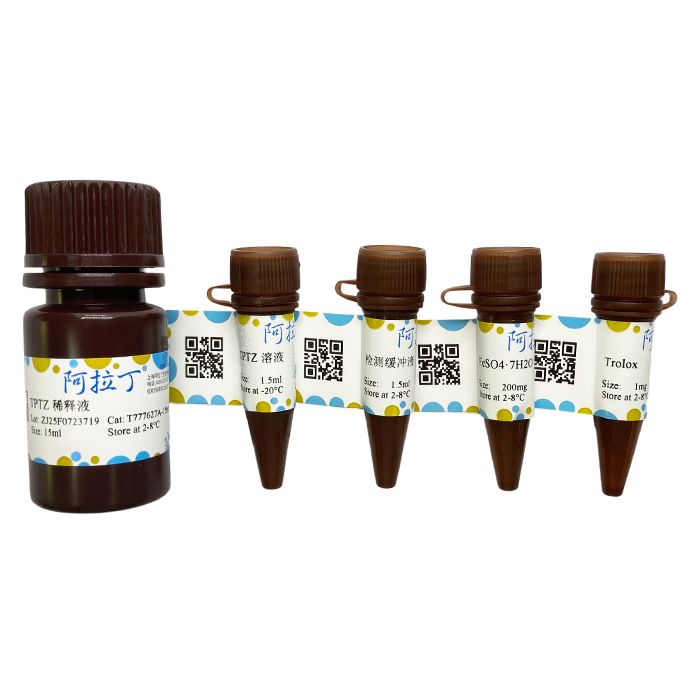
组分与储存:
| 储运单元货号 | 储运单元名称 | 组分货号 | 组分名称 | 物理外观 | 100T | 储存 |
| T777627WT | 总抗氧化能力检测试剂盒 (FRAP法) (2-8℃组分) | T777627A | TPTZ 稀释液 | 液体 | 15 mL | 2-8℃. 避光 |
|
| T777627C | 检测缓冲液 | 液体 | 1.5 mL | 2-8℃. 避光 |
|
| T777627D | FeSO₄·7H₂O
| 粉末 | 200 mg | 2-8℃. 避光 |
|
| T777627E | Trolox | 粉末 | 1 mg | 2-8℃. 避光 |
| T777627DT | 总抗氧化能力检测试剂盒 (FRAP法) (-20℃组分) | T777627B | TPTZ 溶液 | 液体 | 1.5 mL | -20℃. 避光 |
试剂准备:
请将试剂在室温下平衡至融化,混匀后使用。其中T777627B、 T777627C液应试剂量较少,所以使用前请短暂低速离心。
使用说明:
1、FRAP 工作液的配制参考下表,根据待测定样品的数量(含标准曲线)配制适量的FRAP工作液:
| 1个检测 | 5个检测 | 10个检测 | 20个检测 | 50个检测 | | TPTZ稀释液 | 150μL | 750μL | 1500μL | 3000μL | 7500μL | | TPTZ溶液 | 15μL | 75μL | 150μL | 300μL | 750μL | | 充分混匀后再加入检测缓冲液 | / | / | / | / | / | | 检测缓冲液 | 15μL | 75μL | 150μL | 300μL | 750μL | | FRAP工作液 | 180μL | 900μL | 1800μL | 3600μL | 9000μL |
FRAP工作液配制后37°C孵育,并宜在1~2h内使用。 |
2、待测样品的准备
2.1 血清、血浆、唾液或尿液样品的准备:血清、血浆、唾液或尿液样品每个样品需要5µL,可直接用于测定。血清、血浆、唾液或尿液样品都可以使用新鲜样品进行测定,也可以-80°C冻存后再进行测定。-80°C冻存的样品至少在一个月内所测定获得的数据没有显著变化。
注意:血浆制备时可使用肝素或柠檬酸钠抗凝,不宜使用EDTA抗凝。
2.2 细胞或组织样品的准备:
对于细胞样品,收集约1×10⁶个细胞(不必精确计数,直接刮下,不宜使用胰酶和EDTA消化),放置在200µL冰冷的PBS或HBSS溶液中,匀浆或超声以充分破碎细胞并释放其中的抗氧化物,在4°C下,12000g离心5min,取上清用于后续测定。
对于组织样品,每20mg组织加入100µL冰冷的PBS或HBSS溶液,匀浆或超声以充分破碎组织并释放其中的抗氧化物,在4°C下,12000g离心5min,取上清用于后续测定。
以上所有操作均需在4°C或冰上操作。
制备好的细胞或组织样品的上清,如果不立即用于测定,可以在-80°C冻存。
-80°C冻存的样品至少在一个月内所测定获得的数据没有显著变化。细胞或组织样品在测定总抗氧化能力时需同时测定蛋白浓度,最后测定获得的总抗氧化能力通常表示为每毫克或每克蛋白重量中的总抗氧化能力,表示单位为mmol/mg或 mmol/g。
2.3 其它样品的准备:
植物或中草药抽提液都可直接用于检测。需注意样品本身的颜色是否会干扰检测。植物或中草药抽提液的抗氧化能力可以表示为每毫克或每克抽提物干重中的总抗氧化能力,表示单位为mmol/mg 或mmol/g。各种抗氧化物测定其抗氧化能力时,通常配制成0.15~1.5mM,然后进行测定。抗氧化物的浓度可以摩尔浓度表示时,测定获得的总抗氧化能力可以用相对总抗氧化能力进行表示,例如0.5mM的某抗氧化物其测定获得的OD值和1mM的亚铁盐测定获得的OD值相同,则其相对总抗氧化能力为2,再如0.2mM的某抗氧化物其测定获得的OD值和 1mM 的亚铁盐测定获得的OD值相同,则其相对总抗氧化能力为5。豌豆可在0.1 mol/L乙酸钠缓冲液(pH 5.0)中均浆。
2.4 Trolox 阳性对照:
在1mg Trolox中加入2.67mL蒸馏水,避光颠倒或涡旋,使其溶解。终浓度为1.5mM,-20°C避光保存3个月。
3、标准曲线测定的准备
称取30mg本试剂盒提供的 FeSO₄·7H₂O,溶解并定容到1.08mL,此时浓度即为100mM。取适量100mM FeSO4溶液稀释至0.15、0.3、0.6、0.9、1.2和1.5mM。通常可使用蒸馏水或样品配制溶液配制标准品。对于血清、血浆、唾液或尿液样品推荐直接用蒸馏水标准品;对于细胞或组织样品,推荐用细胞或组织匀浆液配制标准品,其它样品参考前述方法进行。FeSO₄ 溶液宜新鲜配制使用。100mM FeSO₄ 溶液容易氧化产生三价铁盐,使溶液的颜色从最初的淡绿色逐渐转变为浅黄色。如果发现溶液的颜色已经呈现明显的黄色,应弃用,并使用试剂盒提供的 FeSO₄·7H₂O 重新配制新鲜的FeSO₄溶液。
4、总抗氧化能力的测定
4.1 打开酶标仪,将检测波长调节至593nm。
4.2 在96孔板的每个检测孔中加入180µL FRAP工作液。
4.3 空白对照孔中加入5µL蒸馏水或PBS等适当溶液;标准曲线检测孔内加入5µL各种浓度 的 FeSO₄ 标准溶液;样品检测孔内加入5µL各种样品,阳性对照孔内加入5µL 1.5mM Trolox。 吹打混匀。
4.4 37°C孵育3~5min后测定A593。
4.5 根据标准曲线计算出样品的总抗氧化能力。如果样品测定出来的吸光度在标准曲线范围以外,需把样品适当稀释后再进行测定。
4.6 总抗氧化能力的表示方式:对于FRAP方法,总抗氧化能力用 FeSO₄ 标准溶液的浓度来表示。例如某血浆样品测定获得的吸光度和1mM FeSO₄ 标准溶液的吸光度相同,则该血浆样品的总抗氧化能力即为1mM;再如某血清样品测定获得的吸光度和0.65mM FeSO₄ 标准溶液相同,则该血清样品的总抗氧化能力为0.65mM;再如某细胞匀浆液测定获得的吸光度和0.3mM FeSO₄ 标准溶液相同,并且该匀浆液的蛋白浓度为0.15mg/mL,则该细胞样品的总抗氧化能力为0.3mM/0.15mg/mL,即2mmol/g;再如0.2mM的某抗氧化物其测定获得的吸光度和1mM的亚铁盐测定获得的吸光度相同,则其相对总抗氧化能力为5。
注意事项:
1、为了您的自身安全,使用试剂前,请做好防护,如穿实验服,带手套等。
2、在酸性条件下呈蓝色或接近蓝色的试剂会对本试剂盒的检测产生干扰,需尽量避免。
3、如果样品中含有外加的较高浓度的铁盐或亚铁盐,会干扰测定。但血浆、血清、细胞或组 织裂解液等样品中含有的微量的铁盐或亚铁盐不会干扰测定。
4、样品中不能添加DTT、巯基乙醇等影响氧化还原反应的物质,也不宜添加Tween、Triton 和NP-40 等去垢剂。
5、测定时需可以测定A593的酶标仪一台(测585-605nm也可以)或可以测定微量样品的分光光度计一台。
6、TPTZ 对人体有刺激性,请注意适当防护。
7、第一次使用本试剂盒时建议先取1~2个样品做预实验。
This kit adopts the Ferric Reducing Ability of Plasma (FRAP) assay. It can detect the total antioxidant capacity of various body fluids such as plasma, serum, saliva and urine, lysates of cells or tissues, extracts from plants or Chinese herbal medicines, and solutions of different antioxidants.
Reactive oxygen species (ROS) mainly include hydroxyl radicals, superoxide radicals and hydrogen peroxide. ROS are generated during the normal physiological metabolism of cells or tissues. Meanwhile, certain environmental factors such as ultraviolet irradiation, γ-ray exposure, smoking and environmental pollution can also induce ROS production. Once generated, ROS may cause oxidative damage to intracellular lipids, proteins, DNA and other biomolecules, triggering oxidative stress, which further contributes to various disorders including tumors, atherosclerosis, rheumatoid arthritis, diabetes, liver injury and central nervous system diseases.
A variety of antioxidants exist in organisms, including macromolecular antioxidants, small-molecule antioxidants and antioxidant enzymes. They scavenge ROS generated *in vivo* and prevent ROS-mediated oxidative stress. The collective level of macromolecular antioxidants, small-molecule antioxidants and antioxidant enzymes within a system represents the total antioxidant capacity of that system. Therefore, determination of total antioxidant capacity in body fluids (plasma, serum, urine, saliva, etc.) and cell/tissue lysates carries important biological significance. Measurement of total antioxidant capacity in plant or Chinese herbal extracts and antioxidant solutions can be used to evaluate antioxidant potency and screen agents with strong antioxidant activity.
The principle of the FRAP assay for total antioxidant capacity is as follows: under acidic conditions, antioxidants reduce ferric-tripyridyltriazine (Fe³⁺-TPTZ) to form blue Fe²⁺-TPTZ. The absorbance of blue Fe²⁺-TPTZ is then measured at 593 nm to quantify the total antioxidant capacity of the sample. The acidic reaction environment suppresses several endogenous interfering factors. In addition, the total concentration of ferric and ferrous ions in samples such as plasma is generally lower than 10 μM, so these iron ions do not cause significant interference to the FRAP reaction. Since iron ions in the reaction system are chelated with TPTZ, trace metal ion chelators inherently present in samples normally do not substantially affect the assay.
Trolox, an antioxidant, is provided as the reference standard. Trolox is a water-soluble vitamin E analog with antioxidant capacity comparable to that of vitamin E.
Contents & Storage:
| Storage Unit No. | Storage Unit Name | Component No. | Component Name | Appearance | 100T | Storage |
| T777627WT | Total Antioxidant Capacity Assay Kit with
FRAP method (2-8℃ Components) | T777627A | TPTZ Diluent | Liquid | 15 mL | 2-8℃. Store in the dark. |
|
| T777627C | Assay Buffer | Liquid | 1.5 mL | 2-8℃. Store in the dark. |
|
| T777627D | FeSO4·7H2O | Powder | 200 mg | 2-8℃. Store in the dark. |
|
| T777627E | Trolox | Powder | 1 mg | 2-8℃. Store in the dark. |
| T777627DT | Total Antioxidant Capacity Assay Kit with
FRAP method (-20℃ Components) | T777627B | TPTZ Solution | Liquid | 1.5 mL | -20℃. Store in the dark. |
Reagent Preparation:
Allow all reagents to thaw and equilibrate to room temperature, and mix thoroughly before use. Reagents T777627B and T777627C are supplied in small volumes; briefly spin down at low speed prior to use.
Instructions for Use:
1. Preparation of FRAP working solution: Prepare an appropriate volume of FRAP working solution according to the number of samples to be tested (including standard curve samples), as shown in the table below:
| 1 test
| 5 tests
| 10 tests | 20 tests | 50 tests | TPTZ Diluent
| 150μL | 750μL | 1500μL | 3000μL | 7500μL | TPTZ Solution
| 15μL | 75μL | 150μL | 300μL | 750μL | Mix well, then add Assay Buffer
| / | / | / | / | / | Assay Buffer
| 15μL | 75μL | 150μL | 300μL | 750μL | FRAP Working Solution
| 180μL | 900μL | 1800μL | 3600μL | 9000μL |
Incubate the prepared FRAP working solution at 37 °C. It is recommended to use within 1–2 hours.
|
2. Preparation of Test Samples
2.1 Preparation of serum, plasma, saliva or urine samples
A volume of 5 µL is required for each serum, plasma, saliva or urine sample for direct assay. Fresh samples can be used immediately, or samples may be stored at −80 °C before testing. Samples stored at −80 °C yield data with no significant changes for at least one month.
Note: Heparin or sodium citrate can be used as anticoagulants for plasma preparation; EDTA is not recommended.
2.2 Preparation of cell or tissue samples
For cell samples: Collect approximately 1×10⁶ cells (accurate cell counting is not required; scrape cells directly. Trypsin and EDTA digestion is not recommended). Resuspend cells in 200 µL ice‑cold PBS or HBSS. Homogenize or sonicate to fully lyse cells and release intracellular antioxidants. Centrifuge at 12000 g for 5 min at 4 °C, and collect the supernatant for subsequent assay.
For tissue samples: Add 100 µL ice‑cold PBS or HBSS to every 20 mg tissue. Homogenize or sonicate to fully disrupt tissue and release antioxidants. Centrifuge at 12000 g for 5 min at 4 °C, and collect the supernatant for subsequent assay.
All operations above should be performed at 4 °C or on ice.
If the supernatant of prepared cell or tissue samples is not assayed immediately, it can be stored at −80 °C. Samples stored at −80 °C yield data with no significant changes for at least one month. When measuring the total antioxidant capacity of cell or tissue samples, the protein concentration must be determined in parallel. The final total antioxidant capacity is typically normalized to protein mass, expressed as mmol/mg or mmol/g protein.
2.3 Preparation of other samples
Plant or Chinese herbal extracts can be directly used for detection. Attention should be paid to whether the intrinsic color of the sample interferes with the assay. The antioxidant capacity of plant or Chinese herbal extracts can be normalized to the dry weight of the extract, expressed as mmol/mg or mmol/g dry weight. For antioxidant compounds, test solutions are generally prepared at 0.15–1.5 mM prior to measurement. When the antioxidant concentration is given as molarity, the result can be reported as relative total antioxidant capacity.
Example 1: If the OD value of a 0.5 mM antioxidant equals that of 1 mM ferrous salt, its relative total antioxidant capacity is 2.
Example 2: If the OD value of a 0.2 mM antioxidant equals that of 1 mM ferrous salt, its relative total antioxidant capacity is 5.
Pea samples can be homogenized in 0.1 mol/L sodium acetate buffer (pH 5.0).
2.4 Trolox positive control
Dissolve 1 mg Trolox in 2.67 mL distilled water. Mix by gentle inversion or vortexing in the dark. The final concentration is 1.5 mM. Store at −20 °C protected from light for up to 3 months.
3. Preparation for standard curve measurement
Weigh 30 mg of FeSO₄·7H₂O provided in the kit, dissolve and bring the volume to 1.08 mL to obtain a 100 mM stock solution. Dilute aliquots of the 100 mM FeSO₄ stock to 0.15, 0.3, 0.6, 0.9, 1.2 and 1.5 mM. Distilled water or sample matrix solution can generally be used for preparing standards. Distilled water is recommended for standards matching serum, plasma, saliva and urine samples. For cell and tissue samples, standards are preferably prepared using cell/tissue homogenate matrix. Follow the corresponding method for other sample types.
FeSO₄ solutions are best prepared freshly. The 100 mM FeSO₄ stock is prone to oxidation to ferric salt, with color gradually changing from pale green to light yellow. Discard the solution if obvious yellow color develops, and prepare fresh FeSO₄ solution using the FeSO₄·7H₂O supplied with the kit.
4. Determination of total antioxidant capacity
4.1 Turn on the microplate reader and set the detection wavelength to 593 nm.
4.2 Add 180 µL FRAP Working Solution to each well of a 96‑well plate.
4.3 Add 5 µL of distilled water, PBS or other suitable solution to blank control wells; add 5 µL of FeSO₄ standard solutions of different concentrations to standard curve wells; add 5 µL of sample to sample wells; add 5 µL of 1.5 mM Trolox to positive control wells. Mix by pipetting.
4.4 Incubate at 37 °C for 3–5 min and record A₅₉₃.
4.5 Calculate the total antioxidant capacity of samples based on the standard curve. If the absorbance reading falls outside the linear range of the standard curve, dilute the sample appropriately and re‑measure.
4.6 Reporting of total antioxidant capacity: For the FRAP assay, total antioxidant capacity is reported as the equivalent concentration of FeSO₄ standard.
Example 1: If the absorbance of a plasma sample matches that of 1 mM FeSO₄ standard, its total antioxidant capacity is 1 mM.
Example 2: If the absorbance of a serum sample matches that of 0.65 mM FeSO₄ standard, its total antioxidant capacity is 0.65 mM.
Example 3: If the absorbance of a cell homogenate matches that of 0.3 mM FeSO₄ standard and the protein concentration of the homogenate is 0.15 mg/mL, the total antioxidant capacity of the cell sample is 0.3 mM / 0.15 mg/mL = 2 mmol/g.
Example 4: If the OD value of a 0.2 mM antioxidant equals that of 1 mM ferrous salt, its relative total antioxidant capacity is 5.
Precautions:
1. For personal safety, wear appropriate protective equipment such as a lab coat and gloves before handling reagents.
2. Reagents that appear blue or near‑blue under acidic conditions may interfere with this assay and should be avoided as much as possible.
3. Exogenously added high concentrations of ferric or ferrous salts in samples will interfere with the measurement. Trace amounts of ferric or ferrous salts inherently present in plasma, serum, cell lysates, tissue lysates and other similar samples do not interfere.
4. Do not add redox‑active substances such as DTT or β‑mercaptoethanol to samples. Detergents including Tween, Triton and NP‑40 are also not recommended.
5. A microplate reader capable of reading absorbance at 593 nm (readings between 585–605 nm are acceptable) or a spectrophotometer suitable for microvolume samples is required.
6. TPTZ is irritating to the human body; take proper precautions.
7. A pilot test using 1–2 samples is recommended when using this kit for the first time.

 J2622108


 危险品化学品经营许可证(带存储)