Rat anti Mouse VCAM1/CD106 Antibody, Monoclonal (M/K-2.7), could be used for in vivo VCAM-1 neutralization, ICC, IF, Flow and so on. Application: in vivo VCAM-1 neutralization: Use at an assay dependent concentration. ICC/IF: Use at an assay dependent concentration. Flow: Use at an assay dependent concentration. Protein Function Important in cell-cell recognition. Appears to function in leukocyte-endothelial cell adhesion. Interacts with the beta-1 integrin VLA4 on leukocytes, and mediates both adhesion and signal transduction. The VCAM1/VLA4 interaction may play a pathophysiologic role both in immune responses and in leukocyte emigration to sites of inflammation.
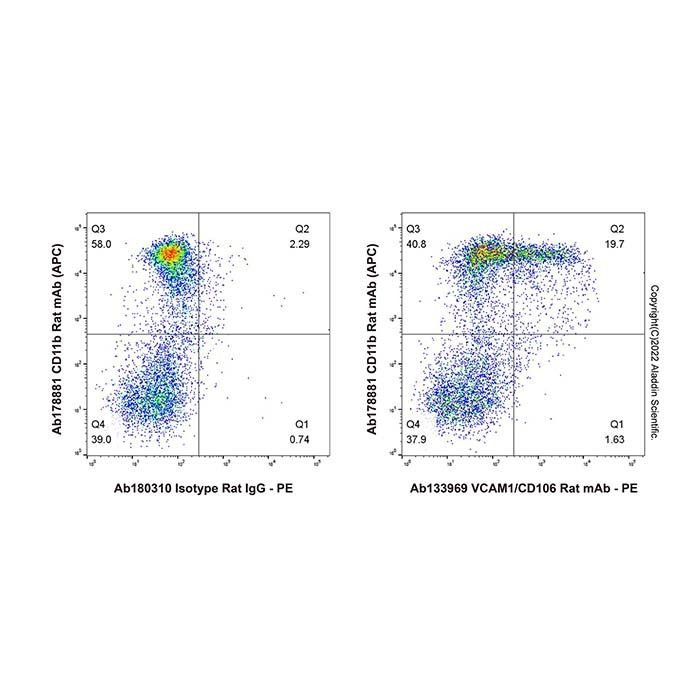
VCAM1/CD106 Rat mAb (Ab133969) - Flow Cytometry Two-color flow cytometric analysis of VCAM1/CD106 expression on mouse bone marrow. mouse bone marrow cells were stained with CD11b Rat mAb (APC) (Ab178881) and either Rat IgG Isotype Control Antibody (Biotin) (Ab180310; Left panel) or VCAM1/CD106 Rat mAb (Ab133969; Right panel) at 0.5 μg/mL. Two-color flow cytometric dot plots showing the correlated expression of CD11b versus VCAM1/CD106 (or Isotype control staining) were derived from gated events with the forward and side light-scatter characteristics of viable mononuclear cells.
VCAM1/CD106 Rat mAb (Ab133969) - Flow Cytometry Two-color flow cytometric analysis of VCAM1/CD106 expression on mouse splenocytes. C57BL/6 mouse spleen cells were stained with CD11c Armenian Hamster mAb (APC) (Ab178872) and either Rat IgG Isotype Control Antibody (Biotin) (Ab180310; Left panel) or VCAM1/CD106 Rat mAb (Ab133969; Right panel) at 0.5 μg/mL. Two-color flow cytometric dot plots showing the correlated expression of CD11c versus VCAM1/CD106 (or Isotype control staining) were derived from gated events with the forward and side light-scatter characteristics of viable mononuclear cells.

 ZJ24F0809801


 危险品化学品经营许可证(带存储)