产品介绍
L-乳酸脱氢酶检测试剂盒(WST-8法)是一种基于WST-8的显色反应,通过比色法快速、高灵敏地对血清、血浆、组织、细胞以及组织或细胞培养上清样品中L-乳酸脱氢酶活性进行检测的试剂盒。
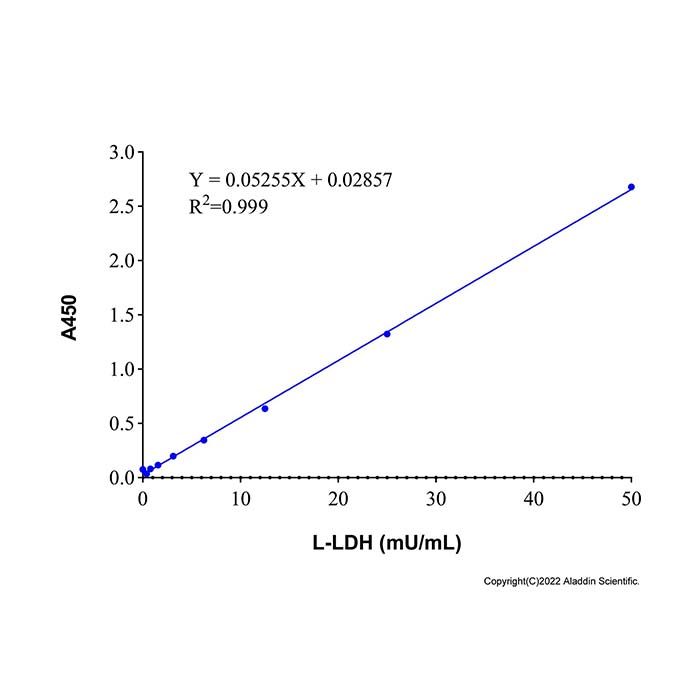
本试剂盒的检测原理为:L-乳酸脱氢酶催化L-乳酸(L-Lactate)氧化生成丙酮酸(Pyruvate),在这一过程中NAD+还原为NADH;生成的NADH在电子耦合试剂1-mPMS (1-Methoxy-5-methylphenazinium methyl sulfate)的作用下将WST-8还原成橙黄色的甲瓒(Formazan),在450 nm左右有最大吸收峰。催化生成的甲瓒的量与L-乳酸脱氢酶的活性呈正比,通过测定450 nm处的吸光值可以非常灵敏地检测样品中L-乳酸脱氢酶的活性。本试剂盒在样品体积为50 μL时,可检测活力低至0.39 mU/mL的L-乳酸脱氢酶,在0.39-50 mU/mL活力范围内有良好的线性关系。
D1373349 | Component | 50 T | 100 T | 500T | Storage conditions | D1373349A | L-LDH Lysis Buffer | 10 mL | 20 mL | 100 mL | -20℃. | D1373349B | L-LDH Assay Buffer | 10 mL | 20 mL | 100 mL | -20℃. | D1373349C | Coenzyme | 200 μL | 400 μL | 2000 μL | -20℃.Store in the dark. | D1373349D | L-Lactate Solution | 100 μL | 200 μL | 1000 μL | -20℃.Store in the dark. | D1373349E | WST-8 | 100 μL | 200 μL | 1000 μL | -20℃.Store in the dark. | D1373349F | 1-mPMS | 100 μL | 200 μL | 1000 μL | -20℃.Store in the dark. | D1373349G | L-Lactate Dehydrogenase (5 U/mL) | 100 μL | 200 μL | 1000 μL | -20℃.Store in the dark. |
|
3. WST-8 Working Solution的配制
按照下表配置WST-8工作液,注意冰上操作。
Samples | 1 | 10 | 20 | 50 | L-LDH Assay Buffer | 40 μL | 400 μL | 800 μL | 2000 μL | Coenzyme | 4 μL | 40 μL | 80 μL | 200 μL | L-Lactate Solution | 2 μL | 20 μL | 40 μL | 100 μL | WST-8 | 2 μL | 20 μL | 40 μL | 100 μL | PMS | 2 μL | 20 μL | 40 μL | 100 μL | Total volume | 50 μL | 500 μL | 1000 μL | 2500 μL |
|
4、样本测定
(1)取1-50 μL样品或稀释后的样品至96孔板样品孔中,并加入Assay Buffer补足50 µL。同时设置仅含L-LDH Assay Buffer的孔为空白对照。
(2)各孔加入WST-8显色工作液50 µL,混匀。
(3)立即使用酶标仪在450 nm测定吸光度。此时记录0分钟读值为A1。
(4)37ºC反应20-30分钟,测定A450,记为A2。吸光值的升高取决于L-乳酸脱氢酶的活性,ΔA = A2-A1。
5、结果计算
建立L-乳酸脱氢酶标准曲线,将ΔA代入标准曲线,即可计算出反应时间内样品中L-乳酸脱氢酶的活性。
L-LDH活性计算公式如下:L-LDH Activity (mU/mL) = B × n
注:B为根据标准曲线确定的L-LDH活性(mU/mL);n为样品总稀释倍数。
L-乳酸脱氢酶酶活力单位的定义:1个酶活力单位(unit, U)在25或37ºC,pH7.5的条件下,在1分钟内可以催化生成1 µmol丙酮酸。
注意事项
1. Lysis Buffer和L-LDH Assay Buffer需要完全解冻并平衡至室温后再使用,否则会影响检测结果。
2. NADH和NADPH以及会影响NADH和NADPH水平的物质等的存在会对检测产生干扰。如果样品含有干扰物质,须同时设置样品的背景对照孔,即配制WST-8显色工作液时L-Lactate Solution用L-LDH Assay Buffer替代。计算时样品孔的读数值需要减去背景对照孔的读数。
3. 为确保样品数值在标准曲线范围内,建议进行预实验将样品设置多个稀释倍数,以确定样品中L-乳酸脱氢酶的大致活性,如果数值不在标准曲线范围内,请调整样品的稀释倍数。
4. 为取得最佳的检测结果,反应时间可以根据待测样品中的L-乳酸脱氢酶活性进行调整,但必须确保读数在标准曲线的范围内。
5. 请按照实验需求将组分进行分装,避免反复冻融。
L-Lactate Dehydrogenase Assay Kit (WST-8) is a kit designed for the rapid and highly sensitive colorimetric detection of L-lactate dehydrogenase activity in samples such as serum, plasma, tissues, cells, and tissue or cell culture supernatants, based on the chromogenic reaction of WST-8.
The assay principle is as follows: L-lactate dehydrogenase catalyzes the oxidation of L-lactate to pyruvate, during which NAD⁺ is reduced to NADH. The generated NADH then reduces WST-8 to an orange-yellow formazan in the presence of the electron coupling reagent 1-mPMS (1-Methoxy-5-methylphenazinium methyl sulfate). The formazan product exhibits a maximum absorption peak at approximately 450 nm. The amount of formazan generated is proportional to the activity of L-lactate dehydrogenase, allowing for highly sensitive detection of LDH activity by measuring the absorbance at 450 nm. With a sample volume of 50 μL, this kit can detect L-lactate dehydrogenase activity as low as 0.39 mU/mL and demonstrates a strong linear relationship within the activity range of 0.39–50 mU/mL.
D1373349 | Component | 50 T | 100 T | 500T | Storage conditions |
D1373349A | L-LDH Lysis Buffer | 10 mL | 20 mL | 100 mL | -20℃. |
D1373349B | L-LDH Assay Buffer | 10 mL | 20 mL | 100 mL | -20℃. |
D1373349C | Coenzyme | 200 μL | 400 μL | 2000 μL | -20℃.Store in the dark. |
D1373349D | L-Lactate Solution | 25 μL | 50 μL | 250 μL | -20℃.Store in the dark. |
D1373349E | WST-8 | 100 μL | 200 μL | 1000 μL | -20℃.Store in the dark. |
D1373349F | PMS | 100 μL | 200 μL | 1000 μL | -20℃.Store in the dark. |
D1373349G | L-Lactate Dehydrogenase (5 U/mL) | 100 μL | 200 μL | 1000 μL | -20℃.Store in the dark. |
Usage Protocol
1. Sample Preparation
1) Preparation of Blood Samples:
For serum samples: Allow whole blood to clot at room temperature for 30 minutes to 2 hours. Centrifuge at approximately 1000-2000 × g for 10 minutes at 4°C and collect the supernatant.
For plasma samples: Collect whole blood using heparin or EDTA as an anticoagulant. Centrifuge at approximately 1000-2000 × g for 10 minutes at 4°C and collect the supernatant.
2) Preparation of Cell Samples:
For cultured adherent cells: Wash the cells once with PBS; For cultured suspension cells: Centrifuge to collect the cells and wash them once with PBS. Add Lysis Buffer at a ratio of 100-200 µL per 1 million cells. Pipette appropriately to mix and incubate on ice for 5-10 minutes for complete lysis. Centrifuge at 12,000 × g for 5 minutes at 4°C. Collect the supernatant for subsequent assays.
3) Preparation of Tissue Samples:
Add Lysis Buffer at a ratio of 100 µL per 10 mg of tissue. Homogenize the tissue using a homogenizer on ice. Centrifuge at approximately 12,000 × g for 5 minutes at 4°C. Collect the supernatant for subsequent assays.
4) Preparation of Cell Culture Supernatant Samples:
For adherent cells: Directly collect the culture medium; For suspension cells: Centrifuge the culture and collect the supernatant.
All the above procedures must be performed at 4°C or on ice. Prepared cell or tissue samples can be stored at -20°C or -80°C if not assayed immediately.
2. Establishment of L-Lactate Dehydrogenase Standard Curve
Take 9 microcentrifuge tubes. Add 297 μL of Assay Buffer to the first tube and 150 μL of Assay Buffer to each of the remaining tubes. Pipette 3 μL from the L-Lactate Dehydrogenase (5 U/mL) standard into the first tube and mix thoroughly to prepare a 50 mU/mL standard solution. Transfer 150 μL from the first tube to the second tube. After mixing, transfer 150 μL from the second tube to the third tube. Continue this serial dilution stepwise. The last tube contains 150 μL of Assay Buffer. The resulting standard concentrations are 50, 25, 12.5, 6.25, 3.13, 1.56, 0.78, 0.39, and 0 mU/mL, respectively.
3. Preparation of WST-8 Working Solution
Prepare the WST-8 Working Solution according to the table below. Note: This procedure must be performed on ice.
Samples | 1 | 10 | 20 | 50 |
L-LDH Assay Buffer | 41.5 μL | 415 μL | 830 μL | 2075 μL |
Coenzyme | 4 μL | 40 μL | 80 μL | 200 μL |
L-Lactate Solution | 0.5 μL | 5 μL | 10 μL | 25 μL |
WST-8 | 2 μL | 20 μL | 40 μL | 100 μL |
PMS | 2 μL | 20 μL | 40 μL | 100 μL |
Total volume | 50 μL | 500 μL | 1000 μL | 2500 μL |
4. Sample Assay
1) Add 1-50 µL of the sample or diluted sample to the sample wells of a 96-well plate. Bring the volume in each well to 50 µL with Assay Buffer. Simultaneously, set up wells containing only L-LDH Assay Buffer as the blank control.
2) Add 50 µL of the WST-8 Chromogenic Working Solution to each well and mix thoroughly.
3) Immediately measure the absorbance at 450 nm using a microplate reader. Record this initial reading (0-minute time point) as A1.
4) Incubate the reaction at 37°C for 20-30 minutes, then measure the absorbance at 450 nm again, recorded as A2. The increase in absorbance (ΔA = A2 - A1) is proportional to the L-Lactate Dehydrogenase activity.
5. Calculation of Results
Generate a standard curve for L-Lactate Dehydrogenase. Substitute the ΔA value obtained for the sample into the standard curve to calculate the L-Lactate Dehydrogenase activity in the sample during the reaction time.
The L-LDH activity is calculated as follows: L-LDH Activity (mU/mL) = B × n
Note: B is the L-LDH activity (mU/mL) determined from the standard curve; n is the total dilution factor of the sample.
Definition of L-Lactate Dehydrogenase Activity Unit: One unit (U) of enzyme activity is defined as the amount of enzyme that catalyzes the generation of 1 µmol of pyruvate per minute at 25°C or 37°C and pH 7.5.
Precautions
1. Both the Lysis Buffer and L-LDH Assay Buffer must be completely thawed and equilibrated to room temperature prior to use, as failure to do so may affect the assay results.
2. The presence of NADH, NADPH, or other substances that can influence NADH/NADPH levels may interfere with the detection. If the sample contains such interfering substances, a background control well for the sample must be set up concurrently. This is prepared by replacing the L-Lactate Solution in the WST-8 Chromogenic Working Solution with L-LDH Assay Buffer. During calculation, the absorbance reading from the sample well must be subtracted by the reading from its background control well.
3. To ensure that sample values fall within the range of the standard curve, it is recommended to perform a preliminary experiment testing multiple dilution factors for the sample to estimate the approximate L-LDH activity. Adjust the sample dilution factor accordingly if the values lie outside the standard curve range.
4. For optimal results, the reaction time can be adjusted based on the estimated L-LDH activity in the sample, provided that the measured absorbance remains within the linear range of the standard curve.
5. Aliquot the components according to experimental needs to avoid repeated freeze-thaw cycles.

 ZJ26F0332686


 危险品化学品经营许可证(带存储)