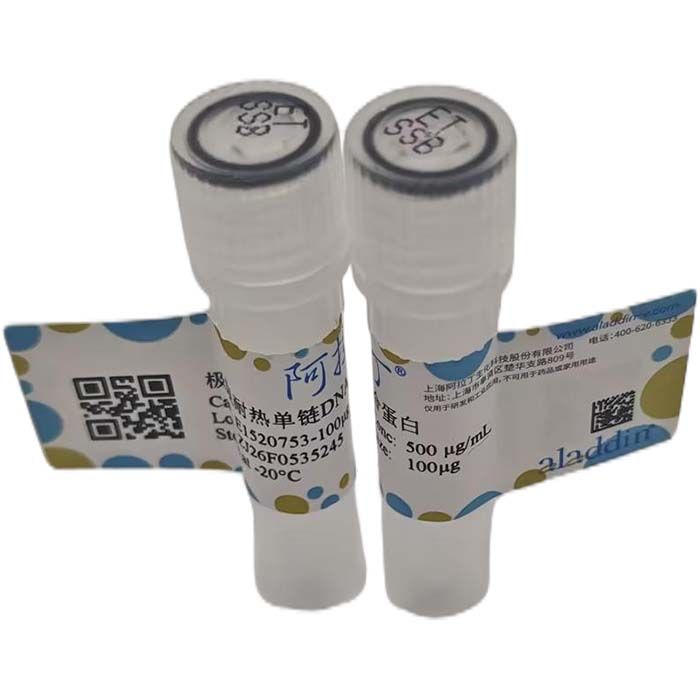
极限耐热单链DNA结合蛋白(Extreme Thermostable single-strand DNA Binding Protein, ET SSB)是一种从耐热微生物中分离出来的单链 DNA 结合蛋白,分子量为 16 kDa。在 95℃温育 60 min 后仍保持充分的活性。由于 ET SSB 具有极高的热稳定性 , 因此可以用于要求极高温度条件的应用,如核酸扩增和测序。
ET SSB蛋白是一种不依赖于特异性序列的单链DNA结合蛋白,它不能结合RNA或双链DNA。ssDNA存在易被DNase降解、易形成二级结构等特点,其不稳定性极大限制了酶促反应的正常进行;ET SSB蛋白与ssDNA的结合可稳定并保护单链DNA免被DNase降解或形成二级结构,促使DNA聚合酶与底物结合,进而提高DNA聚合酶的催化活性,改善PCR等的扩增效率。
SSB蛋白存在于几乎所有种类的生物中,虽然所有的SSB蛋白都具有相似的功能,但它们的序列相似性很小、与ssDNA结合特性差异较大,根据其聚集状态,SSB蛋白可分为单体、同源二聚体、异源三聚体和同源四聚体四类。ET SSB蛋白源自极度嗜热微生物,在溶液中主要以单体形式存在,每个单体编码一个OB-fold结构域,只有在结合单链DNA底物时,才会形成二聚体或多聚体。
应用范围
1. 提高DNA聚合酶的持续合成能力;
2. 稳定和标记ssDNA结构;
3. 提高PCR和等温扩增反应的产量和特异性;
4. 在 RT-PCR过程中提高RT的产量和转化率;
5. 在具有强二级结构的区域改进DNA测序;
6. 增强 RecA对ssDNA结合和链转移的活性。
使用方法
1. ET SSB 在任何聚合酶缓冲液中均有活性;
2. 每 50 μL 反应体系加入50~200 ng的ET SSB。
质量控制
1. 蛋白纯度检测
经SDS-PAGE 电泳检测,蛋白纯度大于等于95%。
2. 核酸内切酶活性检测
将0.5 μg ET SSB与 200 ng超螺旋质粒DNA在37℃下,共同温育4 h后,使用琼脂糖凝胶电泳检测,少于10%的质粒DNA转变成缺刻或线性状态。
3. 非特异性核酸酶活性检测
将0.5 μg ET SSB与 15 ng双链DNA片段在37℃温育16 h,使用琼脂糖凝胶电泳检测双链DNA底物无变化。
4. 宿主DNA残留检测
使用大肠杆菌16S rDNA特异性引物探针组,采用荧光定量PCR法检测0.5 μg ET SSB,大肠杆菌宿主基因组DNA残留低于10 copies。
注意事项
1. 本产品仅限于专业人员的科学研究用,不得用于临床诊断或治疗,不得用于食品或药品,不得存放于普通住宅内。
2. 为了您的安全和健康,请穿实验服并戴一次性手套操作。
Extreme Thermostable Single-Strand DNA Binding Protein (ET SSB) is a single-strand DNA binding protein isolated from thermophilic microorganisms, with a molecular weight of 16 kDa. It retains full activity after incubation at 95°C for 60 minutes. Due to its extremely high thermostability, ET SSB can be used in applications requiring very high temperature conditions, such as nucleic acid amplification and sequencing.
ET SSB is a sequence‑independent single‑strand DNA binding protein; it does not bind RNA or double‑stranded DNA. ssDNA is prone to degradation by DNase and the formation of secondary structures, and its instability greatly limits the normal progress of enzymatic reactions. Binding of ET SSB to ssDNA stabilizes and protects single‑stranded DNA from DNase degradation or secondary structure formation, facilitates the binding of DNA polymerase to the substrate, thereby increasing the catalytic activity of DNA polymerase and improving the amplification efficiency of PCR and other reactions.
SSB proteins exist in almost all organisms. Although all SSB proteins have similar functions, they share little sequence similarity and differ significantly in their ssDNA binding properties. Based on their oligomeric state, SSB proteins can be classified into four types: monomers, homodimers, heterotrimers, and homotetramers. ET SSB originates from hyperthermophilic microorganisms and exists mainly as a monomer in solution, with each monomer encoding one OB‑fold domain. It forms dimers or multimers only when binding to single‑stranded DNA substrates.
Applications
Increase the processivity of DNA polymerase;
Stabilize and label ssDNA structures;
Improve the yield and specificity of PCR and isothermal amplification reactions;
Enhance the yield and conversion efficiency of reverse transcriptase (RT) during RT‑PCR;
Improve DNA sequencing in regions with strong secondary structures;
Enhance the activity of RecA in ssDNA binding and strand transfer.
Usage Method
ET SSB is active in any polymerase buffer;
Add 50–200 ng of ET SSB per 50 μL reaction system.
Quality Control
Protein Purity Assay
SDS‑PAGE analysis shows protein purity ≥95%.
Endonuclease Activity Assay
After incubating 0.5 μg ET SSB with 200 ng of supercoiled plasmid DNA at 37°C for 4 hours, agarose gel electrophoresis detects that less than 10% of the plasmid DNA is converted to nicked or linear forms.
Non‑Specific Nuclease Activity Assay
After incubating 0.5 μg ET SSB with 15 ng of double‑stranded DNA fragments at 37°C for 16 hours, agarose gel electrophoresis shows no change in the double‑stranded DNA substrate.
Host DNA Residue Detection
Using E. coli 16S rDNA‑specific primer/probe sets and real‑time PCR, the residual E. coli host genomic DNA in 0.5 μg ET SSB is less than 10 copies.
Precautions
This product is for professional scientific research use only. It must not be used for clinical diagnosis or treatment, nor for food or drug purposes, nor stored in ordinary residential areas.
For your safety and health, wear a lab coat and disposable gloves during handling.

 ZJ26F1039640


 危险品化学品经营许可证(带存储)