阿拉丁生产的 E. coli DNA Ligase 即大肠杆菌 DNA 连接酶,由自主研发的技术平台表达、纯化获得的重组酶。E. coli DNA Ligase 是一种以 NAD⁺(烟酰胺腺嘌呤二核苷酸)为辅酶,Mg²⁺依赖的,催化双链 DNA 中 5' 磷酸和 3' 羟基之间形成磷酸二酯键,即催化双链 DNA 粘性末端连接或双链 DNA 中的缺刻修复的 DNA 连接酶。E. coli DNA Ligase 可催化双链 DNA 相邻粘性末端 5' 磷酸和 3' 羟基磷酸二酯键的形成,但常规条件下不能进行平末端双链 DNA 的连接。在添加 10–15% PEG 和适当高浓度的单价阳离子时,也可以催化平末端双链 DNA 的连接反应。E. coli DNA Ligase 在一定温度范围内(4–37℃)均具有活性,同时可以被热失活(65℃孵育 20 分钟)。
| 来源(Source) | 大肠杆菌重组表达 | | 外观(Appearance) | 无菌液体 | | 保存液(Storage Buffer) | 10mM Tris-HCl, 50mM KCl, 1mM DTT, 0.1mM EDTA, 200µg/ml BSA, 50% Glycerol, pH7.4 @25℃.
| | 酶浓度(Enzyme Concentration) | 10 U/μl | | 纯度(Purity) | 不含除 E. coli DNA Ligase 之外的其它种类的 DNA 连接酶,不含内切酶和外切酶, 不含 RNA 酶,不含磷酸酯酶。
| | 活性定义(Activity Definition) | One unit is defined as the amount of enzyme required to give 50% ligation of HindIII fragments of λ DNA (5' DNA termini concentration of 0.12μM, 300μg/ml) in a total reaction volume of 20μl in 30 minutes at 16℃ in 1× E. coli DNA Ligase Reaction Buffer. |
|
组分表
E745500
| Component | 200U
| 1KU | 5×1KU | Storage | | E745500A | E. coli DNA Ligase (10U/μl) | 20µl | 100µl | 5×100µl | -20℃. Avoid freeze/ Thaw cycle. | | E745500B | 10× Reaction Buffer | 100µl
| 500µl
| 5×500µl | -20℃. Avoid freeze/ Thaw cycle. |
|
产品应用
E.coli DNA Ligase 可催化双链 DNA 相邻粘性末端 5'磷酸和 3'羟基磷酸二酯键的形成,催化双链 DNA 粘性末端连接或双链 DNA 中的缺刻修复的 DNA 连接酶.
产品优势
E. coli DNA Ligase 在一定温度范围内(4-37℃)均具有活性,同时可以被热失活(65℃孵育 20 分钟)。具有相当的连接粘性末端双链线性 DNA 的效果。
使用说明
1.参考下表在冰浴中配制反应体系(以 20μl 体系为例):
| Reagent | Volume | Final Concentration |
|---|
| dsDNA | x μl | up to 0.25 μg/μl | | 10× Reaction Buffer | 2 μl | 1× | | E. coli DNA Ligase (10U/μl) | 1 μl | 0.5U/μl | | Nuclease-free Water | (17−x) μl | — | | Total Volume | 20 μl | — |
|
注 1:如果同时进行多个反应,可把上表中除底物 DNA 之外的所有组分预先混合,然后再分装到各反应管。
注 2:E. coli DNA Ligase 使用时宜存放在冰盒内或冰浴上。
2. 轻轻震荡混匀或移液器反复吹打混匀,随后低速离心以使粘附在管壁上的液体沉淀至管底。
3. 反应条件:16℃ 孵育 30–60 分钟。
4. 终止反应:反应结束后立即将反应产物在 65℃ 条件下孵育 20 分钟,以终止反应。
5. 将反应后的产物进行琼脂糖凝胶或聚丙烯酰胺电泳,拍照观察并分析连接效果。如果需要从琼脂糖凝胶中回收 DNA 样品,推荐使用 DNA 凝胶回收试剂盒;如果需要从酶切消化反应体系中纯化 DNA 样品,推荐使用 PCR 纯化试剂盒 / DNA 纯化试剂盒。
常见问题
1. E. coli DNA Ligase 和 T4 DNA Ligase 有什么区别?
在推荐的使用条件下,E. coli DNA Ligase 不能连接平末端 DNA 或 RNA 分子。
2. E. coli DNA Ligase 能否被热失活?
可以。将 E. coli DNA Ligase 在 65℃ 条件下孵育 20 分钟,即可使其完全失活。
3. 应该选用哪种连接酶或连接试剂盒?
如果需要平末端或粘性末端的快速连接,建议使用快速 DNA 连接试剂盒。T4 DNA Ligase 是大多数 DNA 重组反应所选用的酶,可用于粘性末端(室温 10 分钟连接)或平末端(室温 2 小时或过夜)的连接。E. coli DNA Ligase 对底物的选择比 T4 DNA Ligase 更具有特异性,如果只需要粘性末端的连接,抑制平末端或 RNA 分子的连接,建议使用 E. coli DNA Ligase。如果实验目的是单链 DNA 或 RNA 分子的连接,建议使用 T4 RNA Ligase。
保存条件
-20°C保存,两年有效。 10× Reaction Buffer 建议长期保存于-80°C,以延长NAD半衰期。
注意事项
(1) E. coli DNA Ligase 需要以 NAD⁺(烟酰胺腺嘌呤二核苷酸)作为辅酶,而不是像 T4 DNA 连接酶等以 ATP 为辅酶。
(2) E. coli DNA Ligase 对于平末端片段的连接效率是极低的,对于平末端的连接建议使用 T4 DNA Ligase。
(3) E. coli DNA Ligase 的催化底物是双链 DNA 分子,不能用于单链 DNA 或 RNA 的连接反应。
(4) E. coli DNA Ligase 连接反应需要以 NAD 作为辅助因子,10× Reaction Buffer 中含有辅助因子 NAD,因此 10× Reaction Buffer 建议长期保存于 -80℃,以延长 NAD 半衰期。
(5) 本产品仅限于专业人员的科学研究用,不得用于临床诊断或治疗,不得用于食品或药品,不得存放于普通住宅内。
(6) 为了您的安全和健康,请穿实验服并戴一次性手套操作。
E. coli DNA Ligase produced by Aladdin is a recombinant enzyme expressed and purified using our independently developed technical platform.E. coli DNA Ligase is an NAD⁺ (nicotinamide adenine dinucleotide)-dependent and Mg²⁺-dependent DNA ligase that catalyzes the formation of a phosphodiester bond between the 5'-phosphate and 3'-hydroxyl groups in double-stranded DNA, thereby ligating cohesive ends of double-stranded DNA or repairing nicks in double-stranded DNA. E. coli DNA Ligase can catalyze phosphodiester bond formation between adjacent 5'-phosphate and 3'-hydroxyl groups at cohesive ends of double-stranded DNA, but cannot ligate blunt-ended double-stranded DNA under standard conditions.It can catalyze the ligation of blunt-ended double-stranded DNA in the presence of 10–15% PEG and appropriately high concentrations of monovalent cations. E. coli DNA Ligase is active over a temperature range of 4–37°C and can be heat-inactivated by incubation at 65°C for 20 minutes.
| Source | Recombinant expressed in Escherichia coli
| | Appearance | Sterile liquid
| | Storage Buffer | 10mM Tris-HCl, 50mM KCl, 1mM DTT, 0.1mM EDTA, 200µg/ml BSA, 50% Glycerol, pH7.4 @25℃.
| | Enzyme Concentration | 10 U/μl | | Purity | Free of other DNA ligases except E. coli DNA Ligase. Free of endonucleases, exonucleases, RNases and phosphatases.
| | Activity Definition | One unit is defined as the amount of enzyme required to give 50% ligation of HindIII fragments of λ DNA (5' DNA termini concentration of 0.12μM, 300μg/ml) in a total reaction volume of 20μl in 30 minutes at 16℃ in 1× E. coli DNA Ligase Reaction Buffer. |
|
Component List
E745500
| Component | 200U
| 1KU | 5×1KU | Storage | | E745500A | E. coli DNA Ligase (10U/μl) | 20µl | 100µl | 5×100µl | -20℃. Avoid freeze/ Thaw cycle. | | E745500B | 10× Reaction Buffer | 100µl
| 500µl
| 5×500µl | -20℃. Avoid freeze/ Thaw cycle. |
|
Product Applications
E. coli DNA Ligase catalyzes the formation of a phosphodiester bond between adjacent 5'-phosphate and 3'-hydroxyl groups at the cohesive ends of double-stranded DNA. It is a DNA ligase that performs ligation of cohesive-ended double-stranded DNA or nick repair of double-stranded DNA.
Product Advantages
E. coli DNA Ligase is active over a wide temperature range (4–37 °C) and can be heat-inactivated at 65 °C for 20 minutes. It shows high ligation efficiency for cohesive-ended linear double-stranded DNA.
Instructions for Use
1.Prepare the reaction mixture on ice according to the table below (using a 20 μl system as an example):
| Reagent | Volume | Final Concentration |
|---|
| dsDNA | x μl | up to 0.25 μg/μl | | 10× Reaction Buffer | 2 μl | 1× | | E. coli DNA Ligase (10U/μl) | 1 μl | 0.5U/μl | | Nuclease-free Water | (17−x) μl | — | | Total Volume | 20 μl | — |
|
Note 1. If multiple reactions are performed simultaneously, all components except the substrate DNA in the table above can be pre-mixed and then aliquoted into each reaction tube.
Note 2. E. coli DNA Ligase should be kept in an ice box or on ice during use.
2. Mix gently by vortexing or pipetting up and down, then centrifuge at low speed to bring any liquid adhering to the tube walls down to the bottom.
3. Reaction conditions: Incubate at 16°C for 30–60 minutes.
4. Termination of reaction: Immediately after the reaction, incubate the product at 65°C for 20 minutes to terminate the reaction.
5. Analyze the ligation product by agarose or polyacrylamide gel electrophoresis and photograph to observe and assess ligation efficiency. If DNA samples need to be recovered from agarose gels, a DNA gel recovery kit is recommended; if DNA samples need to be purified from restriction digestion reaction systems, a PCR purification kit / DNA purification kit is recommended.
Frequently Asked Questions
1. What is the difference between E. coli DNA Ligase and T4 DNA Ligase?
Under recommended conditions, E. coli DNA Ligase cannot ligate blunt-ended DNA or RNA molecules.
2. Can E. coli DNA Ligase be heat-inactivated?
Yes. Incubating E. coli DNA Ligase at 65°C for 20 minutes will completely inactivate the enzyme.
3. Which ligase or ligation kit should be chosen?
For rapid ligation of blunt or cohesive ends, a rapid DNA ligation kit is recommended. T4 DNA Ligase is the enzyme of choice for most DNA recombination reactions, suitable for ligation of cohesive ends (10 minutes at room temperature) or blunt ends (2 hours at room temperature or overnight). E. coli DNA Ligase is more substrate-specific than T4 DNA Ligase. If only cohesive end ligation is required and blunt end or RNA ligation needs to be inhibited, E. coli DNA Ligase is recommended. For ligation of single-stranded DNA or RNA molecules, T4 RNA Ligase is recommended.
Storage Conditions
Store at -20°C with a two-year validity period. For the 10× Reaction Buffer, long-term storage at -80°C is recommended to extend the half-life of NAD.
Precautions
(1) E. coli DNA Ligase requires NAD⁺ (nicotinamide adenine dinucleotide) as a cofactor, unlike T4 DNA Ligase and others which use ATP.
(2) E. coli DNA Ligase has extremely low ligation efficiency for blunt-ended fragments; T4 DNA Ligase is recommended for blunt end ligation.
(3) E. coli DNA Ligase catalyzes reactions on double-stranded DNA molecules and cannot be used for ligation of single-stranded DNA or RNA.
(4) E. coli DNA Ligase ligation reactions require NAD as a cofactor. The 10× Reaction Buffer contains NAD, so it is recommended to store the 10× Reaction Buffer long-term at -80°C to extend the half-life of NAD.
(5) This product is for scientific research use only by qualified personnel. It is not for clinical diagnosis or treatment, not for use in food or pharmaceuticals, and must not be stored in ordinary residential premises.
(6) For your safety and health, please wear a lab coat and disposable gloves when handling.


 ZJ26F0535150

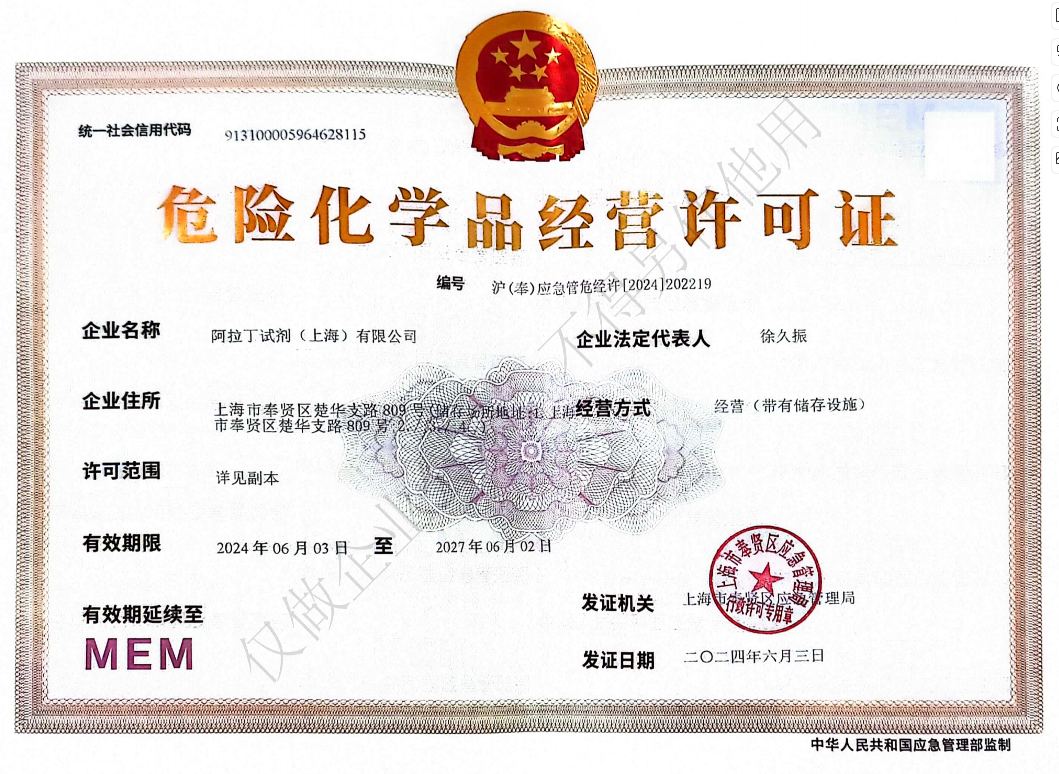 危险品化学品经营许可证(带存储)