Iron is the most abundant transition metal element in organisms and participates in a wide range of physiological processes. In recent years, labile intracellular iron has attracted extensive research attention. Labile iron primarily exists in two stable redox states: ferrous ion (Fe²⁺) and ferric ion (Fe³⁺). For researchers investigating the intracellular reductive environment, metal transporters and the aqueous solubility of Fe²⁺, characterizing the behavior of Fe²⁺ is more critical than studying Fe³⁺. As a novel fluorescent probe, RhoNox-4 enables fluorescence imaging of intracellular Fe²⁺ in live cells. The fluorescence intensity enhancement induced by the reaction between RhoNox-4 and Fe²⁺ is irreversible, which distinguishes it from calcium-sensing fluorescent probes such as Fluo-3 (Cat.No.: F131394) that support real-time monitoring of calcium ions.
规格
别名
细胞亚铁离子检测荧光探针
英文别名
Fluorescent Probe for Intracellular L Fe²⁺ Fluorescent Probe bile Fe²⁺ | Intracellular Labile Fe²⁺ Fluorescent Probe | Fe2+ indicator
规格或纯度
BioReagent, 生物染色剂, 适用于荧光分析, 用于显微镜, ≥95%(HPLC)
稳定性与储存
Store at -20℃ long term (12 months). Store in the dark.
Flow cytometric histograms of Jurkat cells stained with FerroOrange.
Black: untreated cells without probe (negative control);
Blue: untreated cells with probe (basal Fe²⁺ level);
Red: cells pretreated with 100 μM ferrous ammonium sulfate (FAS) (A112646) for 30 min before probe incubation (elevated Fe²⁺);
Green: cells pretreated with 100 μM 2,2'-bipyridyl (BPY) (D108977) for 30 min before probe incubation (Fe²⁺ chelation).
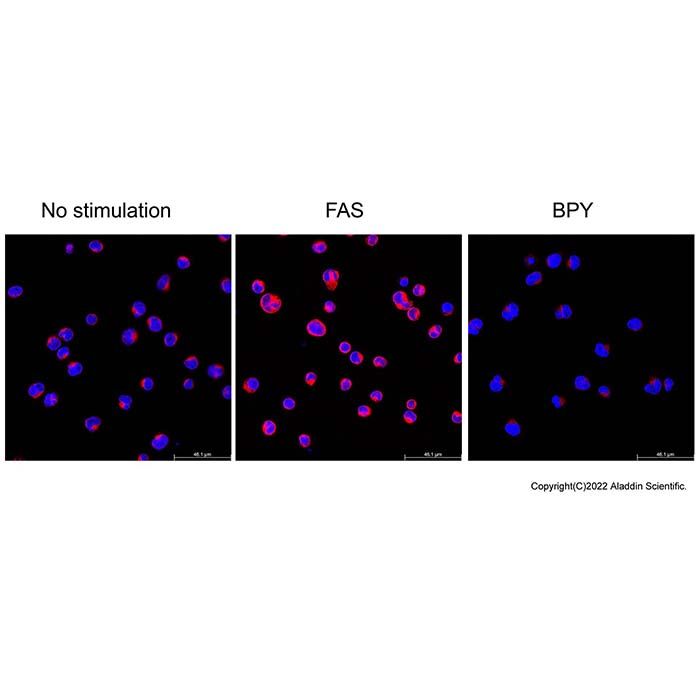
RhoNox-4/FerroOrange (Fe²⁺ Fluorescent Probe) (F1455371) - IF
Confocal fluorescence images of Jurkat cells stained with the Fe²⁺ probe FerroOrange (RhoNox-4).
Left: untreated cells show weak red fluorescence, indicating endogenous Fe²⁺.
Middle: after treatment with 100 μM ferrous ammonium sulfate (FAS) (A112646) for 30 min, the red fluorescence intensity increases significantly, reflecting elevated intracellular Fe²⁺.
Right: addition of 100 μM 2,2'-bipyridyl (BPY) (D108977), a Fe²⁺ chelator, binds Fe²⁺ and prevents its reaction with FerroOrange, resulting in a marked decrease in red signal.

 ZJ26F0939463


 危险品化学品经营许可证(带存储)