Effect of Glycosylation on the Hydrophilic–Lipophilic Partitioning and Solubility Behavior of Natural Products—Quercetin, Isoquercitrin, and Rutin as Examples
Effect of Glycosylation on the Hydrophilic–Lipophilic Partitioning and Solubility Behavior of Natural Products—Quercetin, Isoquercitrin, and Rutin as Examples
Introduction
When natural products form glycosides with sugars, the properties of the resulting molecules often change accordingly. The introduction of glycosyl groups not only increases molecular weight but also alters the number and distribution of oxygen-containing functional groups, hydrogen-bonding interactions, and the hydrophilic–lipophilic balance of the molecule. These structural changes further affect the partitioning of compounds between aqueous and organic phases, the solubility behavior of solids in water, and their retention characteristics in reversed-phase chromatography.
Quercetin, isoquercitrin, and rutin constitute a suitable structural series for comparison. All three share the same quercetin aglycone but differ in their sugar moieties. Studies of plant glycosyltransferases have shown that 3-O-glucosylation of quercetin can generate isoquercitrin, while further 6″-O-rhamnosylation of the glucose moiety of isoquercitrin can produce rutin [1].
This structural series illustrates a central question in glycosylation research: what molecular properties are actually altered when glycosyl groups are introduced into natural-product molecules? Why can an increase in hydrophilicity not simply be equated with the assumption that “more sugar means higher water solubility”?
Understanding this question requires distinguishing among molecular affinity for the aqueous phase, liquid–liquid partitioning, and the water solubility of solids, while also considering the effects of glycosylation on liquid-phase solvation and intermolecular interactions in the solid state.
1 Molecular Structural Changes Induced by Glycosylation
1.1 Structural Relationships among Quercetin, Isoquercitrin, and Rutin
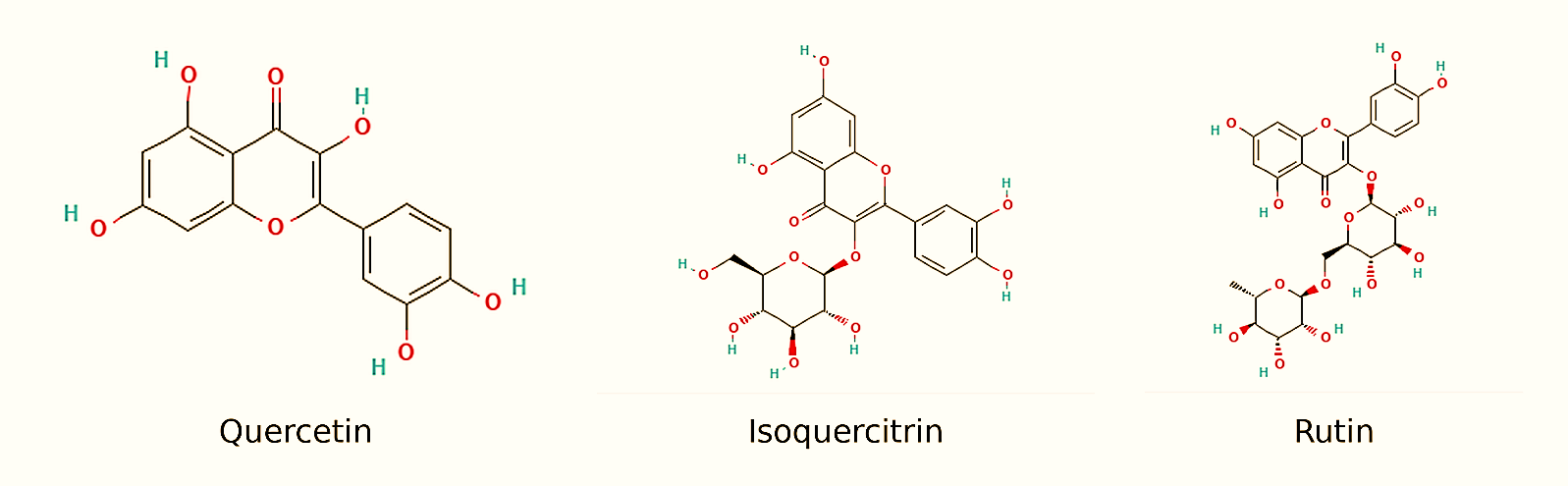
Quercetin belongs to the flavonol class of compounds. Isoquercitrin is an O-glycoside formed by attachment of glucose through the oxygen atom at the 3-position of quercetin; further attachment of rhamnose to the 6″-position of the glucose moiety in isoquercitrin yields rutin [1].
The structural relationship among the three compounds can be represented as follows:
Quercetin
↓ 3-O-glucosylation
Isoquercitrin
↓ Glucose 6″-O-rhamnosylation
Rutin
1.2 Molecular Characteristics Altered by the Introduction of Glycosyl Groups
After glucose is attached at the 3-position of quercetin, the original 3-hydroxyl group forms an O-glycosidic bond, while a sugar moiety containing multiple hydroxyl groups and a ring oxygen atom is introduced into the molecule.
These structural changes directly affect the noncovalent interaction characteristics of the molecule:
① Hydroxyl groups on the sugar ring increase the number of hydrogen-bond donor and acceptor sites;
② The ring oxygen and oxygen atoms in the glycosidic linkage increase the number of hydrogen-bond acceptor sites;
③ The distribution of molecular polarity changes;
④ The proportion of hydrophilic structural features within the overall molecule increases;
⑤ Molecular conformation and intermolecular interactions may also change with the sugar moiety.
These relationships can be represented as follows:
Introduction of glycosyl groups
→ Changes in oxygen-containing functional groups and hydrogen-bonding sites
→ Changes in polarity and hydrophilic–lipophilic balance
→ Changes in interactions with the aqueous phase, nonpolar environments, and other molecules
→ Corresponding changes in partitioning, solubility, and chromatographic behavior
2 Effects of Glycosylation on Hydrophilic–Lipophilic Partitioning
2.1 What Does Octanol/Water Partitioning Reflect?
The octanol/water system is commonly used to investigate the tendency of organic compounds to partition between a relatively lipophilic environment and an aqueous phase.
Once partition equilibrium is reached, a higher proportion of a compound in the octanol phase generally reflects greater lipophilic character, whereas an increased proportion in the aqueous phase reflects greater affinity for the aqueous environment.
Rothwell et al. performed octanol/water partitioning experiments on various flavones, flavonols, flavanones, isoflavones, and related compounds, and used high-performance liquid chromatography (HPLC) to analyze compound concentrations in the two phases. The aqueous phase in this study was maintained at pH 7.4. Among the compounds tested, aglycones were generally more lipophilic than their corresponding conjugated derivatives, and the nature of the conjugating group had a pronounced effect on partitioning behavior [2].
2.2 Differences among Polarity, Liquid–Liquid Partitioning, and Water Solubility
In glycosylation studies, polarity, hydrophilic–lipophilic partitioning, and water solubility are easily confused, although they describe properties at different levels.
Concept | What It Mainly Describes | Major Influencing Factors |
Polarity | Intramolecular charge distribution and the characteristics of interactions with polar environments | Functional groups, electronic structure, molecular conformation |
Hydrophilic–lipophilic partitioning | Equilibrium distribution of a compound between two immiscible liquid phases | Molecular structure, pH, ionization state, composition of the two phases |
Water solubility | The extent to which a substance can dissolve in water under specified conditions | Solvation, solid-state structure, temperature, pH, crystal form, or solvation state |
Rothwell et al. reported the octanol/water concentration ratios measured at pH 7.4 in the form of log P values [2]. For polyphenolic compounds that may undergo ionization, interpretation of such data also requires consideration of the aqueous-phase pH and the specific measurement conditions; data obtained from different sources should not be compared independently of their experimental conditions.
The increased affinity of glycosylated flavonoids for the aqueous phase does not mean that their actual water solubility can be calculated directly from the number of glycosyl groups.
3 Glycosylation and Actual Water Solubility
3.1 Behavior of Quercetin, Isoquercitrin, and Rutin in Water
In a study of different quercetin glycosides, Makino et al. reported estimated dissolved concentrations in water of approximately 50.0, 206, and 196 nmol/mL for quercetin, isoquercitrin, and rutin, respectively [3].
Estimated Dissolved Concentrations of Quercetin and Its Glycosides in Water [3]
Compound | Sugar Moiety | Estimated Dissolved Concentration in Water |
Quercetin | None | 50.0 nmol/mL |
Isoquercitrin | Glucose | 206 nmol/mL |
Rutin | Sugar moiety composed of glucose + rhamnose | 196 nmol/mL |
The difference between quercetin and isoquercitrin is relatively pronounced. Under the conditions of this study, the estimated molar dissolved concentration of isoquercitrin was approximately four times that of quercetin, indicating that 3-O-glucosylation can markedly alter the behavior of quercetin in water [3].
The comparison between isoquercitrin and rutin provides another layer of information. Rutin has a larger sugar moiety than isoquercitrin, yet their reported estimated molar dissolved concentrations were 206 and 196 nmol/mL, respectively. Thus, the molar solubility did not continue to increase proportionally with an increase in the number of sugar residues [3].
This structural series therefore shows both that 3-O-glucosylation can markedly alter the behavior of quercetin in water and that the further addition of a rhamnose residue does not cause the molar dissolved concentration in water to increase further. This indicates that the effect of glycosylation on water solubility cannot be predicted solely from the number of sugar residues or from changes in hydrophilicity.
3.2 Why the Number of Sugar Residues Cannot Directly Predict Water Solubility
For crystalline organic compounds, dissolution involves two interrelated processes. On the one hand, solute molecules must overcome lattice forces and intermolecular interactions in the solid state in order to leave the solid phase. On the other hand, molecules entering the liquid phase must form favorable solvation interactions with the solvent.
This process can be summarized as follows:
Crystalline solid
↓ Escape from the solid phase by overcoming lattice and intermolecular interactions
Dispersed solute molecules
↓ Solvation by water
Solute in aqueous solution
Glycosyl groups simultaneously affect solvation in the liquid phase and intermolecular interactions and structural stability in the solid state. The ultimate effect of glycosylation on water solubility results from the combined influence of liquid-phase solvation and solid-state stability and cannot be determined solely from hydrophilicity or the number of sugar residues.
3.2.1 Solvation in the Aqueous Phase
Glycosyl groups contain multiple hydroxyl groups and oxygen atoms and can therefore alter the conditions under which molecules form hydrogen bonds and other noncovalent interactions with water.
For quercetin-related compounds, glycosylation increases the proportion of hydrophilic structural features in the overall molecule, consistent with experimentally observed changes in octanol/water partitioning [2].
However, favorable solvation alone cannot determine the equilibrium dissolution state of a solid. The solute must first escape from its original solid-state structure.
3.2.2 Effects of Solid-State Structure on Solubility Behavior
Glycosyl groups can also alter molecular conformation, intermolecular hydrogen bonding, and molecular packing within crystals. Different solid-state forms may exhibit different solubility and dissolution characteristics even when the parent compound is the same.
Liu et al. investigated a rutin ethanolate solvate and compared it with rutin trihydrate. The study showed that the two solid forms of rutin had different solid-state structures and that the metastable rutin ethanolate solvate exhibited higher solubility and a faster dissolution process [4]. This demonstrates that, even when the parent molecule is rutin in both cases, differences in solid-state form can still alter actual solubility and dissolution behavior.
Amorphous systems of quercetin show a similar pattern. Uchiyama et al. used differential scanning calorimetry (DSC) and powder X-ray diffraction (PXRD) to study quercetin composite systems containing α-glucosyl rutin (Rutin-G). Quercetin and isoquercitrin were observed to become amorphous after co-evaporation with Rutin-G; in this system, isoquercitrin also inhibited the recrystallization of amorphous quercetin in the dissolution medium, thereby improving the stability of its supersaturated state [5].
These experimental results demonstrate that:
Actual solubility behavior is jointly influenced by aqueous-phase solvation and solid-state stability.
“Increasing the number of glycosyl groups,” “increasing the number of hydroxyl groups,” or “increasing hydrophilicity” cannot individually substitute for direct measurement of actual solubility.
4 Effects of Glycosylation on Retention in Reversed-Phase Chromatography
4.1 Differences in Retention under the Same Chromatographic Conditions
Changes in hydrophilic–lipophilic partitioning caused by glycosylation can also be reflected in reversed-phase chromatographic retention behavior.
Using an octadecylsilyl-bonded stationary phase under a gradient HPLC analytical method, Makino et al. reported retention times of approximately 9.4, 9.9, and 15.8 min for rutin, isoquercitrin, and quercetin, respectively [3].
In this reversed-phase high-performance liquid chromatography (RP-HPLC) system, the two glycosides had shorter retention times than quercetin, consistent with the increased affinity for the aqueous phase after glycosylation and the corresponding reduction in relative retention on the hydrophobic stationary phase.
4.2 Retention Time Reflects Experimental Behavior under Specific Chromatographic Conditions
Retention time is not an intrinsic physical property that remains unchanged when a compound is removed from its experimental conditions.
Retention in RP-HPLC is affected by factors including stationary-phase type, mobile-phase composition, gradient program, pH, flow rate, and temperature.
This experimental phenomenon links structural changes with analytical practice:
Changes in glycosyl structure
→ Changes in hydrophilic–lipophilic partitioning
→ Changes in interactions with the mobile phase and reversed-phase stationary phase
→ Changes in chromatographic retention
This is also one of the physicochemical foundations underlying the effects of glycosylation on extraction strategies and chromatographic analysis of natural products.
5 Water Solubility and Bioavailability Are Properties at Different Levels
Better dissolution behavior in the aqueous phase does not necessarily correspond to higher oral bioavailability.
In rat experiments, Makino et al. observed substantial differences in the bioavailability of different quercetin glycosides. For example, some glycosides with relatively high water solubility still exhibited low bioavailability, whereas isoquercitrin and certain glycosides that could be efficiently processed by intestinal enzymes showed different behavior. The study also found that different sugar-chain structures had pronounced effects on hydrolysis by enzymes associated with the intestinal epithelium [3].
Human studies likewise indicate that the sugar moiety affects the absorption process of quercetin. Graefe et al. conducted a four-way crossover study in 12 healthy subjects comparing quercetin-4′-O-glucoside, rutin, and plant-derived samples. The time to peak plasma concentration was approximately 0.7 h for treatment with quercetin-4′-O-glucoside and approximately 7.0 h for rutin, with marked differences also observed in peak concentrations [6]. The investigators concluded that the sugar moiety is one of the important factors influencing the disposition of quercetin in vivo.
Several concepts should not be used interchangeably:
Increased hydrophilicity ≠ a fixed proportional increase in water solubility
Increased water solubility ≠ a proportional increase in oral absorption
Changes in absorption ≠ direct inference of pharmacological effects
Water solubility describes the ability of a substance to enter the aqueous phase, whereas oral bioavailability also involves processes such as hydrolysis, absorption, transport, and metabolism in the gastrointestinal tract and therefore requires independent pharmacokinetic evidence.
Taken together, the structures and experimental results of quercetin, isoquercitrin, and rutin show that the effects of glycosylation on the physicochemical properties of natural products cannot be reduced simply to an increase in hydroxyl groups or hydrophilicity. The introduction of glycosyl groups alters both the partitioning tendency of molecules between aqueous and hydrophobic environments and their molecular conformation, intermolecular interactions, and solid-state structure. Hydrophilic–lipophilic partitioning, water solubility, and bioavailability are properties at different levels and need to be evaluated separately using appropriate experiments; one property cannot be directly inferred from the number of sugar residues or from another single property.
6 Representative Chemicals for Studies of the Effects of Glycosylation on Hydrophilic–Lipophilic Partitioning and Solubility Behavior of Quercetin and Related Flavonols
Table 1. Flavonol Aglycones and Hydrates
Classification | CAS No. | Aladdin Catalog No. | Name | Specification or Purity | Product Features and Applications |
Pentahydroxyflavonol | 117-39-5 | Quercetin | Analytical standard, Moligand™, ≥98.5% | Used as an aglycone reference for quercetin glycosides; for comparing water solubility, hydrophilic–lipophilic partitioning, and reversed-phase chromatographic retention before and after glycosylation. | |
Pentahydroxyflavonol dihydrate | 6151-25-3 | Quercetin dihydrate | Analytical standard, ≥98% (HPLC) | For comparing solid-state characterization, solubility, dissolution, and sample-preparation behavior of quercetin in different hydration states. | |
Tetrahydroxyflavonol | 520-18-3 | Kaempferol | Analytical standard, Moligand™, ≥98% | Used as an aglycone reference for kaempferol glycosides; for comparing the effects of hydroxyl substitution on the flavonol skeleton and glycosylation on polarity, solubility, and chromatographic behavior. | |
Hexahydroxyflavonol | 529-44-2 | Myricetin | Analytical standard, ≥98% | Used as an aglycone reference for myricetin glycosides; for comparing hydration, solubility, and hydrophilic–lipophilic partitioning of highly hydroxylated flavonols before and after glycosylation. |
Table 2. Quercetin Monoglycosides and Glucuronide
Classification | CAS No. | Aladdin Catalog No. | Name | Specification or Purity | Product Features and Applications |
Quercetin 3-O-glucoside | 482-35-9 | Q1525095 | Quercetin 3-β-D-glucoside | ≥98% | Quercetin 3-O-glucoside; for comparing the effects of the number of sugar residues and sugar-chain length among quercetin, isoquercitrin, and rutin on water solubility, partitioning, and chromatographic retention. |
Quercetin 7-O-glucoside | 491-50-9 | Quercetin 7-O-glucoside | ≥98% | Serves as a positional-linkage reference to quercetin 3-O-glucoside; for studying the effects of glycosylation position on hydration, solubility, partitioning, and reversed-phase chromatographic retention. | |
Quercetin 3-O-galactoside | 482-36-0 | Hyperoside | Analytical standard, Moligand™, ≥98% | Has the same aglycone and 3-position glycosylation site as isoquercitrin; for comparing the effects of galactosyl and glucosyl groups on solubility, partitioning, and chromatographic behavior. | |
Quercetin 3-O-rhamnoside | 522-12-3 | Quercitrin | ≥98% | For comparing the effects of introducing rhamnosyl, glucosyl, and galactosyl groups on quercetin polarity, hydration, solubility, and chromatographic behavior. | |
Quercetin 3-O-arabinopyranoside | 22255-13-6 | Quercetin 3-O-α-L-arabinopyranoside | ≥95% (HPLC) | Serves as an arabinose ring-form reference to avicularin; for comparing the effects of arabinopyranosyl and arabinofuranosyl groups on quercetin solubility and chromatographic behavior. | |
Quercetin 3-O-arabinofuranoside | 572-30-5 | Avicularin | Moligand™, ≥98% | Used together with the arabinopyranosyl-type quercetin glycoside to investigate how differences in sugar-ring form affect physicochemical behavior when sugar composition and linkage position are otherwise the same. | |
Quercetin 3-O-xyloside | 549-32-6 | Quercetin 3-D-xyloside | ≥97% (HPLC) | For comparing molecular polarity, hydration, solubility, and chromatographic retention of quercetin after introduction of the pentose xylose versus the hexose glucose. | |
Quercetin 3-O-glucuronide | 22688-79-5 | Quercetin 3-glucuronide | ≥98% | For studying the effects of the glucuronic acid group and the ionization state of its carboxyl group on the aqueous-phase behavior, hydrophilic–lipophilic partitioning, and chromatographic properties of quercetin. |
Table 3. Quercetin Polyglycosides and Kaempferol and Myricetin Glycosides
Classification | CAS No. | Aladdin Catalog No. | Name | Specification or Purity | Product Features and Applications |
Quercetin 3-O-rutinoside | 153-18-4 | Rutin | ≥95% | Quercetin 3-O-rutinoside; used in the quercetin–isoquercitrin–rutin system to compare the effects of monosaccharide- and disaccharide-containing glycosides on water solubility, partitioning, and chromatographic retention. | |
Quercetin 3-O-rutinoside trihydrate | 250249-75-3 | (+)-Rutin trihydrate | ≥97% | For studying solid-state characteristics, solubility, dissolution, and sample-preparation behavior of rutin in different hydration states. | |
Quercetin 3-O-gentiobioside | 7431-83-6 | Quercetin 3-gentiobioside | ≥99% | The sugar chain consists of two glucose residues linked through a 1→6 bond; for comparing the effects of sugar-chain linkage patterns on quercetin hydration, solubility, partitioning, and chromatographic retention. | |
Quercetin 3-O-sophoroside | 18609-17-1 | Quercetin 3-O-sophoroside | ≥98% | The sugar chain consists of two glucose residues linked through a 1→2 bond; provides a structural comparison with the gentiobioside in which the sugar composition is the same but the linkage position differs. | |
Quercetin 3,7-diglucoside | 6892-74-6 | Quercetin 3,7-diglucoside | ≥99% | Two glucose residues are attached separately at the 3- and 7-positions of quercetin; for comparison with 3-position disaccharide-chain glycosides to examine solubility and chromatographic behavior when the number of sugar residues is the same but their spatial distribution differs. | |
Glucosylated rutin | 130603-71-3 | α-Glucosylrutin | Moligand™, ≥70% | A sugar-chain extension system produced by further glucosylation of rutin; for comparing the effects of sugar-chain extension on aqueous solubility, partitioning, and chromatographic retention. | |
Kaempferol 3-O-glucoside | 480-10-4 | Kaempferol 3-glucoside | ≥97% (HPLC) | Forms an aglycone–monoglycoside structural comparison with kaempferol; for studying the effects of glucosylation on kaempferol polarity, solubility, and reversed-phase chromatographic retention. | |
Kaempferol 3-O-rutinoside | 17650-84-9 | Kaempferol 3-O-rutinoside | ≥98% (HPLC) | Together with kaempferol and kaempferol 3-O-glucoside, forms an aglycone–monoglycoside–diglycoside structural series for comparing the effects of sugar-chain length on physicochemical behavior. | |
Myricetin 3-O-rhamnoside | 17912-87-7 | Myricitrin | ≥98% | Forms a structural comparison with myricetin before and after glycosylation; for studying the effects of rhamnosyl-group introduction on hydration, solubility, and partitioning behavior of polyhydroxylated flavonols. |
Table 4. Monosaccharide, Uronic Acid, and Disaccharide Structural Units
Classification | CAS No. | Aladdin Catalog No. | Name | Specification or Purity | Product Features and Applications |
D-Glucose-type aldohexose | 50-99-7 | D-(+)-Glucose | Anhydrous grade, UltraBio™, ≥99.5% (HPLC), sum of enantiomers | Used as a reference for the sugar composition and hydrolysis products of isoquercitrin and various quercetin glucosides; for sugar-composition analysis and glycosylated-structure studies. | |
D-Galactose-type aldohexose | 59-23-4 | D-(+)-Galactose | For cell culture, suitable for insect cell culture, ≥99% | Used as a constituent-sugar reference for hyperoside; for confirming galactose after hydrolysis and for comparative studies of glucose- and galactose-type quercetin glycosides. | |
L-Rhamnose-type 6-deoxyhexose | 3615-41-6 | Rhamnose | Moligand™, 10 mM in DMSO | Used as a sugar-composition reference for quercitrin, rutin, kaempferol 3-O-rutinoside, and myricitrin; for confirming rhamnose composition and analyzing sugar chains. | |
D-Glucuronic acid-type hexuronic acid | 6556-12-3 | D-Glucuronic acid | Moligand™, ≥98% | Used as a sugar-acid composition reference for quercetin glucuronide; for confirming hydrolysis products and studying glucuronic acid-containing structures. | |
L-Arabinose-type aldopentose | 5328-37-0 | L-(+)-Arabinose | Natural | Used as a constituent-sugar reference for arabinopyranosyl- and arabinofuranosyl-type quercetin glycosides; for confirming arabinose composition after hydrolysis. | |
D-Xylose-type aldopentose | 58-86-6 | D-Xylose | Analytical standard, Moligand™, ≥99% | Used as a constituent-sugar reference for quercetin xyloside; for confirming xylose after hydrolysis and analyzing pentose-type glycosides. | |
α-(1→4)-linked glucose disaccharide | 69-79-4 | Maltose solution | BioReagent, molecular biology grade, ~20% in H₂O | A disaccharide system in which two glucose residues are linked through a 1→4 bond; used for comparison with gentiobiose to examine the effects of sugar–sugar linkage position on the aqueous behavior of disaccharides and as a sugar-chain structural reference. | |
β-(1→6)-linked glucose disaccharide | 554-91-6 | β-Gentiobiose | ≥85% | The sugar-chain structural unit of quercetin 3-gentiobioside; for confirming sugar-chain composition and studying the structure of 1→6-linked glucose disaccharides. | |
α-(1→6)-linked rhamnose–glucose disaccharide | 90-74-4 | Rutinose | ≥90% | The disaccharide structural unit of rutin and kaempferol rutinosides; for confirming rutinosyl composition, analyzing sugar-chain hydrolysis products, and studying 1→6 sugar–sugar linkages. |
Note: The products listed above are representative Aladdin research-related products. Specific applications should be determined according to the product specifications, batch Certificate of Analysis (COA), and the intended reaction or evaluation system. Additional information on product specifications, grades, and COAs can be retrieved from the Aladdin website using the “product name/CAS/catalog number.”
References
[1] Zou J, Li H, Wang Z, Ye M. Functional characterization of two efficient glycosyltransferases catalysing the formation of rutin from Sophora japonica L. Organic & Biomolecular Chemistry, 2023, 21(39): 7913-7916. DOI: 10.1039/D3OB01281F.
[2] Rothwell J A, Day A J, Morgan M R A. Experimental determination of octanol-water partition coefficients of quercetin and related flavonoids. Journal of Agricultural and Food Chemistry, 2005, 53(11): 4355-4360. DOI: 10.1021/jf0483669.
[3] Makino T, Shimizu R, Kanemaru M, Suzuki Y, Moriwaki M, Mizukami H. Enzymatically modified isoquercitrin, α-oligoglucosyl quercetin 3-O-glucoside, is absorbed more easily than other quercetin glycosides or aglycone after oral administration in rats. Biological and Pharmaceutical Bulletin, 2009, 32(12): 2034-2040. DOI: 10.1248/bpb.32.2034.
[4] Liu Y, Zhao X, Zhang Q, et al. Characterization and evaluation of the solubility and oral bioavailability of rutin-ethanolate solvate. AAPS PharmSciTech, 2020, 21: 241. DOI: 10.1208/s12249-020-01779-w.
[5] Uchiyama H, Wada Y, Takamatsu M, Kadota K, Tozuka Y. Improved solubility of quercetin by preparing amorphous solid with transglycosylated rutin and isoquercitrin. Environmental Control in Biology, 2018, 56(4): 161-165. DOI: 10.2525/ecb.56.161.
[6] Graefe E U, Wittig J, Mueller S, et al. Pharmacokinetics and bioavailability of quercetin glycosides in humans. Journal of Clinical Pharmacology, 2001, 41(5): 492-499. DOI: 10.1177/00912700122010366.
For more related articles, see below:
Will glycosylation affect the biological activity of recombinant protein?
Plant proteomics and glycosylation experiments
β-1,4-Galactosyltransferase 1: A Precise Glycosyltransferase in Glycan Biosynthesis


 危险品化学品经营许可证(带存储)