
Are Lipids Fats? Understanding the Multiple Functions of Lipids from Cellular Metabolism to mRNA Delivery
Are Lipids Fats? Understanding the Multiple Functions of Lipids from Cellular Metabolism to mRNA Delivery
Lipids are not synonymous with fats. Fats mainly refer to energy-storage lipids such as triacylglycerols, whereas lipids comprise a much broader range of structural classes, including fatty acids, glycerophospholipids, sphingolipids, and sterol lipids. Different lipids participate not only in energy storage and biological-membrane construction but also in the regulation of cellular signaling, inflammation, oxidative stress, and cellular senescence. Lipids are also core materials of lipid nanoparticles (LNPs) used for the delivery of nucleic acids such as mRNA and siRNA.
Keywords: lipids; lipid metabolism; fatty acids; sphingolipids; cellular senescence; lipid peroxidation; lipid nanoparticles; mRNA delivery
1 Lipids Are More Than Fats
1.1 Conceptual Boundaries Between Lipids and Fats
Fats represent only one subset of lipids. What is commonly referred to as fat mainly consists of triacylglycerols (TAGs), which are formed from glycerol and fatty acids and serve as an important long-term energy-storage form in the body. Lipids constitute a much broader chemical and biological category that also includes phospholipids, sphingolipids, Cholesterol, and numerous bioactive lipids. Different lipids can function in energy storage, membrane structure, signal transduction, protein modification, and as precursors of biologically active molecules.
1.2 Not All Lipids Share the Same Structure
(1) Amphiphilic Lipids
Glycerophospholipids and certain sphingolipids contain hydrophilic head groups and hydrophobic fatty-acyl chains. In aqueous environments, they can form lipid bilayers, vesicles, and other ordered structures and therefore constitute an important material basis for cellular membranes and lipid-based delivery systems.
(2) Hydrophobic Lipids
Neutral lipids such as triacylglycerols and Cholesteryl Esters are predominantly hydrophobic and are generally stored within lipid droplets. Therefore, the structural model of a “polar head group + hydrophobic tails” applies to many membrane lipids but cannot be used as a universal structural definition for all lipids.
1.3 Major Lipid Classes
According to structural backbone and biosynthetic origin, lipids can be classified into major categories including Fatty Acyls, Glycerolipids, Glycerophospholipids, Sphingolipids, Sterol Lipids, Prenol Lipids, Saccharolipids, and Polyketides.
Table 1 Major Lipid Classes and Functional Positioning
Lipid Class | Representative Molecules | Major Functions |
Fatty Acyls | Palmitic Acid, Oleic Acid, and Arachidonic Acid | Energy metabolism, membrane-lipid synthesis, and precursors of lipid mediators |
Glycerolipids | Triacylglycerols and Diacylglycerols | Energy storage, lipid-droplet formation, and signal regulation |
Glycerophospholipids | Phosphatidylcholine and Phosphatidylethanolamine | Biological-membrane construction, membrane curvature, and membrane fusion |
Sphingolipids | Ceramide, Sphingomyelin, and Sphingosine | Membrane structure and regulation of apoptosis, proliferation, and inflammatory signaling |
Sterol Lipids | Cholesterol and Steroid Hormones | Membrane fluidity and synthesis of hormones and bile acids |
Prenol Lipids | Ubiquinone and isoprenoid derivatives | Electron transfer, protein modification, and metabolic regulation |
Saccharolipids | Lipid A and related molecules | Membrane structure, host recognition, and immune responses |
Polyketides | Various natural products | Bioactive molecules and natural-product biosynthesis |
2 How Lipids Participate in Cellular Metabolism and Signaling
2.1 Energy Storage and Fatty Acid Oxidation
Triacylglycerols are an important form of energy storage. When cellular energy demand increases, lipolysis releases fatty acids. Long-chain fatty acids are activated and transported into mitochondria through the carnitine shuttle, where β-oxidation progressively generates Acetyl-CoA, NADH, and FADH₂, which subsequently enter the tricarboxylic acid cycle and respiratory chain. Lipid metabolism therefore connects lipid-droplet storage, mitochondrial energy production, and overall cellular-energy status.
2.2 Biological Membranes and Organelle Function
Phospholipids, sphingolipids, and Cholesterol collectively determine the physical properties of plasma membranes and organelle membranes. Fatty-acyl chain length, degree of unsaturation, proportions of different head groups, and Cholesterol content can alter membrane fluidity, membrane thickness, membrane curvature, and lipid-raft formation and can further influence receptor clustering, membrane-protein localization, vesicular trafficking, and interorganelle contacts.
2.3 Bioactive Lipid Signaling
(1) Diacylglycerol
Diacylglycerol (DAG) is both an intermediate in glycerolipid metabolism and an important regulator of signaling proteins such as Protein Kinase C. It links membrane-lipid metabolism with cellular proliferation, differentiation, and immune signaling.
(2) Sphingolipids
Ceramide, Sphingosine, and Sphingosine-1-Phosphate (S1P) form an important sphingolipid signaling network involved in apoptosis, cell survival, migration, and immune regulation. Ceramides with different fatty-acyl chain lengths may have distinct tissue distributions and biological functions, so sphingolipid research generally needs to resolve individual molecular species.
(3) Polyunsaturated Fatty Acid Derivatives
Polyunsaturated fatty acids such as Arachidonic Acid, EPA, and DHA can be further converted into lipid mediators including Prostaglandins, Leukotrienes, Lipoxins, and Resolvins, linking fatty acid metabolism with inflammation initiation, immune-cell recruitment, and inflammation resolution.
3 Lipid Metabolism and Cellular Senescence
3.1 Remodeling of Lipid Uptake and Synthesis
Senescent cells may exhibit altered uptake, de novo synthesis, and intracellular trafficking of fatty acids and Cholesterol. CD36 and LDLR regulate lipid uptake, the SREBP-ACC-FASN axis regulates fatty acid synthesis, HMGCR participates in Cholesterol synthesis, and ABCA1 is associated with Cholesterol efflux. Remodeling of these pathways can alter membrane composition, the supply of lipid-signaling substrates, and intracellular lipid burden.
3.2 Lipid Droplets and Lipid Storage
Excess fatty acids can be re-esterified into triacylglycerols and stored in lipid droplets, reducing lipotoxicity and membrane damage caused by free fatty acids. Increased lipid-droplet accumulation in senescent cells does not necessarily indicate isolated enhancement of lipid synthesis. It may also result from increased lipid uptake, reduced fatty acid oxidation, or impaired lipid-droplet degradation and should therefore be interpreted together with lipid metabolic flux.
3.3 Fatty Acid Oxidation and Lipid Peroxidation
(1) Fatty Acid β-Oxidation
Fatty acid β-oxidation can contribute to the energetic adaptation of senescent cells, whereas mitochondrial dysfunction may cause incomplete fatty acid oxidation, Acylcarnitine accumulation, and increased ROS. Oxygen-consumption rate, Acylcarnitine profiles, ATP levels, and mitochondrial membrane potential can be combined to evaluate metabolic changes.
(2) Lipid Peroxidation
PUFAs contain readily oxidizable double bonds and can undergo lipid peroxidation to generate Lipid Hydroperoxides, 4-HNE, MDA, and other products. Persistent lipid peroxidation can damage membrane structures and protein function and intersects with oxidative stress, cellular senescence, and Ferroptosis.
(3) SASP and Inflammatory Lipids
The senescence-associated secretory phenotype (SASP) is regulated not only by cytokines but also closely associated with lipid metabolism. Arachidonic Acid metabolites and other oxidized lipids can alter inflammatory-mediator release, making lipid metabolism an important link between senescent cells and the surrounding immune microenvironment.
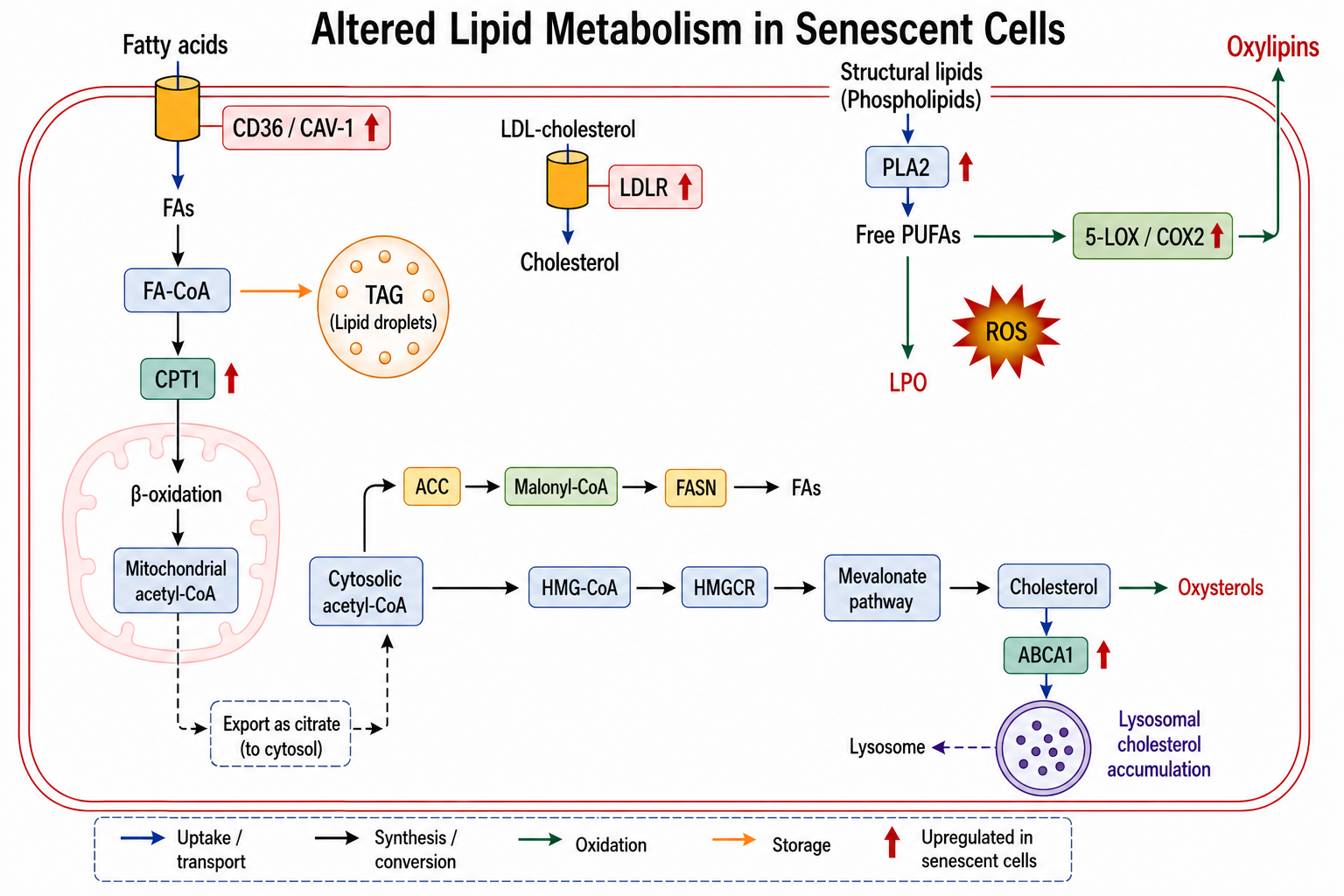
Figure 1. Remodeling of lipid uptake, synthesis, oxidation, and inflammatory lipid metabolism in senescent cells
Table 2 Senescence-Associated Lipid Metabolic Changes and Experimental Indicators
Metabolic Process | Representative Molecules/Pathways | Major Research Indicators |
Lipid uptake | CD36 and LDLR | Fatty acid uptake and Cholesterol content |
Fatty acid synthesis | SREBP, ACC, and FASN | Fatty acid profiles and ACC/FASN activity |
Cholesterol metabolism | HMGCR and ABCA1 | Total Cholesterol, free Cholesterol, and Cholesterol efflux |
Fatty acid oxidation | CPT-associated pathways | OCR, Acylcarnitines, and ATP |
Lipid peroxidation | PUFAs and ALOX | Lipid ROS, 4-HNE, and MDA |
Lipid-droplet storage | TAG and lipid droplets | TAG content and BODIPY/Oil Red O staining |
4 Why mRNA Delivery Requires Lipids
4.1 Major Limitations of Nucleic Acid Delivery
mRNA and siRNA are large molecules with high-density negative charges, are readily degraded by nucleases, and cannot efficiently cross hydrophobic cell membranes on their own. Lipid nanoparticles (LNPs) improve nucleic acid stability, promote cellular uptake, and facilitate release of nucleic acids from endosomes into the cytoplasm, making them an important platform for mRNA and siRNA delivery.
4.2 Core Components of LNPs
(1) Ionizable Lipids
Ionizable lipids are the core components of modern nucleic acid LNPs. Under acidic formulation conditions, protonation facilitates association with negatively charged nucleic acids. After entering endosomes, renewed protonation promotes membrane disruption and endosomal escape, whereas at near-physiological pH the overall charge is relatively low, reducing nonspecific interactions associated with permanently cationic lipids.
(2) Helper Phospholipids and Cholesterol
Phospholipids such as DSPC and DOPE regulate LNP structure and membrane-fusion properties, whereas Cholesterol helps maintain particle stability and regulates lipid packing. Changes in helper-lipid composition can substantially affect particle morphology, membrane fluidity, and nucleic acid release.
(3) PEGylated Lipids
PEGylated lipids help reduce particle aggregation and control LNP size and surface properties. However, an excessively high proportion of PEG lipids may restrict cellular uptake and endosomal escape. Their levels therefore need to be optimized according to nucleic acid type, administration route, and target tissue.
Table 3 Major LNP Components and Their Functions
Component | Major Function | Key Parameters |
Ionizable lipids | Nucleic acid encapsulation and endosomal escape | pKa, biodegradability, and transfection efficiency |
Helper phospholipids | Structural stabilization and regulation of membrane fusion | Fatty-acyl structure and phase-transition characteristics |
Cholesterol | Particle stabilization and regulation of membrane properties | Formulation ratio and structural type |
PEGylated lipids | Particle-size control and aggregation reduction | PEG chain length, lipid anchoring, and shedding rate |
4.3 LNP Performance Evaluation
LNP quality cannot be assessed on the basis of particle size alone. Particle size and PDI reflect particle distribution, encapsulation efficiency and RNA integrity reflect nucleic acid protection, cellular uptake determines whether particles enter target cells, and endosomal escape determines whether the nucleic acid actually reaches the cytoplasm and exerts its function. For mRNA systems, protein-expression levels should ultimately be used to evaluate functional output, whereas siRNA systems should assess target-gene silencing efficiency.
5 Frequently Asked Questions
5.1 Are Lipids and Fats the Same Concept?
No. Fats mainly refer to energy-storage lipids such as triacylglycerols, whereas lipids also include fatty acids, phospholipids, sphingolipids, sterol lipids, and many other classes. Fats are only one subset of lipids.
5.2 Do All Lipids Have a Hydrophilic Head and Hydrophobic Tail?
No. Phospholipids and certain sphingolipids have typical amphiphilic structures, whereas neutral lipids such as triacylglycerols and Cholesteryl Esters are predominantly hydrophobic.
5.3 Is Ceramide Only a Structural Component of Cell Membranes?
No. Ceramide is both an important intermediate in sphingolipid metabolism and a bioactive signaling lipid involved in stress responses, apoptosis, inflammation, and metabolic regulation.
5.4 Does Increased Lipid-Droplet Accumulation Indicate Enhanced Fatty Acid Synthesis?
Not necessarily. Increased lipid droplets may also result from enhanced lipid uptake, reduced fatty acid oxidation, or impaired lipid-droplet degradation. Fatty acid uptake, synthesis, and oxidation indicators should be analyzed together.
5.5 Are Fatty Acid β-Oxidation and Lipid Peroxidation the Same Process?
No. β-Oxidation is an enzyme-catalyzed energy-metabolism process that mainly occurs in mitochondria and peroxisomes. Lipid peroxidation is the oxidative modification of polyunsaturated lipids that generates lipid peroxides. Their mechanisms and biological consequences are different.
5.6 Does mRNA Delivery Use Liposomes or LNPs?
Both systems can be used for nucleic acid delivery, but modern mRNA delivery predominantly uses LNPs. LNPs differ from conventional liposomes in internal particle structure, lipid composition, and the mode of nucleic acid encapsulation.
5.7 Are Cationic Lipids and Ionizable Lipids the Same?
No. Permanently cationic lipids remain positively charged over a relatively broad pH range, whereas the charge state of ionizable lipids changes with pH, which better balances nucleic acid encapsulation, endosomal escape, and biocompatibility.
6 Products for Lipid Metabolism and Nucleic Acid Delivery Research
6.1 Fatty Acid and Sterol Products
Product Name | CAS No. | Category/Characteristics | Application Positioning |
Palmitic Acid | Saturated Fatty Acid | Used for research on lipotoxicity, fatty acid oxidation, and metabolic stress | |
Stearic Acid | Saturated Fatty Acid | Used for research on fatty acid metabolism and membrane-lipid composition | |
Oleic Acid | Monounsaturated Fatty Acid | Used for research on lipid-droplet formation, TAG storage, and lipotoxicity controls | |
Linoleic Acid | ω-6 Polyunsaturated Fatty Acid | Used for PUFA metabolism and lipid-peroxidation research | |
α-Linolenic Acid | ω-3 Polyunsaturated Fatty Acid | Used for fatty acid metabolism and inflammation research | |
Arachidonic Acid | ω-6 Polyunsaturated Fatty Acid | Used for COX/LOX pathways and inflammatory lipid-mediator research | |
Eicosapentaenoic Acid (EPA) | ω-3 Polyunsaturated Fatty Acid | Used for inflammatory lipid-mediator and membrane-lipid research | |
Docosahexaenoic Acid (DHA) | ω-3 Polyunsaturated Fatty Acid | Used for neural-lipid, membrane-structure, and inflammation research | |
Cholesterol | Sterol Lipid | Used for membrane-structure, Cholesterol-metabolism, and LNP-formulation research | |
Squalene | Sterol Biosynthesis Precursor | Used for Cholesterol biosynthesis and lipid-metabolism research |
6.2 Sphingolipid and Signaling-Lipid Products
Product Name | CAS No. | Category/Characteristics | Application Positioning |
Sphingosine | Sphingolipid Metabolic Intermediate | Used for sphingolipid-metabolism and cellular-signaling research | |
Sphingosine-1-Phosphate | Bioactive Sphingoid Base 1-Phosphate | Used for research on cell migration, proliferation, and immune signaling | |
Dihydrosphingosine | Sphingolipid Biosynthesis Intermediate | Used for Ceramide-synthesis and sphingolipid-metabolism research | |
C2 Ceramide | Short-Chain Ceramide | Used for research on apoptosis, stress, and sphingolipid signaling | |
C6 Ceramide | Short-Chain Ceramide | Used for Ceramide-signaling and cell-death research | |
Prostaglandin E2 | Arachidonic Acid Metabolite | Used for research on inflammation, SASP, and lipid mediators | |
Leukotriene B4 | Pro-inflammatory Lipid Mediator | Used for leukocyte chemotaxis and inflammatory-signaling research |
6.3 Phospholipids and LNP Delivery Materials
Product Name | CAS No. | Category/Characteristics | Application Positioning |
Dipalmitoylphosphatidylcholine (DPPC) | Saturated Phosphatidylcholine | Used for liposomes, membrane models, and delivery systems | |
Distearoylphosphatidylcholine (DSPC) | Saturated Phosphatidylcholine | Used as an LNP helper phospholipid and for particle-stability research | |
Dimyristoylphosphatidylcholine (DMPC) | Phosphatidylcholine | Used for membrane-fluidity and liposome research | |
Dioleoylphosphatidylcholine (DOPC) | Unsaturated Phosphatidylcholine | Used for membrane models and liposomal delivery | |
Dioleoylphosphatidylethanolamine (DOPE) | Phosphatidylethanolamine | Used for membrane fusion and endosomal escape | |
Distearoylphosphatidylethanolamine (DSPE) | Phosphatidylethanolamine | Used for liposome and PEG-lipid construction | |
1-Palmitoyl-2-oleoylphosphatidylcholine (POPC) | Mixed-Chain Phosphatidylcholine | Used for biological-membrane and membrane-fluidity research | |
DOTAP Chloride | Cationic Lipid | Used for DNA, RNA, and liposomal delivery | |
DLin-MC3-DMA | Ionizable Lipid | Used for siRNA LNP and endosomal-escape research | |
SM-102 | Ionizable Lipid | Used for mRNA LNP formulation and delivery research | |
ALC-0315 | Ionizable Lipid | Used for mRNA LNP assembly and delivery research | |
ALC-0159 | PEGylated Lipid | Used to regulate LNP particle size and surface stability |
6.4 Products for Lipid Metabolism and Lipid-Peroxidation Research
Product Name | CAS No. | Mechanistic Characteristics | Application Positioning |
Orlistat | Lipase- and FASN-Associated Research Tool | Used for lipid-synthesis and lipase research | |
C75 | FASN-Associated Inhibitor | Used for research on de novo fatty acid synthesis | |
TOFA | ACC-Associated Research Tool | Used for fatty acid-synthesis research | |
Etomoxir | CPT1-Associated Research Tool | Used for fatty acid β-oxidation research | |
Simvastatin | HMG-CoA Reductase Inhibitor | Used for Cholesterol-biosynthesis research | |
4-Hydroxynonenal (4-HNE) | Lipid-Peroxidation Product | Used for research on oxidative stress, senescence, and protein adducts | |
Malondialdehyde (MDA) | Lipid-Peroxidation-Associated Product | Used for lipid-oxidation detection and standard-related research | |
Thiobarbituric Acid | MDA Chromogenic Reagent | Used for TBARS lipid-peroxidation assays | |
N-Acetyl-L-Cysteine | Antioxidant and Thiol-Reducing Agent | Used for ROS and lipid-oxidation research | |
Ferrostatin-1 | Lipid-Peroxidation and Ferroptosis Inhibitor | Used for lipid ROS and Ferroptosis-mechanism research | |
Nile Red | Hydrophobic Fluorescent Dye | Used for lipid-droplet and neutral-lipid staining | |
Oil Red O | Lipophilic Dye | Used for detection of neutral lipids and lipid-droplet accumulation |
Lipids are not simply energy-storage molecules but a diverse group of molecules connecting energy metabolism, membrane structure, cellular signaling, and biomaterial applications. Whether the research focus is cellular senescence, lipid peroxidation, or mRNA delivery, specific lipid species, metabolic directions, and functional outputs need to be distinguished to accurately interpret the biological significance of lipid alterations.
References
[1] Zeng Q, et al. Lipids and lipid metabolism in cellular senescence: Emerging targets for age-related diseases. Ageing Res Rev. 2024;97:102294.
[2] Sahin U, et al. mRNA-based therapeutics--developing a new class of drugs. Nat Rev Drug Discov. 2014;13(10):759-780.
[3] Chaudhary N, et al. mRNA vaccines for infectious diseases: principles, delivery and clinical translation. Nat Rev Drug Discov. 2021;20(11):817-838.
[4] Hou X, et al. Lipid nanoparticles for mRNA delivery. Nat Rev Mater. 2021;6:1078-1094.
For more related articles, please see below:
[3] Principles, Applicable Scenarios, and Result Interpretation of Common Lipid Staining Methods
[4] Lipid Regulatory Mechanisms in Inflammation and Immune Responses


 危险品化学品经营许可证(带存储)