淀粉水解酶,包括α-淀粉酶(α-AL,EC3.2.1.1)和β-淀粉酶(β-AL)。α-淀粉酶随机催化淀粉中α-1,4-糖苷键水解,生成葡萄糖、麦芽糖、麦芽三糖、糊精等还原糖,同时使淀粉的粘度降低,因此又称为液化酶。α-淀粉酶分布十分广泛,遍及微生物乃至高等植物。
检测原理:淀粉水解酶催化淀粉水解生成还原糖,还原糖还原3,5-二硝基水杨酸生成棕红色物质,在540nm有吸收峰;通过测定540nm吸光度增加速率,计算淀粉酶活性。α-淀粉酶耐热,但是β-淀粉酶在70°C下15min可钝化。因此粗酶液经过70°C钝化15min,就只有α-淀粉酶能够催化淀粉水解。
检测范围:0.0156-1 mg/mL
灵敏度:0.0078 mg/mL
适用样本:唾液、动物组织、植物组织(种子或新萌发幼苗)
注意:检测范围和灵敏度均为标准品,需要根据样本情况折算为活性的检测范围和灵敏度。
G1501772
| Component
| 96T | Storage
|
G1501772A
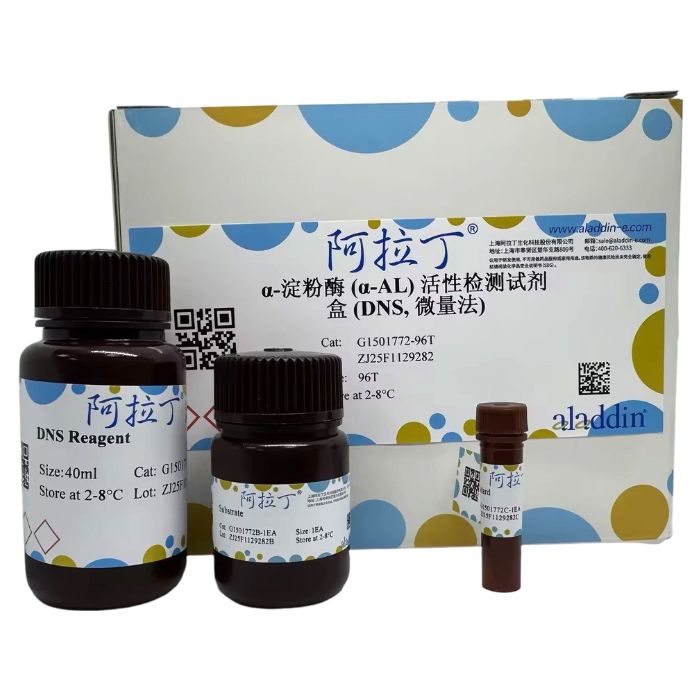
| DNS Reagent
| 40 mL
| 2-8℃. Store in the dark.
|
G1501772B
| Substrate
| 1EA | 2-8℃
|
G1501772C
| Standard
| 1EA
| 2-8℃ |
注意:正式检测前,建议选择2-3个预期差异较大的样本进行预实验。
自备仪器和试剂
酶标仪或可见分光光度计(能测540nm处的吸光度)
96孔板或微量玻璃比色皿,可调节式移液枪及枪头
离心机,水浴锅
去离子水
匀浆器(如果是组织样本)
实验流程
1、试剂准备
试剂名称
| 试剂准备
| 注意事项
|
DNS Reagent
| 即用型;使用前平衡到室温
| 4℃避光保存;有毒,建议在通风橱进行实验。
|
Substrate
| 临用前加入20mL去离子水,上下颠倒摇晃几次,加热至溶解
| 用不完的试剂4℃保存1周;如有沉淀,可加热至70℃溶解
|
Standard
| 临用前加入1mL去离子水溶解,得10mg/mL标准品(葡萄糖)
| 4℃可保存2周 |
2、标准曲线设置
按下表所示,用去离子水将10mg/mL标准品稀释为1、0.5、0.25、0.125、0.0625、0.0313、0.0156 mg/mL的标准溶液。
标准品序号
| 标准品体积 (μL)
| 去离子水体积 (μL)
| 标准品浓度 (mg/mL)
|
Std.1
| 40μL (10 mg/mL) | 360 | 1 |
| Std.2 | 200μL of Std.1 | 200
| 0.5 |
| Std.3 | 200μL of Std.2
| 200
| 0.25 |
| Std.4 | 200μL of Std.3
| 200
| 0.125 |
| Std.5 | 200μL of Std.4
| 200
| 0.0625 |
| Std.6 | 200μL of Std.5
| 200
| 0.0313 |
| Std.7 | 200μL of Std.6
| 200
| 0.0156 |
注意:每次实验都要做一次标准品检测,制作标曲;稀释后的标准品溶液不稳定,必须在4小时内使用。
3、样本制备
注意:推荐使用新鲜样本。
3.1 动物组织
称取约0.1g样本,加入1mL去离子水匀浆,匀浆液倒入离心管中,在室温下放置15min,每隔5min振荡1次,使其充分提取。6,000g,室温离心10min,吸取上清液并且加去离子水定容至10mL,摇匀,即为淀粉酶原液。
3.2 植物组织
称取约0.1g样本,加入1mL去离子水捣碎,超声波破碎5min(功率20%,超声3s,间隔7s,重复30次),在室温下放置15min,每隔5min振荡1次,使其充分提取。6,000g,室温离心10min,吸取上清液并且加去离子水定容至10mL,摇匀,即为淀粉酶原液。
3.3 唾液等液体样本
直接测定。建议预实验确定合适的稀释倍数。
注意:
对于脂肪含量较高的动物组织,离心后移除上层脂肪,再取上清液。
如需测定蛋白浓度,推荐使用阿拉丁B665595 BCA蛋白定量试剂盒或R1491648 即用型BCA蛋白定量试剂盒。
4、实验步骤
4.1 酶标仪或可见分光光度计预热30min以上,调节波长到540nm,可见分光光度计用去离子水调零。
4.2 水浴锅预热到70℃。
4.3 取75μL样本沸水浴5min作为对照管使用。
4.4 样本测定(在EP管中依次加入下列试剂):
| 试剂 | 空白管(μL) | 标准管(μL) | 测定管(μL) | 对照管(μL) |
| 去离子水 | 75 | 0
| 0
| 0 |
| 不同浓度Std. | 0
| 75
| 0
| 0 |
| 样本 | 0
| 0
| 75
| 75(煮沸样本) |
70℃水浴15min,冷却。
40℃恒温水浴中保温5min。
DNS Reagent
| 150 | 150
| 150
| 150
|
Substrate
| 75
| 75
| 0 | 75 |
4.5 混匀,沸水浴5min,冷却,取200μL至96孔板或微量玻璃比色皿中,测定540nm处的吸光值,计算ΔA 测定=A测定-A对照;ΔA标准 =A标准-A空白。
注意:
每个样本需设置一个对照管,空白管只需做1管。
实验之前建议选择2-3个预期差异大的样本做预实验。如果样本A 测定 >2,则说明样本酶活力太高,必须用去离子水稀释成适当浓度(计算公式中乘以相应稀释倍数)。若ΔA 测定 <0.005可以重新提取样本减少去离子水定容的体积。
5、结果计算
5.1 标准曲线的绘制
以标准液浓度为y轴,ΔA 标准 为x轴,绘制标准曲线。将ΔA 测定 带入方程得到y值(mg/mL)。
5.2 α-淀粉酶活性计算
(1) 按样本鲜重计算
单位定义:每g组织每分钟催化产生1mg还原糖定义为1个酶活力单位。
α-淀粉酶活性 (U/g质量)=y×V 样 ÷(W×V 样 ÷V 样总 )÷T×n=2×y÷W×n
(2) 按样本蛋白浓度计算
单位的定义:每mg组织蛋白每分钟产生1mg还原糖定义为1个酶活力单位。
α-淀粉酶活性 (U/mg prot)=y×V 样 ÷(Cpr×V 样 )÷T×n=0.2×y÷Cpr×n
(3) 按液体样本体积计算
单位的定义:每升液体样本每分钟产生1mg还原糖定义为1个酶活力单位。
α-淀粉酶活性 (U/L)=1000×y÷T×n=200×y×n
参数说明
V 样 :加入反应体系中样本体积,0.075mL;
W:样本质量,g;
V 样总 :样本总体积,10mL;
T:反应时间,5min;
n:样本稀释倍数;
Cpr:样本蛋白质浓度,mg/mL;
1000:1L=1000mL
6、结果展示
典型标准曲线:y=0.4948x-0.0179,R²=0.9982

注意事项
1、生化检测试剂普遍具有刺激性、生物毒性等,为了您的安全和健康,请在实验全程做好生物安全防护,穿戴实验服、口罩、手套、头套等安全护具,在通风橱、生物安全柜中进行实验。
2、本产品仅供科学研究使用,不适用于临床诊断。
Starch hydrolases include α-amylase (α-AL, EC 3.2.1.1) and β-amylase (β-AL). α-Amylase randomly catalyzes the hydrolysis of α-1,4-glycosidic bonds in starch, producing reducing sugars such as glucose, maltose, maltotriose, and dextrins, while simultaneously reducing the viscosity of starch, hence it is also known as the liquefying enzyme. α-Amylase is widely distributed, from microorganisms to higher plants.
Detection Principle: Starch hydrolases catalyze the hydrolysis of starch to produce reducing sugars. These reducing sugars reduce 3,5-dinitrosalicylic acid (DNS) to produce a brown-red-colored compound with an absorption peak at 540 nm. The amylase activity is calculated by measuring the rate of increase in absorbance at 540 nm. α-Amylase is heat-stable, but β-amylase can be inactivated by heating at 70°C for 15 minutes. Therefore, after the crude enzyme extract is treated at 70°C for 15 minutes, only α-amylase can catalyze starch hydrolysis.
Detection Range: 0.0156 - 1 mg/mL
Sensitivity: 0.0078 mg/mL
Applicable Samples: Saliva, animal tissues, plant tissues (seeds or newly germinated seedlings)
Note: The detection range and sensitivity are based on the standard. The actual detection range and sensitivity for activity need to be calculated according to the sample conditions.
G1501772
| Component
| 96T | Storage
|
G1501772A
| DNS Reagent
| 40 mL
| 2-8℃. Store in the dark.
|
G1501772B
| Substrate
| 1EA | 2-8℃
|
G1501772C
| Standard
| 1EA
| 2-8℃ |
Note: Before formal testing, it is recommended to perform a preliminary test with 2-3 samples expected to have significant differences.
User-Prepared Instruments and Reagents
1.Microplate reader or visible spectrophotometer (capable of measuring absorbance at 540 nm)
2.96-well plate or micro glass cuvettes, adjustable micropipettes and tips
3.Centrifuge, water bath
4.Deionized water
5.Homogenizer (for tissue samples)
Experimental Procedure
1. Reagent Preparation
Reagent Name
| Reagent Preparation
| Notes
|
DNS Reagent
| Ready-to-use; Equilibrate to room temperature before use.
| Store at 4°C protected from light.
|
Substrate
| Before use, add 20 mL deionized water, invert and shake several times, heat until dissolved.
| Unused reagent can be stored at 4°C for one week. If precipitate forms, heat to 70°C to dissolve.
|
Standard
| Before use, add 1 mL deionized water to dissolve, obtaining a 10 mg/mL standard (Glucose) stock.
| Can be stored at 4°C for 2 weeks. |
2. Standard Curve Setup
Dilute the 10 mg/mL standard stock solution with deionized water to concentrations of 1, 0.5, 0.25, 0.125, 0.0625, 0.0313, and 0.0156 mg/mL as shown in the table below.
Tube
| Standard Volume
| Deionized Water Volume (μL)
| Standard Concentration (mg/mL)
|
Std.1
| 40μL (10 mg/mL) | 360 | 1 |
| Std.2 | 200μL of Std.1 | 200
| 0.5 |
| Std.3 | 200μL of Std.2
| 200
| 0.25 |
| Std.4 | 200μL of Std.3
| 200
| 0.125 |
| Std.5 | 200μL of Std.4
| 200
| 0.0625 |
| Std.6 | 200μL of Std.5
| 200
| 0.0313 |
| Std.7 | 200μL of Std.6
| 200
| 0.0156 |
Note: The standard curve must be generated with each experiment. Diluted standard solutions are unstable and must be used within 4 hours
3. Sample Preparation
Note: Fresh samples are recommended.
3.1 Animal Tissue
Weigh approximately 0.1 g of tissue. Add 1 mL of deionized water and homogenize. Transfer the homogenate to a centrifuge tube. Let it stand at room temperature for 15 minutes, vortexing every 5 minutes for sufficient extraction. Centrifuge at 6,000 g for 10 minutes at room temperature. Aspirate the supernatant and dilute to 10 mL with deionized water. Mix well. This is the amylase stock solution.
3.2 Plant Tissue
Weigh approximately 0.1 g of tissue. Add 1 mL of deionized water and grind. Sonicate for 5 minutes (power 20%, pulse 3s on, 7s off, repeat 30 times). Let it stand at room temperature for 15 minutes, vortexing every 5 minutes for sufficient extraction. Centrifuge at 6,000 g for 10 minutes at room temperature. Aspirate the supernatant and dilute to 10 mL with deionized water. Mix well. This is the amylase stock solution.
3.3 Saliva, and Other Liquid Samples
Assay directly. It is recommended to perform a preliminary test to determine the appropriate dilution factor.
Note:
For animal tissues with high fat content, remove the upper fat layer after centrifugation before collecting the supernatant.
If protein concentration measurement is required, use Aladdin's BCA Protein Quantification Kit (B665595) or Ready-to-Use BCA Protein Quantification Kit (R1491648).
4. Assay Steps
4.1 Preheat the microplate reader or visible spectrophotometer for at least 30 minutes. Set the wavelength to 540 nm. For spectrophotometers, zero the instrument with deionized water.
4.2 Preheat a water bath to 70°C.
4.3 Take 75 μL of sample and incubate in a boiling water bath for 5 minutes. This will be used as the Control tube.
4.4 Sample Measurement (Add reagents sequentially into microcentrifuge tubes as below):
| Reagent | Blank Tube (μL) | Standard Tube (μL) | Test Tube (μL) | Control Tube (μL) |
| Deionized Water | 75 | 0
| 0
| 0 |
| Standard (various conc.) | 0
| 75
| 0
| 0 |
| Sample | 0
| 0
| 75
| 75 (boiled sample) |
Heat at 70°C for 15 min, then cool.
Incubate in a constant temperature water bath at 40°C for 5 min.
DNS Reagent
| 150 | 150
| 150
| 150
|
Substrate
| 75
| 75
| 0 | 75 |
4.5 Mix well. Incubate in a boiling water bath for 5 minutes. Cool. Transfer 200 μL to a 96-well plate or micro glass cuvette. Measure the absorbance at 540 nm. Calculate ΔA test = A test - A control ; ΔA standard = A standard - A blank .
Note:
Each sample requires a control tube. The blank tube only needs to be prepared once.
It is recommended to perform a preliminary test with 2-3 samples expected to have significant differences before the formal experiment. If A test > 2, the enzyme activity is too high, and the sample must be diluted with deionized water to an appropriate concentration (multiply by the dilution factor in the calculation). If ΔA test < 0.005, re-extract the sample reducing the final volume of deionized water used for dilution.
5. Calculation of Results
5.1 Standard Curve Plotting
Plot the standard concentration (y-axis) against ΔA standard (x-axis) to generate the standard curve. Substitute ΔA test into the standard curve equation to calculate y (mg/mL).
5.2 α-Amylase Activity Calculation
(1) Based on Sample Fresh Weight Calculation
(1) Based on Sample Fresh Weight Calculation
Unit Definition: One unit of enzyme activity is defined as the amount of enzyme that catalyzes the production of 1 mg of reducing sugar per minute per gram of tissue.
Calculation Formula:
α-Amylase Activity (U/g weight) = y × V sample ÷ (W × V sample ÷ V total ) ÷ T × n = 2 × y ÷ W × n
(2) Based on Sample Protein Concentration
(2) Based on Sample Protein Concentration Calculation
Unit Definition: One unit of enzyme activity is defined as the amount of enzyme that produces 1 mg of reducing sugar per minute per milligram of tissue protein.
Calculation Formula:
α-Amylase Activity (U/mg prot) = y × V sample ÷ (Cpr × V sample ) ÷ T × n = 0.2 × y ÷ Cpr × n
(3) Based on Liquid Sample Volume
Calculation
Unit Definition: One unit of enzyme activity is defined as the amount of enzyme that produces 1 mg of reducing sugar per minute per liter of liquid sample.
Calculation Formula:
α-Amylase Activity (U/L) = 1000 × y ÷ T × n = 200 × y × n
Parameter Definitions:
y: Concentration of reducing sugar calculated from the standard curve (mg/mL)
V sample : Volume of sample added to the reaction system (0.075 mL)
W: Sample weight (g)
V total : Total volume of the sample extract (10 mL)
T: Enzymatic reaction time (5 minutes)
n: Sample dilution factor
Cpr: Sample protein concentration (mg/mL)
1000: Conversion factor between liters and milliliters (1 L = 1000 mL)
6. Representative Results
Typical Standard Curve: y = 0.4948x - 0.0179, R² = 0.9982
Precautions
1. Biochemical reagents are generally irritating and potentially biologically toxic. For your safety and health, please use appropriate biosafety precautions throughout the experiment, including wearing lab coats, masks, gloves, and head covers. Perform experiments in a fume hood or biosafety cabinet.
2. This product is for research use only. Not for use in clinical diagnosis.

 ZJ26F0838123


 危险品化学品经营许可证(带存储)