
 K2216263
计算溶液所需的质量、体积或浓度。
为什么选择此级别
提供 ≥99% 纯度,适用于对基线干扰要求严格的色谱和分析工作流程。
储存与运输
避光,-20°C储存,充氩。超低温运输 。请查阅批次 COA 获取详细规格。
质量文档
SDS、COA、产品数据表及规格说明书均可下载。可通过批号查询获取批次 COA。
文献证明
在色谱分析、有机合成和交叉偶联反应领域已被 2 篇同行评审文献引用。
概述
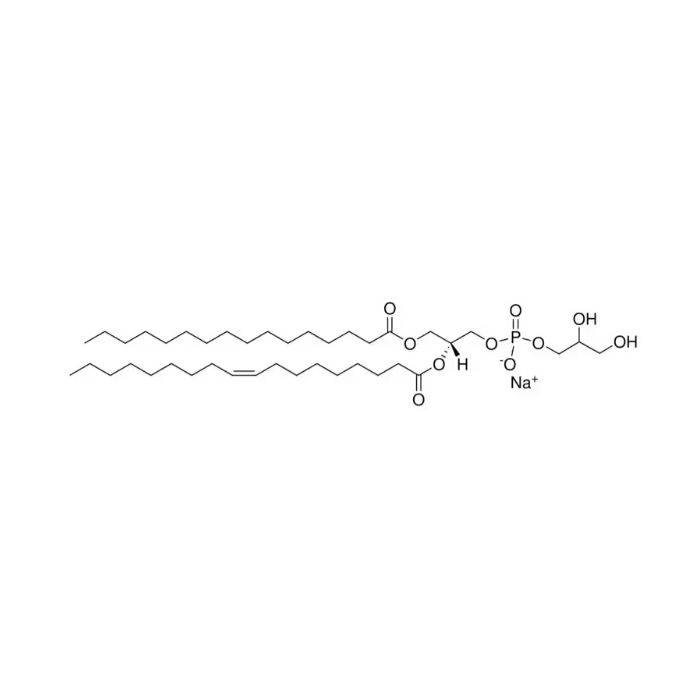
磷脂酰甘油(PG)是食物和生物组织中的主要磷脂之一。PG的结构中有两个酯化后连接甘油的酰基链,而甘油与具有磷酸酯并带有负电荷的头基结构(headgroup structure)键合。PG在细菌膜中含量很高,在哺乳动物膜中含量较低。它在肺表面活性剂中含量丰富。PG由胞苷磷酸-二酰基甘油(CDP-DAG)合成。
蛋PG可用作连续蛋白质错误折叠循环扩增(serial protein misfolding cyclic amplification,sPMCA)反应中的阴离子磷脂底物。它也适用于制备单层大囊泡(large unilamellar vesicle,LUV)并被用作液相色谱-质谱分析(LC-MS)的标准品。
Phosphatidylglycerol (PG) is one of the major phospholipids in food and biological tissues. PG, structurally has two acyl chains esterified to a glycerol, which in turn is bonded to a headgroup structure that has phosphate and carries negative charge. PG is abundant in bacterial membranes and present in lower amounts in mammalian membranes. It is abundant in lung surfactant. PG is synthesized from cytidine phosphate-diacylglycerol (CDP-DAG).
Egg PG has been used as anionic phospholipid substrate in serial protein misfolding cyclic amplification (sPMCA) reaction. It is also suitable for use in the preparation of large unilamellar vesicles (LUVs) and as a standard for liquid chromatography-mass spectrometric analysis (LC-MS).
规格
别名
磷脂酰甘油(鸡蛋)
英文别名
SURFAXIN COMPONENT POPG, NA | J-016573 | 2-Oleoyl-1-palmitoyl-sn-glycero-3-phospho-rac-(1-glycerol) sodium salt, >=98.0% (TLC) | MFCD00674290 | sodium 1-palmitoyl-2-oleoyl-sn-glycero-3-(phospho-rac-(1-glycerol)) | starbld0000181 | 1-palmitoyl-2-oleoyl-sn-
规格或纯度
≥99%
英文名称
L-α-phosphatidylglycerol (Egg, Chicken) (sodium salt)
生化机理
磷脂酰甘油(PG)是胎儿肺成熟度的指标。它是动物心磷脂的前体。在植物中,PG 存在于类囊体膜中,在光合作用中发挥着核心作用。
储存条件
避光,-20°C储存,充氩
运输条件
超低温运输
纯度
≥99%
名称和识别符
PubChem SID
分子类型
小分子
IUPAC Name
sodium;2,3-dihydroxypropyl [(2R)-3-hexadecanoyloxy-2-[(Z)-octadec-9-enoyl]oxypropyl] phosphate
INCHI
1S/C40H77O10P.Na/c1-3-5-7-9-11-13-15-17-18-20-22-24-26-28-30-32-40(44)50-38(36-49-51(45,46)48-34-37(42)33-41)35-47-39(43)31-29-27-25-23-21-19-16-14-12-10-8-6-4-2;/h17-18,37-38,41-42H,3-16,19-36H2,1-2H3,(H,45,46);/q;+1/p-1/b18-17-;/t37?,38-;/m1./s1
InChi Key
FJXDNGDRHUDFST-XQYKCTAGSA-M
Smiles
CCCCCCCCCCCCCCCC(=O)OCC(COP(=O)([O-])OCC(CO)O)OC(=O)CCCCCCCC=CCCCCCCCC.[Na+]
Isomeric SMILES
CCCCCCCCCCCCCCCC(=O)OC[C@H](COP(=O)([O-])OCC(CO)O)OC(=O)CCCCCCC/C=C\CCCCCCCC.[Na+]
Reaxy-Rn
28872211
Reaxys-RN link address
https://www.reaxys.com/reaxys/secured/hopinto.do?context=S&query=IDE.XRN=28872211&ln=
技术文档
高级数据
系统学分类
分类树(Taxonomy Tree)
| 界(kingdom) | 有机化合物 |
|---|---|
| 超类(Superclass) | 脂质和脂质样分子 |
| 类(Class) | 甘油磷脂 |
| 亚类(Subclass) | 甘油磷酸甘油 |
| 中间层级节点(Intermediate Tree Nodes) | 暂无 |
| 直接上位类(Direct Parent) | 磷脂酰甘油 |
| 其他上位类(Alternative Parents) | 脂肪酸酯 磷酸二烷基酯 二羧酸及其衍生物 仲醇 羧酸酯 1,2-二醇 伯醇 有机钠盐 有机氧化物 碳氢化合物衍生物 羰基化合物 有机阳离子 |
| 分子骨架(Molecular Framework) | 脂肪族无环化合物 |
| 取代基(Substituents) | 1,2-二酰基甘油磷酸甘油酯 - 1,2-二醇 - 羟基苯甲酸酯 - 脂肪族非环化合物 - 烷基磷酸酯 - 羰基 - 羧酸衍生物 - 羧酸酰胺 - 二烷基磷酸酯 - 二羧酸或其衍生物 - 脂肪酸酯 - 脂肪酰基 - 烃衍生物 - 有机碱金属盐 - 有机铵盐 - 有机氧化物 - 有机氧化合物 - 有机磷酸酯 - 有机盐 - 有机钠盐 - 有机氧化合物 - 磷酸酯 - 初级醇 - 醛基 |
| 描述(Description) | 该化合物属于磷脂酰甘油类有机化合物。这类化合物是甘油磷酸甘油酯,其中两个脂肪酸通过酯键与1-甘油基团相连。 |
| 外部描述符(External Descriptors) | 暂无 |
化学和物理性质
敏感性
对空气敏感;对光敏感
分子量
771.000 g/mol
XLogP3
氢键供体数Hydrogen Bond Donor Count
2
氢键受体数Hydrogen Bond Acceptor Count
10
可旋转键计数Rotatable Bond Count
41
精确质量Exact Mass
770.507 Da
单同位素质量Monoisotopic Mass
770.507 Da
拓扑极表面积Topological Polar Surface Area
152.000 Ų
重原子数Heavy Atom Count
52
形式电荷Formal Charge
0
复杂度Complexity
875.000
同位素原子数Isotope Atom Count
0
定义的原子立体中心计数Defined Atom Stereocenter Count
1
未定义的原子立体中心计数Undefined Atom Stereocenter Count
1
定义的键立体中心计数Defined Bond Stereocenter Count
1
未定义的键立体中心计数Undefined Bond Stereocenter Count
0
所有立体化学键的总数The total count of all stereochemical bonds
1
共价键合单元计数Covalently-Bonded Unit Count
2
质检证书(CoA,COO,BSE/TSE 和分析图谱)
C of A & Other Certificates(BSE/TSE, COO):
输入批号以搜索分析图谱:
此产品的引用文献
溶液计算器
产品仅提供给经过验证的企业、机构和合格的专业人员用于研发。不适用于人类、动物、诊断或治疗。
Copyright © 2023至今 上海阿拉丁生化科技股份有限公司 保留所有权利。


 危险品化学品经营许可证(带存储)