
 G2631418
计算溶液所需的质量、体积或浓度。
概述
脂多糖(LPS)是革兰氏阴性细菌细胞壁的特征成分。LPS 及其脂质 A 部分通过 Toll 样受体 4(TLR4)刺激先天免疫系统的细胞,TLR4 是 Toll 样受体蛋白家族的成员,它能识别常见的病原体相关分子模式(PAMP)。
制备说明
产物可溶于水(5mg/ml)或细胞培养基(1mg/ml),产生浑浊的淡黄色溶液。在经过涡旋,并升温至 70-80oC 后,含水盐水变得更浓缩,但仍然浑浊(20mg/ml)。脂多糖分子在每种溶剂中均形成胶束。在水和磷酸盐缓冲盐水中观察到浑浊的溶液。使用有机溶剂,溶液也是浑浊的。甲醇产生具有漂浮物的浑浊悬浮液,而水则产生均匀浑浊的溶液。
Lipopolysaccharides (LPSs) are characteristic components of the cell wall of Gram-negative bacteria. LPS and its lipid A moiety stimulate cells of the innate immune system by the Toll-like receptor 4 (TLR4), a member of the Toll-like receptor protein family, which recognizes common pathogen-associated molecular-patterns (PAMPs).
Preparation instructions
The product is soluble in water (5 mg/ml) or cell culture medium (1 mg/ml) yielding a hazy, faint yellow solution. A more concentrated, though still hazy, solution (20 mg/ml) has been achieved in aqueous saline after vortexing and warming to 70-80 oC. Lipopolysaccharides are molecules that form micelles in every solvent. Hazy solutions are observed in water and phosphate buffered saline. Organic solvents do not give clearer solutions. Methanol yields a turbid suspension with floaters, while water yields a homogeneously hazy solution.
规格
英文别名
LPS | Lactose synthase B protein
规格或纯度
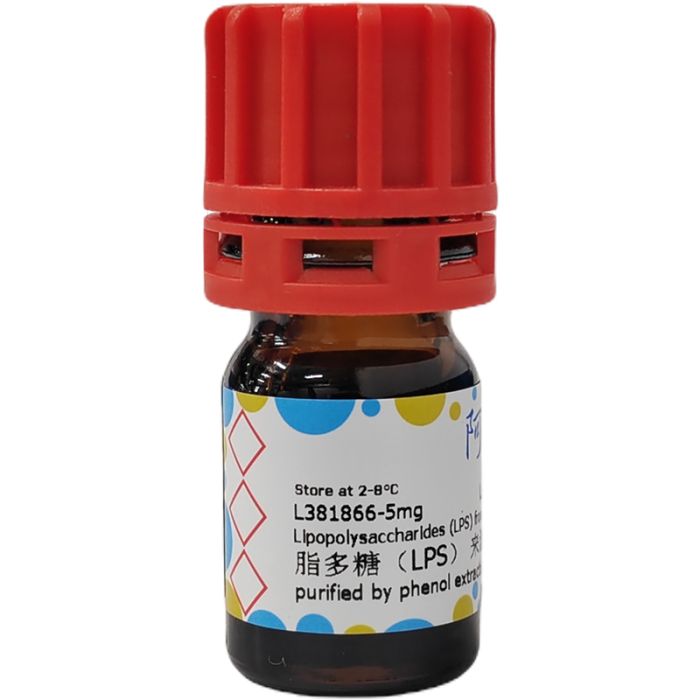
purified by phenol extraction
英文名称
Lipopolysaccharides (LPS) from Salmonella typhosa
生化机理
脂多糖(LPS)位于膜的外层,并且在非包封的菌株中暴露在细胞表面上。它们有助于外膜的完整性,并保护细胞免受胆汁盐和亲脂性抗生素的作用。
储存条件
2-8°C储存
运输条件
低温运输
名称和识别符
高级数据
化学和物理性质
溶解性
Soluble in water (5 mg/ml).
安全和危险性(GHS)
预防措施声明
P264: 处理后要彻底洗手。
WGK Germany
3
RTECS
OJ0895637
Class
6.1
质检证书(CoA,COO,BSE/TSE 和分析图谱)
C of A & Other Certificates(BSE/TSE, COO):
输入批号以搜索分析图谱:
技术文档和文章
溶液计算器
相关产品
脂多糖,来源于大肠杆菌055:B5-purified by phenol extractio,CAS:L118716
脂多糖 来源于大肠杆菌 0111:B4-purified by phenol extraction,CAS:93572-42-0
脂多糖(LPS)-来源于大肠杆菌 055:B5, purified by trichloroacetic acid extraction,CAS:93572-42-0
脂多糖 来源于绿脓假单胞菌 10-Moligand™, purified by trichloroacetic acid extraction,用于Lipopolysaccharides (LPSs) are characteristic components of the cell wall of Gram-negative bacteria. LPS and its lipid A moiety stimulate cells of the innate immune system by the Toll-like receptor 4 (TLR4), a member of the Toll-like receptor protein family, which recognizes common pathogen-associated molecular-patterns (PAMPs).各种应用,TLR4 激动剂,CAS:L611586
脂多糖 来源于大肠杆菌 026:B6-γ-irradiated, BioReagent, 用于细胞培养
脂多糖 来源于肠沙门氏菌 肠道血清型-γ-irradiated, BioReagent, 用于细胞培养
脂多糖 来源于大肠杆菌 0127:B8-γ-irradiated, BioReagent, 用于细胞培养
脂多糖 来源于肠沙门氏菌 肠炎血清型-γ-irradiated, BioReagent, 用于细胞培养
脂多糖 来源于伤寒沙门氏菌-γ-irradiated, BioReagent, 用于细胞培养
产品仅提供给经过验证的企业、机构和合格的专业人员用于研发。不适用于人类、动物、诊断或治疗。
Copyright © 2023至今 上海阿拉丁生化科技股份有限公司 SSE:688179 保留所有权利。


 危险品化学品经营许可证(带存储)