
计算溶液所需的质量、体积或浓度。
为什么选择此级别
,适用于对基线干扰要求严格的色谱和分析工作流程。
储存与运输
2-8°C储存,干燥。低温运输 。请查阅批次 COA 获取详细规格。
质量文档
SDS、COA、产品数据表及规格说明书均可下载。可通过批号查询获取批次 COA。
文献证明
在色谱分析、有机合成和交叉偶联反应领域已被 192 篇同行评审文献引用。
概述
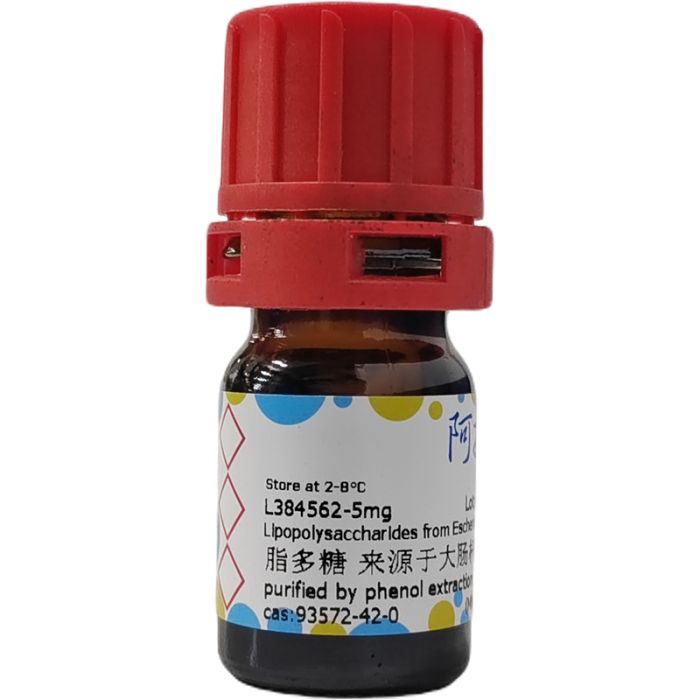
脂多糖是一种糖脂,由与脂肪酸连接的碳水化合物组成。脂多糖(LPS)是革兰氏阴性菌细胞壁的特征性成分。典型的LPS分子具有脂质A(一种基于葡糖胺的磷脂)、一个相对短的核心寡糖以及一个远端的多糖(O-抗原)。LPS有助于外膜的完整性,并可保护细胞免受胆汁盐和亲脂性抗生素的作用。它们通过TLR2和TLR4(toll样受体)对宿主细胞进行刺激。这种刺激可导致各种促炎细胞因子的生成,例如TNFα(肿瘤坏死因子)、IL-1(白细胞介素1)和IL-6。 该产品是从大肠杆菌血清型O111:B4中经酚抽提的。来源菌株来自私人保藏。该LPS血清型已用于刺激B细胞并在人肝细胞中诱导NOS( 一氧化氮合酶)。
应用:
来源于大肠杆菌 O111:B4的脂多糖(LPS)已用于:
刺激巨噬细胞;
小鼠 LPS 预处理;
诱导小鼠急性肾损伤;
诱导小鼠急性呼吸窘迫综合征 (ARDS) ,以研究骨髓间充质干细胞 (BMSC) 来源外泌体的抗炎作用;
诱导重症急性呼吸综合征冠状病毒 2 (SARS-CoV-2) 感染小鼠的高炎症状态;
脂多糖(LPS)是革兰氏阴性菌细胞壁的特征组分。LPS及其脂质A部分可通过能够识别常见的病原体相关分子模式(PAMP)的Toll样受体蛋白家族成员Toll样受体4(TLR4)刺激先天性免疫系统细胞。
Lipopolysaccharides are a type of glycolipid composed of carbohydrates linked to fatty acids. Lipopolysaccharides (LPS) are characteristic components of the cell wall of Gram negative bacteria. A typical LPS molecule consists of lipid A (a glucosamine based phospholipid), a relatively short core oligosaccharide, and a distal polysaccharide (O-antigen). LPS contributes to the integrity of the outer membrane and can protect cells from the effects of bile salts and lipophilic antibiotics. They stimulate host cells through TLR2 and TLR4 (toll like receptors). This stimulus can lead to the generation of various pro-inflammatory cytokines, such as TNF α Tumor necrosis factor, IL-1, and IL-6. This product was extracted with phenol from Escherichia coli serotype O111: B4. The source strain comes from private preservation. This LPS serotype has been used to stimulate B cells and induce NOS (nitric oxide synthase) in human liver cells.
Application:
Lipopolysaccharides (LPS) derived from Escherichia coli O111: B4 have been used for:
Stimulate macrophages;
Mouse LPS pretreatment;
Induce acute kidney injury in mice;
Inducing acute respiratory distress syndrome (ARDS) in mice to study the anti-inflammatory effects of extracellular vesicles derived from bone marrow mesenchymal stem cells (BMSCs);
Inducing a high inflammatory state in mice infected with severe acute respiratory syndrome coronavirus 2 (SARS-CoV-2);
Lipopolysaccharides (LPS) are characteristic components of the cell wall of Gram negative bacteria. LPS and its lipid A fraction can stimulate innate immune system cells through Toll like receptor 4 (TLR4), a member of the Toll like receptor protein family that recognizes common pathogen associated molecular patterns (PAMPs).
规格
英文别名
LPS
规格或纯度
purified by phenol extraction
英文名称
Lipopolysaccharides from Escherichia coli O111:B4
生化机理
脂多糖 (LPS) 是外膜的组成部分,使外膜可透过疏水性分子,如使革兰氏阴性菌具有天然耐药性的抗菌物质。LPS 参与细菌-宿主相互作用,调节宿主系统反应。
储存条件
2-8°C储存,干燥
运输条件
低温运输
名称和识别符
EC号
297-473-0
分子类型
未知
技术文档
高级数据
化学和物理性质
溶解性
Soluble in water (5 mg/ml), and cell culture medium (1 mg/ml).
敏感性
对湿度敏感
安全和危险性(GHS)
信号词
警告
危险声明
H302+H312+H332: 吞咽,皮肤接触或吸入有害。
预防措施声明
P261: 避免吸入灰尘/烟雾/气体/雾/蒸汽/喷雾
P264: 处理后要彻底洗手。
P270: 使用本产品时,请勿进食、饮水或吸烟。
P271: 仅在室外或通风良好的地方使用。
P280: 戴防护手套/穿防护服/戴防护眼罩/戴防护面具。
质检证书(CoA,COO,BSE/TSE 和分析图谱)
C of A & Other Certificates(BSE/TSE, COO):
输入批号以搜索分析图谱:
通过匹配包装上的批号来查找并下载产品的 COA,每批产品都进行了严格的验证,您可放心使用!
| 批号(Lot Number) | 证书类型 | 货号 |
|---|---|---|
 A2410269 |
分析证书 | L384562 |
| A2410271 |
分析证书 | L384562 |
| G2631422 |
分析证书 | L384562 |
| G2631421 |
分析证书 | L384562 |
| G2631420 |
分析证书 | L384562 |
| F2306851 |
分析证书 | L384562 |
| F2306864 |
分析证书 | L384562 |
| C2604530 |
分析证书 | L384562 |
| C2604532 |
分析证书 | L384562 |
| C2604533 |
分析证书 | L384562 |
| G2503492 |
分析证书 | L384562 |
| G2503369 |
分析证书 | L384562 |
| J2425839 |
分析证书 | L384562 |
| J2425835 |
分析证书 | L384562 |
| G2431323 |
分析证书 | L384562 |
| G2431333 |
分析证书 | L384562 |
| C2429858 |
分析证书 | L384562 |
| C2429857 |
分析证书 | L384562 |
| B2423689 |
分析证书 | L384562 |
| B2423688 |
分析证书 | L384562 |
| A2410259 |
分析证书 | L384562 |
| A2410270 |
分析证书 | L384562 |
| I2306855 |
分析证书 | L384562 |
| I2306856 |
分析证书 | L384562 |
| F2306863 |
分析证书 | L384562 |
| F2306859 |
分析证书 | L384562 |
| L2220425 |
分析证书 | L384562 |
| L2220468 |
分析证书 | L384562 |
| H2229316 |
分析证书 | L384562 |
| H2229331 |
分析证书 | L384562 |
技术文档和文章
细菌的外衣——脂多糖LPS
目录: 技术文章
Azithromycin: Physicochemical Features, Mechanism of Action, and Key Points for Research Applications
目录: 技术文章
神经类固醇与中枢神经系统保护机制
目录: 技术文章
Applications of Natural Escherichia coli-Derived Biological Components in Immunoassays, Inflammatory Stimulation, and Control System Design
目录: 技术文章
Experimental Research on Candidate Probiotics: From Strain Identification and Mechanistic Evaluation to Product Selection
目录: 技术文章
Evaluation of Blood-Brain Barrier Permeability: Tracer Extravasation, TEER Measurement, and Interpretation of In Vitro Model Results
目录: 技术文章
Inflammatory Signaling Pathway Research Guide: Danger Signal Recognition, Core Signaling Modules, Detection Readouts, and Representative Research Reagents
目录: 技术文章
Analysis of the Canonical and Non-Canonical NF-κB Pathways: Activation Mechanisms, Detection Methods, and Research Tool Selection
目录: 技术文章
Gentiana Root Extract and Gentiopicroside: Chemical Composition, Antioxidant and Inflammation-Modulating Mechanisms, and Their Potential Effects on Skin Barrier Homeostasis
目录: 技术文章
Potential Mechanisms of p-Cymene in Problem-Prone Skin: Membrane Perturbation, Inflammatory Signaling Modulation, and Localized Delivery
目录: 技术文章
此产品的引用文献
溶液计算器
产品仅提供给经过验证的企业、机构和合格的专业人员用于研发。不适用于人类、动物、诊断或治疗。
Copyright © 2023至今 上海阿拉丁生化科技股份有限公司 保留所有权利。


 危险品化学品经营许可证(带存储)