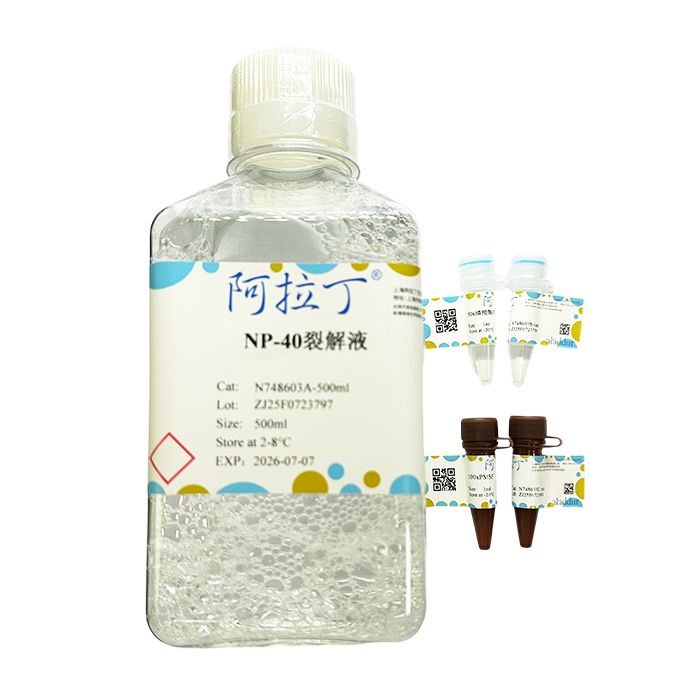
| N748603 | Component | 100mL | 500mL | Storage | | N 748603A | NP-40裂解液 | 100mL | 500mL | 2-8℃ | | N748603B | 50×磷酸酶抑制剂 | 2×1mL | 10×1mL | -20℃. Avoid freeze/thaw cycle. | | N748603C | 100×PMSF | 1mL | 5×1mL | -20℃. Avoid freeze/thaw cycle. |
|
产品介绍:
NP- 40裂解液(NP -40 Lysis Buffer)是-种比较温和的细胞组织裂解液,其裂解得到的蛋白样品可以用于常规的Western、IP和co-IP等。用NP-40裂解液裂解得到的蛋白样品,可以使用BCA蛋白浓度测定试剂盒测定蛋白浓度。由于含有较高浓度的去垢剂,不能用Bradford法测定由本裂解液裂解得到样品的蛋白浓度。
注意事项:
1、为取得最佳的使用效果,可以适当分装后-20°℃保存使用,避免过多的反复冻融;
2、裂解样品的所有步骤都需在冰上或 2~8°℃ 进行;
3、为了您的自身安全,使用试剂前,请做好防护,如穿实验服,带手套等
使用说明:
1、试剂准备
取适当量的裂解液,在使用前数分钟内将蛋白酶抑制剂复合物或/和磷酸酶抑制剂复合物按照1:50 加入裂解液中,或者使用100 mM的PMSF,并使PMSF的最终浓度为1 mM。
2、细胞/组织的裂解
对于贴壁细胞:去除培养液,用PBS、生理盐水或无血清培养液洗一遍按照6孔板每孔加入150-250 uL裂解液的比例加入裂解液。用枪吹打数下,使裂解液和细胞充分接触。通常裂解液接触细胞1-2 秒后,细胞就会被裂解。如果用于ChIP,初步裂解后需在冰浴上继续裂解10分钟; 对于悬浮细胞:离心收集细胞,用手指把细胞用力弹散。按照6孔板每孔细胞加入150-250uL裂解液的比例加入裂解液。再用手指轻弹以充分裂解细胞。如果细胞量较多,必需分装成 50-100 万细胞/管,然后再裂解。充分裂解后应没有明显的细胞沉淀。如果用于ChIP,初步裂解后需在冰浴上继续裂解 10 分钟。对于组织样品:用组织剪将组织剪成碎片后,按照每20mg组织加入150-250uL裂解液的比例加入裂解液,并使用用玻璃匀浆器匀浆,直至充分裂解。如果用于ChIP,初步裂解后需在冰浴上继续裂解10分钟。
3、蛋白样品收集
充分裂解后,10000-14000g 离心3-5分钟,取上清,即可进行后续的PAGE、Western 和ChIP等操作。
| N748603 | Component | 100mL | 500mL | Storage |
| N 748603A | NP-40 cracking solution
| 100mL | 500mL | 2-8℃ |
| N748603B | 50× phosphatase inhibitor | 2×1mL | 10×1mL | -20℃. Avoid freeze/thaw cycle. |
| N748603C | 100×PMSF | 1mL | 5×1mL | -20℃. Avoid freeze/thaw cycle. |
NP-40 Lysis Buffer is a relatively mild cell tissue lysis buffer, and the protein samples obtained from its lysis can be used for conventional Western, IP, and co IP assays. The protein sample obtained by lysing with NP-40 lysate can be measured for protein concentration using the BCA protein concentration assay kit. Due to the high concentration of descaling agents, the Bradford method cannot be used to determine the protein concentration of the sample obtained from the lysis of this lysate.
Precautions:
1. To achieve the best usage effect, it can be appropriately packaged and stored at -20 ℃ to avoid excessive repeated freezing and thawing;
2. All steps of sample cracking must be carried out on ice or at 2-8 ℃;
3. For your own safety, please take protective measures such as wearing lab coats and gloves before using the reagents.
Instructions for Use:
1. Reagent preparation
Take an appropriate amount of lysis buffer and add the protease inhibitor complex and/or phosphatase inhibitor complex to the lysis buffer at a ratio of 1:50 within a few minutes before use, or use 100 mM PMSF and make the final concentration of PMSF 1 mM.
2. Cell/tissue lysis
For adherent cells: Remove the culture medium and wash once with PBS, physiological saline, or serum-free culture medium. Add lysis buffer in a ratio of 150-250 uL per well to a 6-well plate. Blow with a gun several times to ensure full contact between the lysate and the cells. Usually, after 1-2 seconds of contact with the cell lysate, the cell will be lysed. If used for ChIP, it needs to be further cracked on an ice bath for 10 minutes after initial cracking; For suspended cells: Collect cells by centrifugation and use your fingers to forcefully scatter them. Add lysis buffer at a ratio of 150-250uL per well of cells in a 6-well plate. Gently flick with your fingers to fully lyse the cells. If there are a large number of cells, they must be divided into 500000 to 1 million cells/tube and then lysed. After sufficient lysis, there should be no obvious cell precipitation. If used for ChIP, it needs to be further cracked on an ice bath for 10 minutes after initial cracking. For tissue samples: Cut the tissue into fragments using a tissue cutter, add 150-250uL of lysis buffer per 20mg of tissue, and homogenize with a glass homogenizer until fully lysed. If used for ChIP, it needs to be further cracked on an ice bath for 10 minutes after initial cracking.
3. Collection of protein samples
After sufficient lysis, centrifuge at 10000-14000g for 3-5 minutes, take the supernatant, and proceed with subsequent PAGE, Western blot, and ChIP operations.

 I2615459


 危险品化学品经营许可证(带存储)