
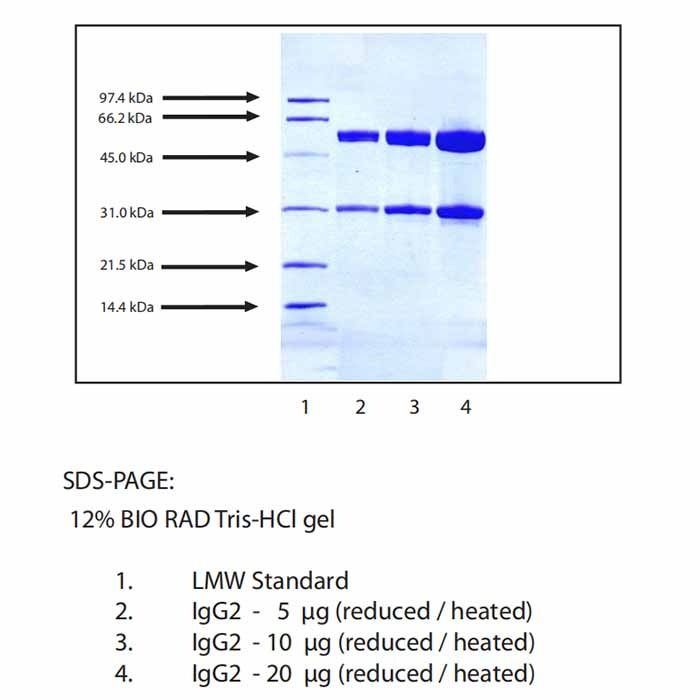
免疫球蛋白G2 (IgG2) 来源于正常人血浆

货号: np001060
有货
级别和纯度: 天然 ? 天然型(Native)—— 处于天然(非重组、非变性)形态的蛋白/生物分子。当需要天然结构和活性时使用。 ≥95%(SDS-PAGE) 蛋白浓度见COA
Accession #
P01859
★
规格
库存
价格
数量
50μg
np001060-50μg
期货 Stock Image
¥999.90
250μg
np001060-250μg
期货 Stock Image
¥2,699.90
1mg
np001060-1mg
期货 Stock Image
¥5,999.90
请输入您要添加的产品数量
🧪
为什么选择此级别

天然 级 提供 ≥95%(SDS-PAGE) 纯度,适用于对基线干扰要求严格的色谱和分析工作流程。

🌡

储存与运输

-20°C储存,避免反复冻融。超低温运输 。请查阅批次 COA 获取详细规格。

📋

质量文档

SDS、COA、产品数据表及规格说明书均可下载。可通过批号查询获取批次 COA。

📚

文献证明

在色谱分析、有机合成和交叉偶联反应领域已被 0 篇同行评审文献引用。

概述

IgG2 是含量第二高的 IgG 亚类;相较于 IgG1/IgG3,其结构更为刚性,因此 IgG2 擅长识别重复的碳水化合物抗原。

蛋白生物学功能 

血清 IgG2 约占总 IgG 的 23%。其铰链区较短,仅 12 个氨基酸,形成多脯氨酸螺旋结构,由 4 条链间二硫键维持稳定。该刚性结构限制 Fab 臂的灵活性,与 IgG1/IgG3 相比,Fcγ 受体(FcγR)结合能力与补体激活能力更弱。但 IgG2 可高效识别肺炎链球菌、流感嗜血杆菌等荚膜菌表面的重复碳水抗原,形成高亲和力相互作用,是多糖抗原免疫应答的关键。其 Fc 结构域可中等亲和力结合 FcγRIIA-H131,在特定条件下介导吞噬细胞清除病原体。 

常见研究用途 

IgG2 缺乏(<2.1 g/L)会削弱抗多糖免疫应答,增加反复鼻窦肺部感染及侵袭性细菌感染风险;该缺陷常伴随 IgG4 或 IgA 缺乏,造成免疫功能受损。临床中,血清 IgG2 定量检测用于评估体液免疫水平,多用于慢性感染、低丙种球蛋白血症患者。在药物研发领域,IgG2 较弱的 Fc 效应功能被应用于肿瘤治疗;帕尼单抗(Panitumumab)为 IgG2 型抗 EGFR 单抗,可在保留肿瘤靶向能力的同时降低细胞因子释放综合征风险。由于铰链区缺少 Gly236,IgG2 经 FcRn 介导的跨细胞转运效率低,胎盘转运水平仅约母体浓度的 50%,降低胎儿暴露风险。新型蛋白改造技术利用 IgG2 结构稳定性,延长血清半衰期并减少非特异性激活,提升药物安全性。

常见用途:ELISA 标准品、体外诊断(IVD)检测标准品、校准品与质控品、治疗药物研究、免疫系统研究。

The second most abundant IgG subclass, but possessing a more rigid structure compared to IgG1/IgG3. Thus, IgG2 excels in targeting repetitive carbohydrate antigens.

Role of protein in biology

Serum IgG2 constitutes approximately 23% of total immunoglobulin G and is distinguished by a truncated 12-amino-acid hinge region with a poly-proline helix stabilized by four interchain disulfide bonds. This rigid structure limits Fab arm flexibility, reducing Fcγ receptor (FcγR) binding and complement activation compared to IgG1/IgG3. However, IgG2 excels in targeting repetitive carbohydrate antigens on encapsulated bacteria like Streptococcus pneumoniae and Haemophilus influenzae, forming high-avidity interactions critical for polysaccharide immunity. Its Fc domain binds FcγRIIA-H131 with moderate affinity, enabling phagocyte-mediated pathogen clearance in specific contexts.

Common research uses

Deficiency in IgG2 (<2.1 g/L) impairs anti-polysaccharide responses, increasing susceptibility to recurrent sinopulmonary infections and invasive bacterial diseases. This deficiency often coexists with IgG4 or IgA deficits, complicating immune competence. Clinically, serum IgG2 quantification aids in evaluating humoral function, particularly in patients with chronic infections or hypogammaglobulinemia. Therapeutically, IgG2’s reduced Fc-mediated effector functions are exploited in oncology. Panitumumab, an IgG2 anti-EGFR monoclonal antibody, minimizes cytokine release syndrome while retaining tumor-targeting efficacy. Its inefficient FcRn-mediated transcytosis-attributed to the absence of Gly236 in the hinge-also results in lower placental transfer (~50% maternal levels), reducing fetal exposure risks. Emerging engineering strategies leverage IgG2’s structural stability for prolonged serum half-life and minimized off-target activation, enhancing therapeutic safety profiles.

Common uses include ELISA standards, IVD Assay standards, calibrators and controls, therapeutics research, immune system research.

规格

产品名称
免疫球蛋白G2 (IgG2) 来源于正常人血浆
规格或纯度
天然, ≥95%(SDS-PAGE), 蛋白浓度见COA
生化机理
Constant region of immunoglobulin (Ig) heavy chains. Igs are membrane-bound or secreted glycoproteins produced by B lymphocytes. In the recognition phase of humoral immunity, the membrane-bound Igs serve as receptors, which upon binding to a specific antigen trigger the clonal expansion and differentiation of B lymphocytes into Ig-secreting plasma cells. Secreted Igs known as antibodies mediate the effector phase of humoral immunity by blocking the interaction of infectious antigens with cellular receptors (via the antigen-binding region) and eliciting effector mechanisms that lead to pathogen neutralization (via the constant region). The antigen-binding region is formed by the variable domain of one heavy chain paired with the variable domain of its associated light chain. Each Ig molecule has two antigen-binding sites with remarkable affinity for a particular antigen due to V-(D)-J rearrangement, somatic hypermutations and affinity maturation of the variable domains upon antigen exposure. The constant region defines the Ig isotype that perform distinct sets of effector functions. B cells diversify and rearrange their Ig constant regions through class-switch recombination, a process by which the constant region is switched from one Ig isotype to another, namely from IgM and IgD to IgG, IgA and IgE. The constant region interacts (via the fragment crystallizable, Fc) with receptors on innate immune cells and the complement system to mediate humoral effector functions. Ig gamma-2 (IgG2) isotype formed against polysaccharide structures found on encapsulated bacteria elicits antibody-dependent protection through activation of complement pathway. Post-translational: N-glycosylated. Carries predominantly biantennary complex-type glycans attached at Asn-176 residue on the Fc region of each heavy chain. Unique Fc glycan profiles found in secreted IgGs are induced in an antigen-specific way, likely programmed during B cell priming to mount an appropriate Ig effector response. The core glycan is composed of two sequential N-acetylglucosamine (GlcNAc) moieties followed by a central mannose (Man) from which two additional Man residues branch out (alpha1,3 and alpha1,6 antennae) each capped with a GlcNAc. Additional sugar molecules can be added to generate over 30 possible glycans. Such sugar modifications include the addition of one fucose at the initial GlcNAc, galactose (Gal) and sialic acid (Neu5Ac) residues at antennary GlcNAc or a bisecting GlcNAc to the core Man. Variable addition of sugars account for different IgG functional states. Fc Igs carrying afucosylated N-glycans display increased affinity for FCGR3A. Glycosylation on Asn-176 is required for interaction with Fc receptors and ability to activate the complement pathway.1 Publication(Microbial infection) Deglycosylation on Asn-176 by S.pyogenes EndoS or Endos2 endoglucosidases prevents interaction between immunoglobulin-gamma (IgG) and Fc receptors, impairing ability to activate the complement pathway.
种属
人(Human)
来源
天然
预测分子量
146 kDa
分子类型
蛋白质
产品线
biological_products
储存与运输
物理形态
液体
储存缓冲液
20 mM Phosphate, 150 mM NaCl, 0.05% NaN₃, pH 7.4.
防腐剂
0.05% Sodium azide
浓度
蛋白浓度见COA
储存条件
-20°C储存,避免反复冻融
运输条件
超低温运输
稳定性与储存
长期储存-20℃(>1年);收货后建议分装,避免反复冻融。

技术文档

📋 安全数据表 (SDS)

全面的危险、操作、储存及法规合规文件。

下载 SDS →

✅ 分析证书 (COA)

批次质量数据。输入批号以获取对应 COA。

查询 COA →

📊 产品数据表

产品规格和应用的快速参考摘要。

查看数据表 →

🔬 规格说明书

该级别的完整质量属性和验收标准。

查看规格说明 →

高级数据

质检证书(CoA,COO,BSE/TSE 和分析图谱)
C of A & Other Certificates(BSE/TSE, COO):
输入批号以搜索分析图谱:
技术文档和文章
溶液计算器

常见问题

本产品的纯度是多少?如何测定?
本产品的纯度为 ≥95%,采用SDS-PAGE测定。批次的具体数值以分析证书(COA)为准。
本产品应如何储存?
请于?20 °C条件下保存。需冷冻保存以维持规定的有效期。
本产品如何运输?
本产品采用保温箱配冰袋运输。收货后请立即拆包,并按上述储存条件保存。
如何获取批次专用COA?
每个订单都会随附分析证书(COA),您也可以从账户订单历史中下载。如需订购前的COA,请联系您的客户代表,或使用PDP上的"申请COA"按钮——我们将提供代表性批次的COA。

需要帮助选择级别?

我们的级别选择指南涵盖了目录中所有的变体的纯度、稳定剂状态和应用适用性。

查看 Native 级别指南 →
