Apo CIII inhibits the activation of lipoprotein lipase by Apo CII. Reduced levels of Apo CIII result in higher fatty acid uptake from plasma triglycerides into adipose tissue. Thus, Apo CIII is a potential target for treatment of obesity and insulin resistance. The normal plasma concentration of Apo CIII is 8-15 mg per 100 ml.
Prepared from fresh, non-frozen plasma shown to be non reactive for HBsAg, anti-HCV, anti-HBc, and negative for anti-HIV 1 & 2 by FDA approved tests.
Component of triglyceride-rich very low density lipoproteins (VLDL) and high density lipoproteins (HDL) in plasma. Plays a multifaceted role in triglyceride homeostasis. Intracellularly, promotes hepatic very low density lipoprotein 1 (VLDL1) assembly and secretion; extracellularly, attenuates hydrolysis and clearance of triglyceride-rich lipoproteins (TRLs). Impairs the lipolysis of TRLs by inhibiting lipoprotein lipase and the hepatic uptake of TRLs by remnant receptors. Formed of several curved helices connected via semiflexible hinges, so that it can wrap tightly around the curved micelle surface and easily adapt to the different diameters of its natural binding partners.
Post-translational: The most abundant glycoforms are characterized by an O-linked disaccharide galactose linked to N-acetylgalactosamine (Gal-GalNAc), further modified with up to 3 sialic acid residues. Less abundant glycoforms are characterized by more complex and fucosylated glycan moieties. O-glycosylated on Thr-94 with a core 1 or possibly core 8 glycan.
种属
人(Human)
来源
天然
预测分子量
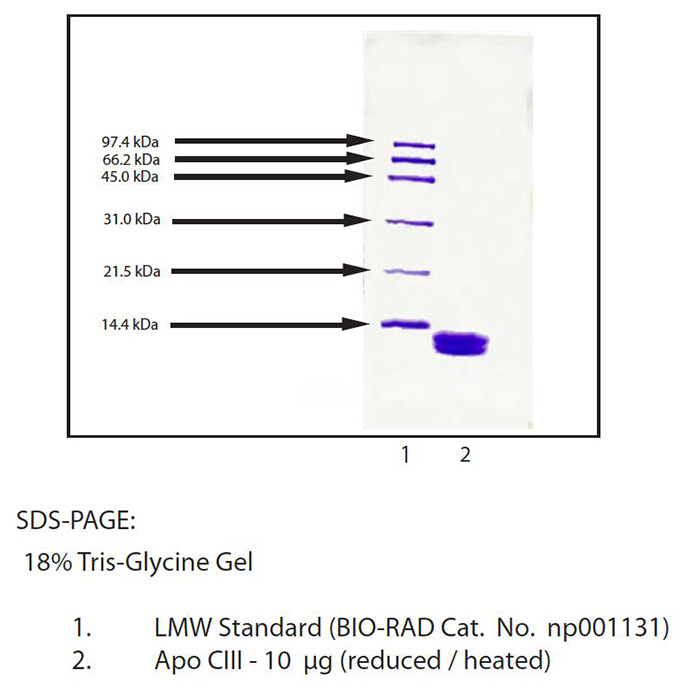
8.75 kDa
分子类型
蛋白质
产品线
生物产品
储存与运输
物理形态
冻干(Lyophilized)
储存缓冲液
Lyophilized from 10 mM NH4HCO3, pH 7.4
浓度
冻干前浓度:见COA
复溶
After centrifugation, we suggest re-addition of lyophilization buffer (10 mM NH4HCO3, pH 7.4) to the original volume (See COA), followed by gentle mixingto ensure adequate homogenization. If further dilution is required, please use the lyophilization buffer.

 ZJ26F0434152


 危险品化学品经营许可证(带存储)