小鼠CD3⁺ 细胞去除磁珠是通过共价偶联的方式将鼠CD3抗体与磁珠结合,可以用来从小鼠脾脏细胞等单细胞悬液中快速有效去除CD3⁺ 细胞。
适用范围
去除小鼠脾脏和淋巴结CD3⁺ 细胞。
磁珠用量(悬浮液体积)
| 可分选细胞总量 |
250 μL
| 5 × 10⁸ 个细胞 |
1 mL
| 2 × 10⁹ 个细胞 |
操作流程(以去除小鼠脾脏中CD3⁺细胞为例):
1. 制备单细胞悬液
在70 μm细胞筛网上研磨脾脏,以预冷的PBS冲洗细胞筛网,收集细胞悬液于50 mL离心管中,500 g,离心5 min。
2. 裂解红细胞
离心结束后弃上清,加入5 mL红细胞裂解液(ACK),室温裂解5 min。再加入20 mL PBS,500 g,离心5 min。若该次实验合并取多只小鼠脾脏同批制样,使用红细胞裂解液的体积需相应增加,具体使用红细胞裂解液的体积应参照该试剂的说明书。
注意:红细胞裂解步骤可根据所用裂解液不同调整用量及时间。少量红细胞残留不会影响后续分选及细胞纯度。
3. 脾细胞的重悬
离心完成后,弃上清,将脾细胞重悬于PBS。随后,将该细胞悬液用70 μm细胞筛网过滤并计数。计数完成后,500 g,离心5 min。
注意:细胞悬液需要过细胞筛网,以除去组织和细胞团块,否则会影响后续细胞分选纯度。
4. 调整浓度
离心完成后,弃上清,将细胞重悬于分选buffer中,调整细胞密度为2×10⁸ cells/mL。
注意:分选buffer为含有2 mM EDTA和2%胎牛血清(FBS)的PBS,或者含有2 mM EDTA和0.5% BSA的PBS,需预先通过0.22 μm滤膜过滤除菌。
5. 细胞与磁珠的孵育
将500 μL细胞悬液(1×10⁸个细胞)加入1.5 mL离心管底部,再加入清洗好后重悬的磁珠50 μL(小鼠CD3⁺ 细胞去除磁珠使用前需用分选buffer清洗:取用磁珠时选择合适量程的移液枪,以吹打混匀的方式彻底重悬磁珠,注意吹打时避免产生气泡。吸取实验需要体积的磁珠至1.5 mL离心管,加入1 mL分选buffer,10000 g离心1 min,或使用磁力架磁吸3 min,弃上清。加入1 mL分选buffer重复洗涤磁珠1次后,用与取用磁珠时相同体积的分选buffer重悬磁珠。例如:吸取50 μL磁珠进行清洗,则清洗后用50 μL分选buffer重悬)。吹打混匀离心管内的液体,室温下使用四维旋转混匀仪孵育30 min。
注意:如果分选更多的细胞,则按比例增加小鼠CD3⁺ 细胞去除磁珠的量,比如:分选1.5×10⁸个细胞时,即在1.5 mL离心管内加入750 μL细胞悬液和75 μL 小鼠CD3⁺ 细胞去除磁珠。如果分选≤5×10⁷个细胞,则在1.5 mL离心管内将细胞悬液体积补至250 μL,加入25 μL 小鼠CD3⁺ 细胞去除磁珠。
6. 磁吸
孵育完成后,加入分选buffer将液体体积补至3 mL(可分次将液体从1.5 mL离心管转移至流式管内),用移液器上下混合吹打10次混匀(避免使用剧烈振荡或者上下颠倒混匀的方式)。随后,将流式管置于磁力架上,静置5 min。
7. 目的细胞的富集
磁吸完成后,上清液中包含目的细胞。小心收集上清液(注意不要混入磁珠),500 g,离心5 min。离心后弃上清,收集细胞。
8. 重悬备用
根据实验需要洗涤细胞后,重悬于所需缓冲液或培养基中,即可用于后续分子生物学或细胞生物学实验。
去除效果
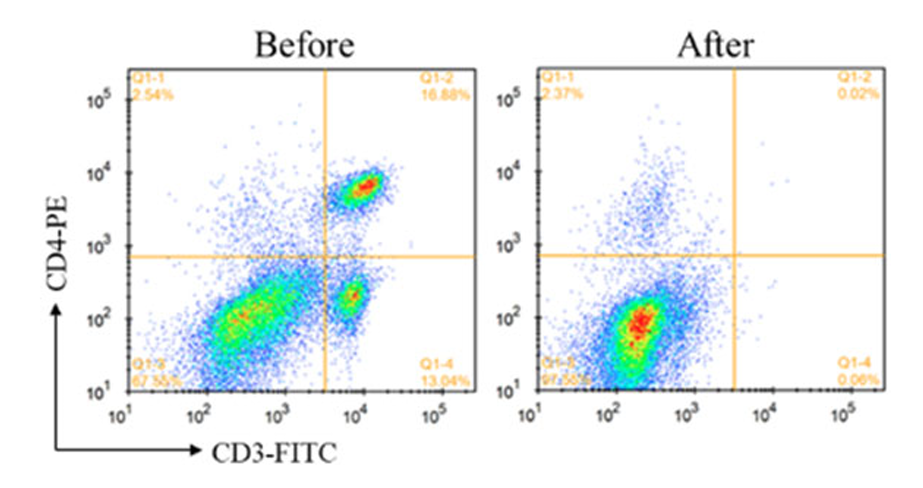
从C57BL/6小鼠脾脏细胞中去除CD3⁺细胞,去除前后的细胞用FITC anti-mouse CD3抗体(克隆号145-2C11)和PE anti-mouse CD4抗体(克隆号RM4-4)标记后进行流式细胞仪分析。去除前后的CD3⁺ T细胞纯度分别为29.92%和0.08%。
注意事项
1. 磁珠使用和保存过程中应避免冷冻。
2. 建议选用低吸附移液器吸头和离心管,避免因吸附造成磁珠的损耗。
3. 取用磁珠前选择合适量程的移液枪,以吹打的方式彻底重悬磁珠,注意吹打时避免产生气泡。
4. 本产品仅供科研使用。
Mouse CD3⁺ Cell Removal Beads are generated by covalently coupling anti-mouse CD3 antibody to magnetic beads. They can be used for rapid and efficient depletion of CD3⁺ cells from single‑cell suspensions such as mouse splenocytes.
Applications
Depletion of CD3⁺ cells from mouse spleen and lymph nodes.
| Beads Volume (suspension) | Total Cell Number |
|---|
| 250 μL | 5 × 10⁸ cells | | 1 mL | 2 × 10⁹ cells |
|
Protocol (Using Depletion of CD3⁺ Cells from Mouse Spleen as an Example)
Prepare single‑cell suspension
Grind the spleen on a 70 μm cell strainer, rinse the strainer with pre‑chilled PBS, collect the cell suspension into a 50 mL centrifuge tube, and centrifuge at 500 g for 5 min.
Lyse red blood cells
After centrifugation, discard the supernatant. Add 5 mL of ACK red blood cell lysis buffer and lyse at room temperature for 5 min. Then add 20 mL PBS and centrifuge at 500 g for 5 min. If spleens from multiple mice are pooled for the same batch, increase the volume of red blood cell lysis buffer accordingly, following the manufacturer's instructions.
Note: The red blood cell lysis step can be adjusted in volume and time depending on the lysis buffer used. A small amount of residual red blood cells will not affect subsequent depletion or cell purity.
Resuspend splenocytes
After centrifugation, discard the supernatant and resuspend the splenocytes in PBS. Filter the cell suspension through a 70 μm cell strainer and count the cells. After counting, centrifuge at 500 g for 5 min.
Note: The cell suspension must be filtered through a cell strainer to remove tissue and cell clumps; otherwise, subsequent cell depletion purity may be affected.
Adjust cell concentration
After centrifugation, discard the supernatant and resuspend the cells in Isolation Buffer to a density of 2×10⁸ cells/mL.
Note: Isolation buffer is PBS containing 2 mM EDTA and 2% fetal bovine serum (FBS), or PBS containing 2 mM EDTA and 0.5% BSA. The buffer must be pre‑filtered through a 0.22 μm filter.
Incubate cells with beads
Add 500 μL of cell suspension (1×10⁸ cells) to the bottom of a 1.5 mL centrifuge tube, then add 50 μL of washed and resuspended beads (Mouse CD3⁺ Cell Removal Beads must be washed before use: select a pipette with an appropriate volume range, thoroughly resuspend the beads by pipetting, avoiding bubbles. Transfer the required volume of beads to a 1.5 mL centrifuge tube, add 1 mL of Isolation Buffer, centrifuge at 10,000 g for 1 min or use a magnetic separator for 3 min, then discard the supernatant. Add 1 mL of Isolation Buffer, wash the beads once more, and then resuspend the beads in the same volume of Isolation Buffer as originally taken. For example, if 50 μL of beads are taken, resuspend them in 50 μL of Isolation Buffer after washing). Mix the liquid in the tube by pipetting, and incubate at room temperature for 30 min using a rotator.
Note: For more cells, increase the volume of Mouse CD3⁺ Cell Removal Beads proportionally. For example, to process 1.5×10⁸ cells, add 750 μL of cell suspension and 75 μL of Mouse CD3⁺ Cell Removal Beads in a 1.5 mL centrifuge tube. For ≤5×10⁷ cells, adjust the cell suspension volume to 250 μL and add 25 μL of Mouse CD3⁺ Cell Removal Beads.
Magnetic separation
After incubation, add Isolation Buffer to bring the total volume to 3 mL (the liquid can be transferred from the 1.5 mL centrifuge tube to a FACS tube in several steps). Mix thoroughly by pipetting up and down 10 times (avoid vigorous shaking or inverting). Then place the FACS tube on a magnetic separator and let stand for 5 min.
Collect target cells
After magnetic separation, the target cells are in the supernatant. Carefully collect the supernatant (avoid taking up any beads), centrifuge at 500 g for 5 min, discard the supernatant, and collect the cells.
Resuspend for further use
Wash the cells as required for your experiment, then resuspend them in the desired buffer or culture medium for subsequent molecular or cell biology experiments.
Depletion Performance
CD3⁺ cells were depleted from C57BL/6 mouse splenocytes. Cells before and after depletion were stained with FITC anti‑mouse CD3 antibody (clone 145‑2C11) and PE anti‑mouse CD4 antibody (clone RM4‑4) and analyzed by flow cytometry. The purity of CD3⁺ T cells before and after depletion was 29.92% and 0.08%, respectively.
Precautions
Avoid freezing the beads during use and storage.
Low‑retention pipette tips and centrifuge tubes are recommended to avoid loss of beads due to adsorption.
Before taking the beads, select a pipette with an appropriate volume range, thoroughly resuspend the beads by pipetting, and avoid generating bubbles during pipetting.
For research use only.


 ZJ26F0838370

 危险品化学品经营许可证(带存储)