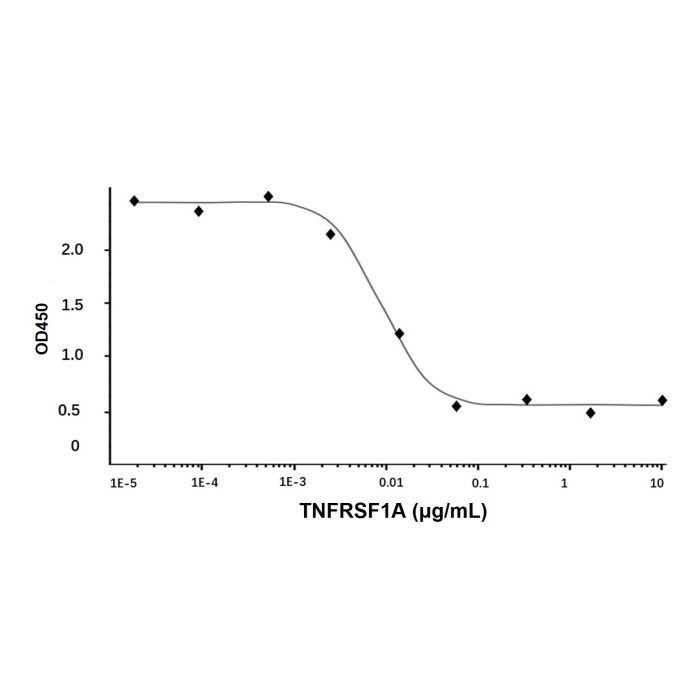
Fully biologically active when compared to standard. The ED₅₀ as determined by its ability to inhibit the TNF-alpha mediated cytotoxicity in the L-929 cells is less than 0.05 μg/ml in the presence of 0.25 ng/mL of rHuTNF-alpha.
Receptor for TNFSF2/TNF-alpha and homotrimeric TNFSF1/lymphotoxin-alpha. The adapter molecule FADD recruits caspase-8 to the activated receptor. The resulting death-inducing signaling complex (DISC) performs caspase-8 proteolytic activation which initiates the subsequent cascade of caspases (aspartate-specific cysteine proteases) mediating apoptosis. Contributes to the induction of non-cytocidal TNF effects including anti-viral state and activation of the acid sphingomyelinase.
Fully biologically active when compared to standard. The ED₅₀ as determined by its ability to inhibit the TNF-alpha mediated cytotoxicity in the L-929 cells is less than 0.05 μg/ml in the presence of 0.25 ng/mL of rHuTNF-alpha.
Lyophilized from a 0.2 µm filtered solution in PBS, pH 7.4
复溶
We recommend that this vial be briefly centrifuged prior to opening to bring the contents to the bottom. Reconstitute in sterile distilled water or aqueous buffer containing 0.1 % BSA to a concentration of 0.1-1.0 mg/mL. Stock solutions should be apportioned into working aliquots and stored at ≤ -20 ℃. Further dilutions should be made in appropriate buffered solutions.
Recombinant Human TNFRSF1A Protein (rp152513)-Protein Bioactivity Fully biologically active when compared to standard. The ED₅₀ as determined by its ability to inhibit the TNF-alpha mediated cytotoxicity in the L-929 cells is less than 0.05 μg/mL, corresponding to a specific activity of > 2 × 10⁴ IU/mg in the presence of 0.25 ng/mL of rHuTNF-alpha.
Recombinant Human TNFRSF1A Protein (rp152513)-SDS-PAGE Recombinant Human TNFRSF1A Protein was resolved with SDS-PAGE under reducing (R) and non-reducing (N) conditions and visualized by Coomassie® Blue staining. Showing a single band at 21.2 kDa under reducing conditions and 19.0 kDa under non-reducing conditions.


 ZJ23F0600347


 危险品化学品经营许可证(带存储)