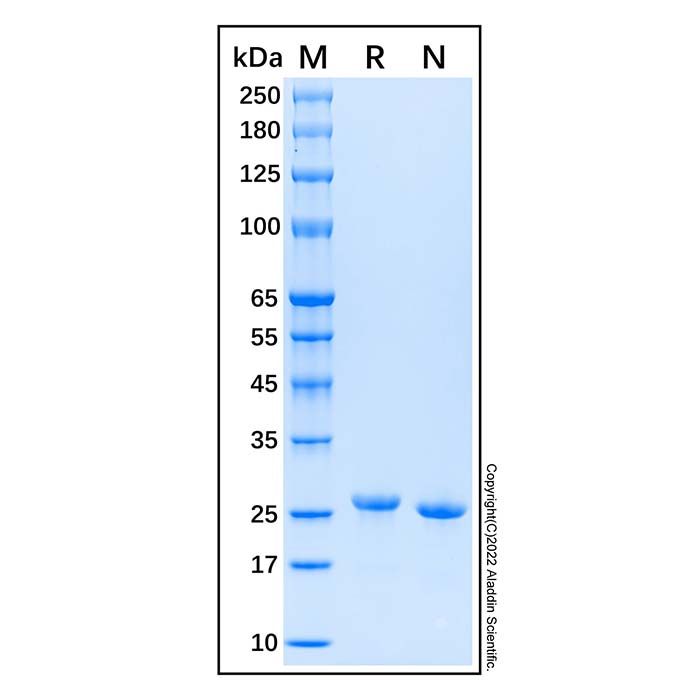
Purity: >95%, by SDS-PAGE visualized with Coomassie® Blue Staining
Description:
Fibroblast growth factor 21 (FGF-21) is a member of the FGF gene family, which currently contains 22 human members. Based on its structure, it is further classified as an FGF19 subfamily member. This subfamily includes FGF-19, -21, and -23. Like all other FGF subfamilies, FGF-19 subfamily members contain a 120 amino acid (aa) core FGF domain that exhibits a beta -trefoil structure. Unlike other FGF subfamilies, FGF-19 subfamily members apparently exhibit poor binding to ECM, resulting in highly diffusible molecules. The c-DNA for FGF-21 predicts a 209 aa polypeptide that contains a 28 aa signal sequence and a 181 aa mature region. Notably, FGF-21, as well as FGF-19 show limited binding to heparin. One potential alternate splice form has been reported. It shows a 43 aa substitution for the C-terminal 12 aa of the standard form. Mature human FGF-21 shows 81% aa identity to mouse FGF-21, and is known to be active on mouse cells. The FGF-19 subfamily is considered endocrine in nature. All three subfamily members impact some aspect of metabolism, all three are induced by a nuclear receptor heterodimer that includes RXR, and all three utilize Klotho family members for signal transduction. FGF-21 is produced by hepatocytes in response to free fatty acid (FFA) stimulation of a PPARa/RXR dimeric complex. This situation occurs clinically during starvation, or following the ingestion of a high-fat/low-carbohydrate diet. Upon FGF-21 secretion, white adipose tissue is induced to release FFAs from triglyceride stores. Once FFAs reach hepatocytes, they are oxidized and reduced to acetyl-CoA. The acetyl-CoA is recombined into 4-carbon ketone bodies (acetoacetate and beta -hydroxybutyrate), released, and transported to peripheral tissues for TCA processing and energy generation.

 ZJ24F0404859


 危险品化学品经营许可证(带存储)