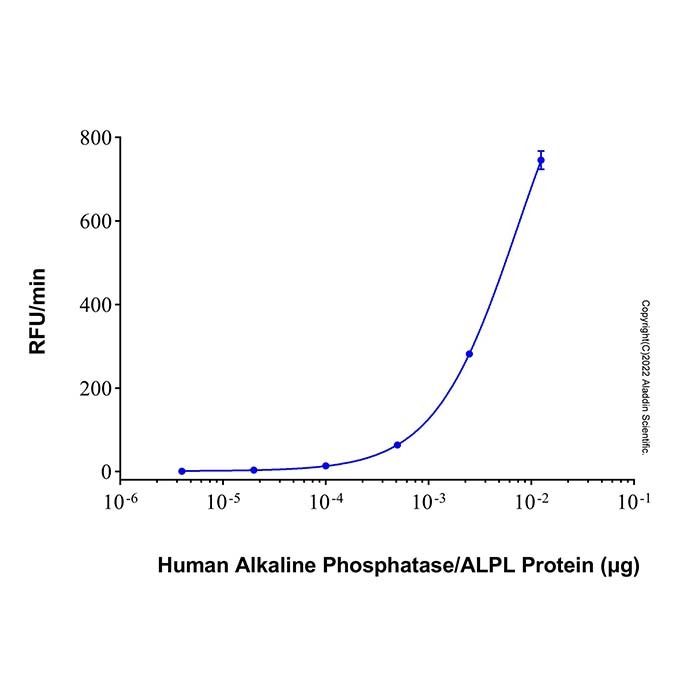
Measured by its ability to cleave a fluorogenic substrate, 4-Methylumbelliferyl phosphate (4-MUP) (M103814). The specific activity is >30,000 pmol/min/µg.
Alkaline phosphatase (ALPL) is a hydrolase enzyme responsible for removing phosphate groups from many types of molecules, including nucleotides, proteins, and alkaloids. The process of removing the phosphate group is called dephosphorylation. As the name suggests, alkaline phosphatases are most effective in an alkaline environment. It is sometimes used synonymously as basic phosphatase. Alkaline phosphatases (APs) are ubiquitous in many species, from bacteria to human. Four genes encode AP isoenzymes in humans and rodents. Three AP genes are expressed in a tissue-specific manner (i.e., placental, embryonic, and intestinal AP isoenzymes). Expression of the fourth AP gene is nonspecific to a single tissue and is especially abundant in bone, liver, and kidney. This isoenzyme is also called tissue-nonspecific alkaline phosphatase (TNAP). The enzyme tissue non-specific alkaline phosphatase (TNAP) belongs to the ectophosphatase family. TNAP is present in large amounts in bone in which it plays a role in mineralization.
Post-translational: N-glycosylated.
生物活性
Measured by its ability to cleave a fluorogenic substrate, 4-Methylumbelliferyl phosphate (4-MUP) (M103814). The specific activity is >30,000 pmol/min/µg.
59.1-72.1 kDa, under reducing conditions; 57.7-70.8 kDa, under non-reducing conditions.
分子类型
蛋白质
产品线
生物产品
储存与运输
物理形态
液体
储存缓冲液
PBS, 10% Glycerol, pH 7.4
浓度
见COA
储存条件
-20°C储存,避免反复冻融
运输条件
超低温运输
稳定性与储存
Store at -20°C for 1 year. Avoid freeze/thaw cycle.
图片
Recombinant Human Alkaline Phosphatase/ALPL Protein - Protein Bioactivity Measured by its ability to cleave a fluorogenic substrate, 4-Methylumbelliferyl phosphate (4-MUP) (M103814). The specific activity is >30,000 pmol/min/µg.
Recombinant Human Alkaline Phosphatase/ALPL Protein (rp183653) - SDS-PAGE 2 μg/lane of Recombinant Human Alkaline Phosphatase/ALPL Protein was resolved with SDS-PAGE under reducing (R) and non-reducing (N) conditions and visualized by Coomassie® Blue staining, showing a band at 59.1-72.1 kDa under reducing conditions and 57.7-70.8 kDa under non-reducing conditions.

 ZJ24F1114282


 危险品化学品经营许可证(带存储)