A hallmark of most cancer cells is an altered metabolism involving a shift to aerobic glycolysis with lactate production coupled with a higher uptake of glucose as the main source of energy. Lactate dehydrogenase (LDH) is key to this shift by catalyzing the formation of lactate by reducing pyruvate with NADH, which also generates NAD(+) that is essential for the continuity of glycolysis. LDHA is a key enzyme that controls the production of lactate in the glycolysis pathway. It is therefore an important control point in the system of cellular energy release. It's up regulation is common in many malignant tumors. Inhibiting LDH activity has an anti-proliferative effect on cancer cells. It may reverse the resistance of tumor cells to conventional chemo- and radiotherapy. Recent research has renewed interest in LDH as an anticancer drug target. The protein is found predominantly in muscle tissue. Mutations in LDHA have been linked to exertional myoglobinuria.
Post-translational: ISGylated
生物活性
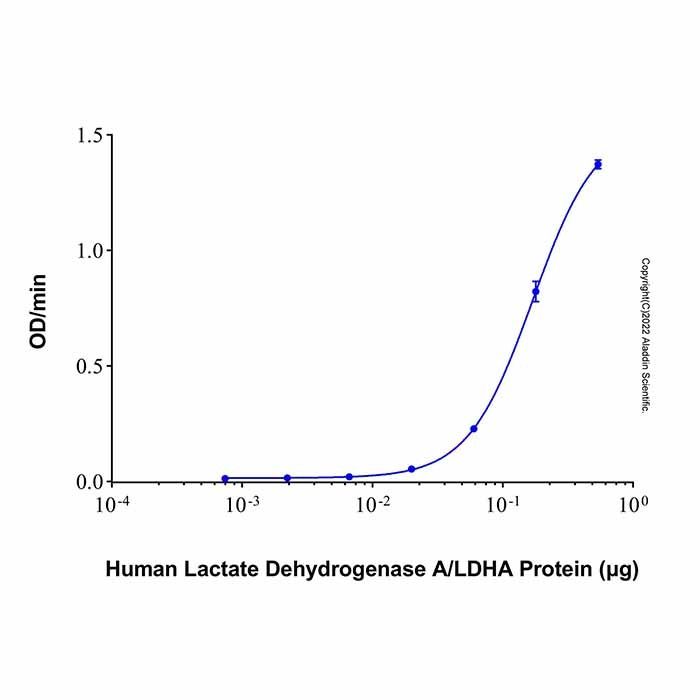
Measured by its ability to reduce pyruvate (S670383) to lactate. The specific activity is > 95,000 pmol/min/μg.
34.5 kDa, under reducing conditions; 34.5 kDa, under non-reducing conditions
分子类型
蛋白质
产品线
生物产品
储存与运输
物理形态
液体
储存缓冲液
20mM Tris, 100mM NaCl, 20% Glycerol, pH 8.0
浓度
见COA
储存条件
-20°C储存,避免反复冻融
运输条件
超低温运输
稳定性与储存
Store at -20°C for 1 year. Avoid freeze/thaw cycle.
图片
Recombinant Human Lactate Dehydrogenase A/LDHA Protein (rp183741) - Protein Bioactivity Measured by its ability to reduce pyruvate (S670383) to lactate. The specific activity is > 95,000 pmol/min/μg.
Recombinant Human Lactate Dehydrogenase A/LDHA Protein (rp183741) - SDS-PAGE 3 μg/lane of Recombinant Human Lactate Dehydrogenase A/LDHA Protein was resolved with SDS-PAGE under reducing (R) and non-reducing (N) conditions and visualized by Coomassie® Blue staining, showing a band at 34.5 kDa.

 ZJ26F1039813


 危险品化学品经营许可证(带存储)