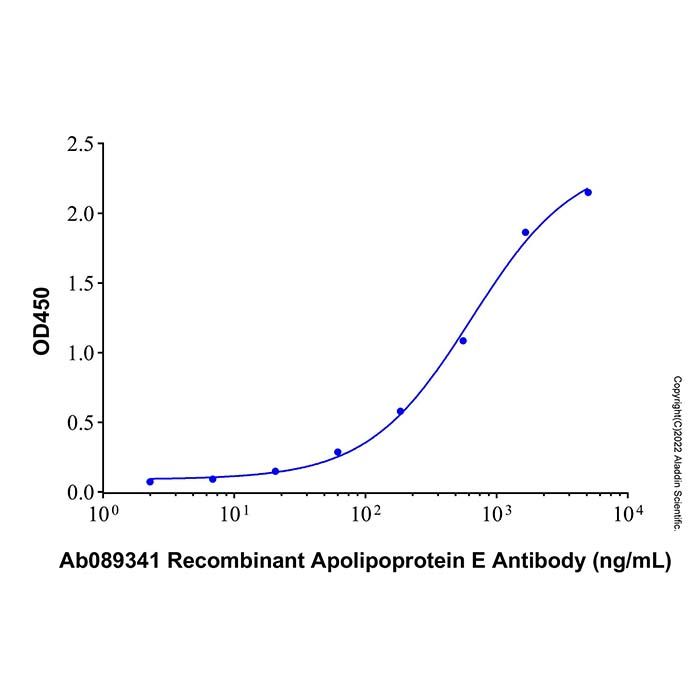
Immobilized Recombinant Human Apo-E Protein (rp214425) at 1.0 μg/mL can bind Recombinant Apolipoprotein E Antibody (Ab089341) with the EC50 of 645.4 ng/mL.
Apolipoprotein E (ApoE) is a 34.2 kDa glycosylated protein with 299 amino acid residues. There are three isoforms in human (apoE2, apoE3, and apoE4) due to different amino acid residues at positions 112 and 158. ApoE is synthesized predominantly in the liver, but also by cells in the spleen, brain, lung, kidney, ovary, adrenal, and muscle tissues. Hepatic parenchyma cells are the main apoE producing cells in mammalian body, probably accounting for two thirds to three fourths of the plasma apoE . In the nervous system, apoE mRNA is present in neurons, astrocytes, ependymal cells, nonmyelinating Schwann cells, but not in microglia, oligodendroglia, choroidal cells, or myelinating Schwann cells. ApoE produced by mammalian cells exists in different forms, monomers, dimers, modified, unmodified, lipid-rich, and lipid-poor, and so forth. ApoE plays a double-role in immune responses. Both apoE containing lipoproteins and multimers of synthetic apoE peptides inhibited proliferation of cultured lymphocytes by inhibiting DNA synthesis and reducing phospholipid turnover in T cells. ApoE can also affect innate and acquired immune responses in vitro by its ability to suppress stimulation of cultured neutrophils. ApoE can bind lipopolysaccharide (LPS), attenuate the inflammatory response, and thus reduce LPS induced lethality. Injection of LPS stimulated higher expression of inflammatory cytokines like interleukin (IL)-1β, IL-12, and interferon-γ (IFN-γ), as well as IL-6.
Post-translational: APOE exists as multiple glycosylated and sialylated glycoforms within cells and in plasma (PubMed:29516132). The extent of glycosylation and sialylation are tissue and context specific (PubMed:29516132). Plasma APOE undergoes desialylation and is less glycosylated and sialylated than the cellular form (PubMed:19838169, PubMed:20511397, PubMed:23234360, PubMed:2498325). Glycosylation is not required for proper expression and secretion (PubMed:2498325).
O-glycosylated with core 1 or possibly core 8 glycans. Thr-307 and Ser-314 are minor glycosylation sites compared to Ser-308 (PubMed:19838169, PubMed:23234360). Glycated in plasma VLDL of normal subjects, and of hyperglycemic diabetic patients at a higher level (2-3 fold). Phosphorylated by FAM20C in the extracellular medium. Undergoes C-terminal proteolytic processing in neurons. C-terminally truncated APOE has a tendency to form neurotoxic intracellular neurofibrillary tangle-like inclusions in neurons.
生物活性
Immobilized Recombinant Human Apo-E Protein (rp214425) at 1.0 μg/mL can bind Recombinant Apolipoprotein E Antibody (Ab089341) with the EC50 of 645.4 ng/mL.
29.9-34.8 kDa, under reducing conditions; 30.5-34.8 & 85.8 kDa, under non-reducing conditions.
分子类型
蛋白质
产品线
生物产品
储存与运输
物理形态
冻干(Lyophilized)
储存缓冲液
Lyophilized from PBS, 5% Trehalose, 5% Mannitol, pH 7.4.
浓度
见COA
复溶
We recommend that this vial be briefly centrifuged prior to opening to bring the contents to the bottom. Reconstitute at 0.5 mg/mL in sterile distilled water. Stock solutions should be apportioned into working aliquots and stored at ≤ -20 °C. Further dilutions should be made in appropriate buffered solutions.
储存条件
-20°C储存,避免反复冻融
运输条件
超低温运输
稳定性与储存
-20℃保存 12个月;复溶后建议分装,避免反复冻融。
图片
Recombinant Human Apolipoprotein E3 Protein (rp214425) - ELISA
Immobilized Recombinant Human Apolipoprotein E3 Protein (rp214425) at 1.0 μg/mL can bind Recombinant Apolipoprotein E Antibody (Ab089341) with the EC₅₀ of 645.4 ng/mL.
Recombinant Human Apolipoprotein E3 Protein (rp214425) - SDS-PAGE
3 μg/lane of Recombinant Human Apolipoprotein E3 Protein was resolved with SDS-PAGE under reducing (R) and non-reducing (N) conditions and visualized by Coomassie® Blue staining, showing the bands at 29.9-34.8 kDa under reducing conditions and 30.5-34.8 & 85.8 kDa under non-reducing conditions.
Apolipoprotein-E3 forms dimers in human frontal cortex and hippocampus. (PMID: 20170526).

 ZJ25F1029175


 危险品化学品经营许可证(带存储)