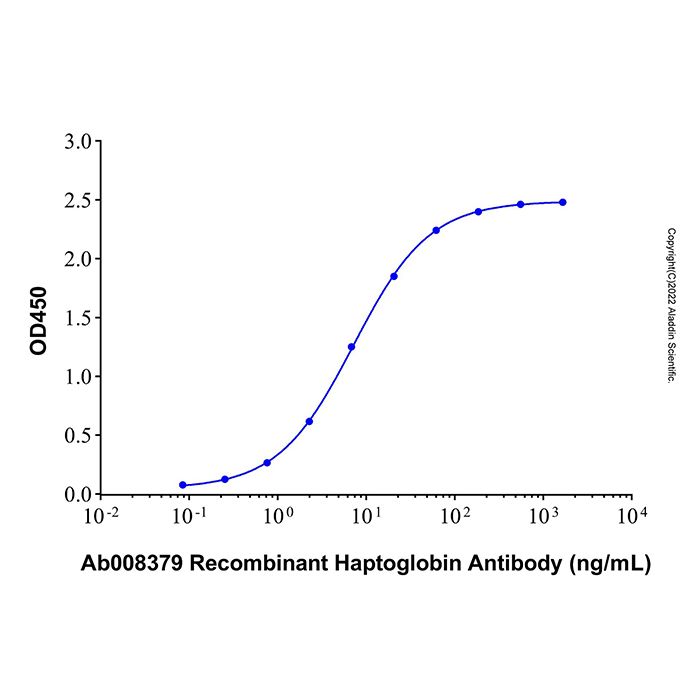
Immobilized Recombinant Human Haptoglobin Protein (rp214491) at 1.0 μg/mL can bind Recombinant Haptoglobin Antibody (Ab008379) with the EC50 of 7.2 ng/mL.
As a result of hemolysis, hemoglobin is found to accumulate in the kidney and is secreted in the urine. Haptoglobin captures, and combines with free plasma hemoglobin to allow hepatic recycling of heme iron and to prevent kidney damage. Haptoglobin also acts as an antioxidant, has antibacterial activity, and plays a role in modulating many aspects of the acute phase response. Hemoglobin/haptoglobin complexes are rapidly cleared by the macrophage CD163 scavenger receptor expressed on the surface of liver Kupfer cells through an endocytic lysosomal degradation pathway. The uncleaved form of allele alpha-2 (2-2), known as zonulin, plays a role in intestinal permeability, allowing intercellular tight junction disassembly, and controlling the equilibrium between tolerance and immunity to non-self antigens.
生物活性
Immobilized Recombinant Human Haptoglobin Protein (rp214491) at 1.0 μg/mL can bind Recombinant Haptoglobin Antibody (Ab008379) with the EC50 of 7.2 ng/mL.
18.0 & 42.5 & 58.1 kDa, under reducing conditions; 250.0 kDa, under non-reducing conditions.
分子类型
蛋白质
产品线
生物产品
储存与运输
物理形态
冻干(Lyophilized)
储存缓冲液
Lyophilized from PBS, pH 7.4.
浓度
见COA
复溶
We recommend that this vial be briefly centrifuged prior to opening to bring the contents to the bottom. Reconstitute at 1.0 mg/mL in sterile distilled water. Stock solutions should be apportioned into working aliquots and stored at ≤ -20 °C. Further dilutions should be made in appropriate buffered solutions.
储存条件
-20°C储存,避免反复冻融
运输条件
超低温运输
稳定性与储存
Store at -20℃ for 6 months. Upon reconstitution, it is recommended to aliquot. Avoid freeze/thaw cycle.
图片
Recombinant Human Haptoglobin Protein (rp214491) - ELISA Immobilized Recombinant Human Haptoglobin Protein (rp214491) at 1.0 μg/mL can bind Recombinant Haptoglobin Antibody (Ab008379) with the EC50 of 7.2 ng/mL.
Recombinant Human Haptoglobin Protein (rp214491) - SDS-PAGE 3 μg/lane of Recombinant Human Haptoglobin Protein was resolved with SDS-PAGE under reducing (R) and non-reducing (N) conditions and visualized by Coomassie® Blue staining, showing a band at 18.0 & 37.7-47.2 & 51.8-66.4 kDa under reducing conditions and 183.6-250.0 kDa under non-reducing conditions. Under reducing conditions, disulfide bonds are disrupted, potentially leading to more pronounced protein degradation and Disulfide bonds cause proteins to have a polermer form under non-reducing conditions (Uniprot ID: P00738).



 危险品化学品经营许可证(带存储)