ADCADN | AIM | CXXC finger protein 9 | CXXC-type zinc finger protein 9 | CXXC9 | DNA (cytosine 5 ) methyltransferase 1 | DNA (cytosine-5)-methyltransferase 1 | DNA methyltransferase 1 | DNA methyltransferase HsaI | DNA methyltransferase M.HsaI | DNA MTase
规格或纯度
无载体,His标签,≥85%(SDS-PAGE),见COA
生化机理
Methylates CpG residues. Preferentially methylates hemimethylated DNA. Associates with DNA replication sites in S phase maintaining the methylation pattern in the newly synthesized strand, that is essential for epigenetic inheritance. Associates with chromatin during G2 and M phases to maintain DNA methylation independently of replication. It is responsible for maintaining methylation patterns established in development. DNA methylation is coordinated with methylation of histones. Mediates transcriptional repression by direct binding to HDAC2. In association with DNMT3B and via the recruitment of CTCFL/BORIS, involved in activation of BAG1 gene expression by modulating dimethylation of promoter histone H3 at H3K4 and H3K9.
Post-translational: Sumoylated; sumoylation increases activity.Acetylation on multiple lysines, mainly by KAT2B/PCAF, regulates cell cycle G2/M transition. Deacetylation of Lys-1349 and Lys-1415 by SIRT1 increases methyltransferase activity.Phosphorylation of Ser-154 by CDKs is important for enzymatic activity and protein stability. Phosphorylation of Ser-143 by AKT1 prevents methylation by SETD7 thereby increasing DNMT1 stability.Methylation at Lys-142 by SETD7 is necessary for the regulation of DNMT1 proteasomal degradation.Ubiquitinated by UHRF1; interaction with USP7 counteracts ubiquitination by UHRF1 by promoting deubiquitination and preventing degradation by the proteasome.
Store at -20℃ long term (12 months). Upon receipt, it is recommended to aliquot. Avoid freeze/thaw cycle.
图片
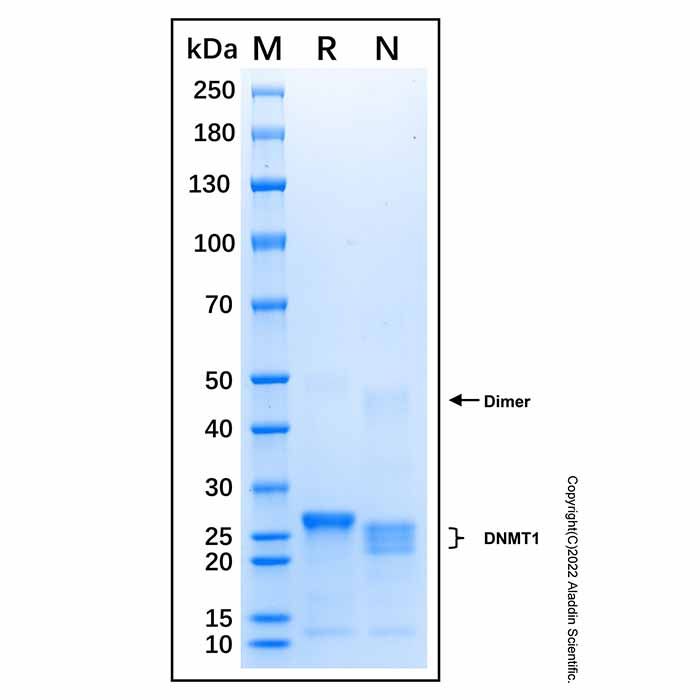
Recombinant Human DNMT1 Protein (rp217144) - SDS-PAGE 3 μg/lane of Recombinant Human DNMT1 Protein was resolved with SDS-PAGE under reducing (R) and non-reducing (N) conditions and visualized by Coomassie® Blue staining, showing a band at 26.8 kDa under reducing conditions and 22.6 & 25.1 & 26.2 & 47.0 kDa under non-reducing conditions. DNMT1 dimer formation could facilitate the discrimination of hemi-methylated target sites as has been found for other palindromic DNA sequence recognizing enzymes(PMID: 19173286). The catalytic activity of DNMT1 relies on its conformational plasticity and ability to change conformation from an auto-inhibited to an activated state(PMID: 39226277).

 ZJ25F0826325


 危险品化学品经营许可证(带存储)