Mammary gland factor | MGF | Signal transducer and activator of transcription 5A | STA5A_HUMAN | STAT 5 | STAT 5A | STAT5 | STAT5A
规格或纯度
无载体,His标签,≥90%(SDS-PAGE),见COA
生化机理
Signal transducers and activators of transcription 5 (STAT5) has been shown to be involved in a variety of cellular processes, including survival, proliferation, invasion, angiogenesis and immune evasion and is frequently overexpressed in human solid tumors and blood malignancies. STAT5a/b species are well known as transcription factors that regulate nuclear gene expression. Using enucleated cytoplasts for a nongenomic mechanism(s) underlying the cystic change in ER structure elicited by STAT5a/b knockdown.
Post-translational: Tyrosine phosphorylated in response to KITLG/SCF, IL2, IL3, IL7, IL15, CSF2/GMCSF, GH1, PRL, EPO and THPO (By similarity). Activated KIT promotes phosphorylation on tyrosine residues and subsequent translocation to the nucleus (PubMed:21135090). Tyrosine phosphorylated in response to constitutively activated FGFR1, FGFR2, FGFR3 and FGFR4 (By similarity). Tyrosine phosphorylation is required for DNA-binding activity and dimerization. Serine phosphorylation is also required for maximal transcriptional activity (By similarity). Tyrosine phosphorylated in response to signaling via activated FLT3; wild-type FLT3 results in much weaker phosphorylation than constitutively activated mutant FLT3 (PubMed:14504097). Alternatively, can be phosphorylated by JAK2 at Tyr-694 (PubMed:12529425). ISGylated.
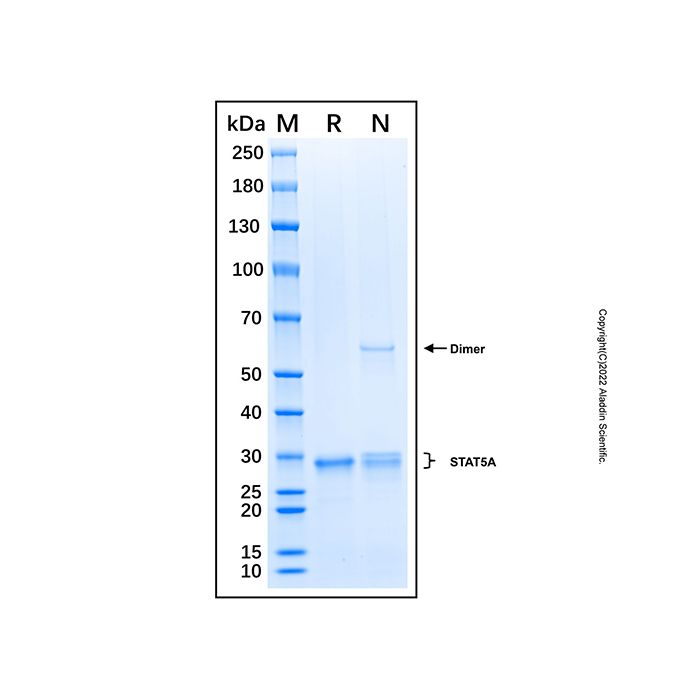
Recombinant Human STAT5A Protein (rp217608) - SDS-PAGE 3 μg/lane of Recombinant Human STAT5A Protein was resolved with SDS-PAGE under reducing (R) and non-reducing (N) conditions and visualized by Coomassie® Blue staining, showing a band at 29.1 kDa under reducing conditions and 29.1 & 30.5 & 58.4 kDa under non-reducing conditions. The STAT5A protein can form homodimers (Uniprot: P42229).

 ZJ25F0623073


 危险品化学品经营许可证(带存储)