级别和纯度: 无载体?无载体(Carrier Free)—— 不含添加的载体蛋白/稳定剂。当载体(如 BSA)会干扰偶联或敏感检测时使用。His标签?组氨酸(His) 标签级 —— 带有 His 标签的重组蛋白,供亲和纯化/检测。用于纯化、固定或检测带标签蛋白。≥90%(SDS-PAGE)expressed in E. coli; 见COA
BHLHD1 | SREBP1 | SREBF1 | Sterol regulatory element-binding protein 1 | SREBP-1 | Class D basic helix-loop-helix protein 1 | Sterol regulatory element-binding transcription factor 1 | bHLHd1
规格或纯度
无载体,His标签,≥90%(SDS-PAGE),expressed in E. coli; 见COA
生化机理
Podoplanin, also known as glycoprotein 36 (gp36), PA2.26 antigen, T1-alpha (T1A), and aggrus, is a 36 kDa type I transmembrane sialoglycoprotein and member of the Podoplanin family. Podoplanin has three potential splice variants, the longest of which is represented by a 238 amino acid (aa) precursor (NP_006465). It contains an undefined signal sequence, a 22 aa transmembrane segment (aa 207-228) and a short cytoplasmic tail (aa 229-238). The ECD contains abundant Ser/Thr residues that could serve as potential O-linked glycosolation sites. The cytoplasmic tail contains putative sites for protein kinase C phosphorylation. There are two potential alternate start sites at Met 77 (Swiss Prot #: Q86YL7) and Met 119 (EAW51692) that generate short forms. The 162 aa short form Podoplanin precursor shares 47% aa identity with mouse Podoplanin. Podoplanin is expressed on glomerular epithelial cells (podocytes), type I lung alveolar cells, lymphatic endothelial cells, and numerous tumors, including colorectal tumors, squamous cell carcinomas, testicular seminoma, and brain tumors. One study shows high expression of Podoplanin mRNA in placenta, lung, skeletal muscle, and heart, and weaker levels in brain, kidney, and liver. Podoplanin is the ligand for C-type lectin-like receptor 2 (CLEC-2). Their association is dependent on sialic acid on O-glycans of Podoplanin. Through its association with CLEC-2, Podoplanin induces platelet aggregation and tumor metastasis. Podoplanin is also necessary for lymphatic vessel formation, normal lung cell proliferation and alveolus formation at birth.
Post-translational: Sterol regulatory element-binding protein 1. Processed in the Golgi apparatus, releasing the protein from the membrane (PubMed:32322062, PubMed:8626610).
At low cholesterol the SCAP-SREBP complex is recruited into COPII vesicles for export from the endoplasmic reticulum (PubMed:32322062, PubMed:8626610).
In the Golgi, complex SREBPs are cleaved sequentially by site-1 (MBTPS1, S1P) and site-2 (MBTPS2, S2P) protease (PubMed:32322062, PubMed:8626610).
The first cleavage by site-1 protease occurs within the luminal loop, the second cleavage by site-2 protease occurs within the first transmembrane domain, releasing the transcription factor from the Golgi membrane (PubMed:32322062).
Phosphorylated by AMPK, leading to suppress protein processing and nuclear translocation, and repress target gene expression (By similarity).
Phosphorylation at Ser-402 by SIK1 represses activity possibly by inhibiting DNA-binding (By similarity).
Sterol regulatory element-binding protein 1
SCAP-free SREBF1 is ubiquitinated by the BCR(ARMC5) complex, leading to its degradation.
Processed sterol regulatory element-binding protein 1
Ubiquitinated; the nuclear form has a rapid turnover and is rapidly ubiquitinated and degraded by the proteasome in the nucleu.
We recommend that this vial be briefly centrifuged prior to opening to bring the contents to the bottom. Reconstitute at 1.0 mg/mL in sterile distilled water. Stock solutions should be apportioned into working aliquots and stored at ≤ -20 °C. Further dilutions should be made in appropriate buffered solutions.
储存条件
-20°C储存,避免反复冻融
运输条件
超低温运输
稳定性与储存
-20℃保存 12个月;复溶后建议分装,避免反复冻融。
图片
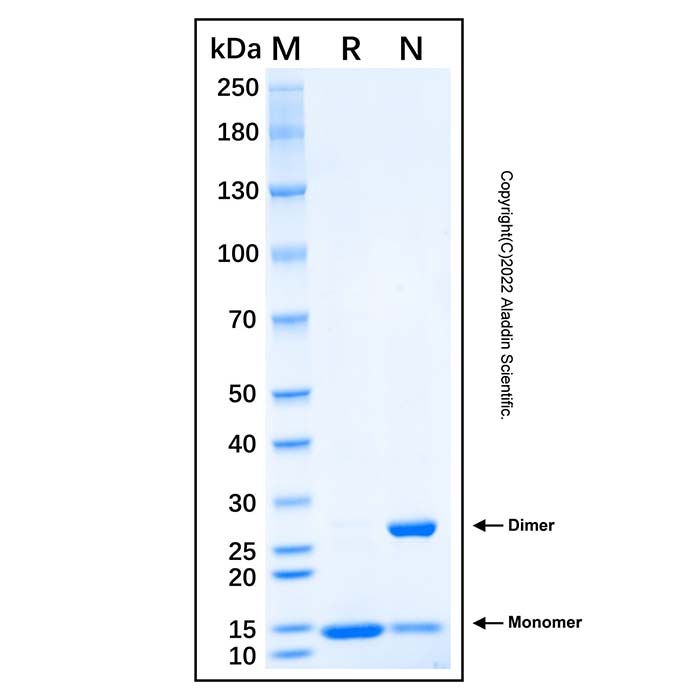
Recombinant Human SREBP1 Protein (rp225008) - SDS-PAGE
3 μg/lane of Recombinant Human SREBP1 Protein was resolved with SDS-PAGE under reducing (R) and non-reducing (N) conditions and visualized by Coomassie® Blue staining, showing the bands at 14.2 & 27.5 kDa.
The reason for the formation of dimerization of SREBP1 is related to its structural and functional regulation (PMID: 38560498).

 ZJ26F0433912


 危险品化学品经营许可证(带存储)