Interleukin-6 (IL-6) is a pleiotropic, alpha-helical, 22-28 kDa phosphorylated and variably glycosylated cytokine that plays important roles in the acute phase reaction, inflammation, hematopoiesis, bone metabolism, and cancer progression. Mature human IL-6 is 183 amino acids (aa) in length and shares 39% aa sequence identity with mouse and rat IL-6. Alternative splicing generates several isoforms with internal deletions, some of which exhibit antagonistic properties. IL-6 induces signaling through a cell surface heterodimeric receptor complex composed of a ligand-binding subunit (IL-6 R alpha) and a signal-transducing subunit (gp130). IL-6 binds to IL-6 R alpha, triggering IL-6 R alpha association with gp130 and gp130 dimerization. Gp130 is also a component of the receptors for CLC, CNTF, CT-1, IL-11, IL-27, LIF, and OSM. Soluble forms of IL-6 R alpha are generated by both alternative splicing and proteolytic cleavage. In a mechanism known as trans-signaling, complexes of soluble IL-6 and IL-6 R alpha elicit responses from gp130-expressing cells that lack cell surface IL-6 R alpha. Trans-signaling enables a wider range of cell types to respond to IL-6, as the expression of gp130 is ubiquitous, while that of IL-6 R alpha is predominantly restricted to hepatocytes, monocytes, and resting lymphocytes. Soluble splice forms of gp130 block trans-signaling from IL-6/IL-6 R alpha but not from other cytokines that use gp130 as a co-receptor. IL-6, along with TNF-alpha and IL-1, drives the acute inflammatory response and the transition from acute inflammation to either acquired immunity or chronic inflammatory disease. When dysregulated, it contributes to chronic inflammation in obesity, insulin resistance, inflammatory bowel disease, arthritis, sepsis, and atherosclerosis. IL-6 can also function as an anti-inflammatory molecule, as in skeletal muscle where it is secreted in response to exercise. In addition, it enhances hematopoietic stem cell proliferation and the differentiation of Th17 cells, memory B cells, and plasma cells.
Post-translational: N- and O-glycosylated.
生物活性
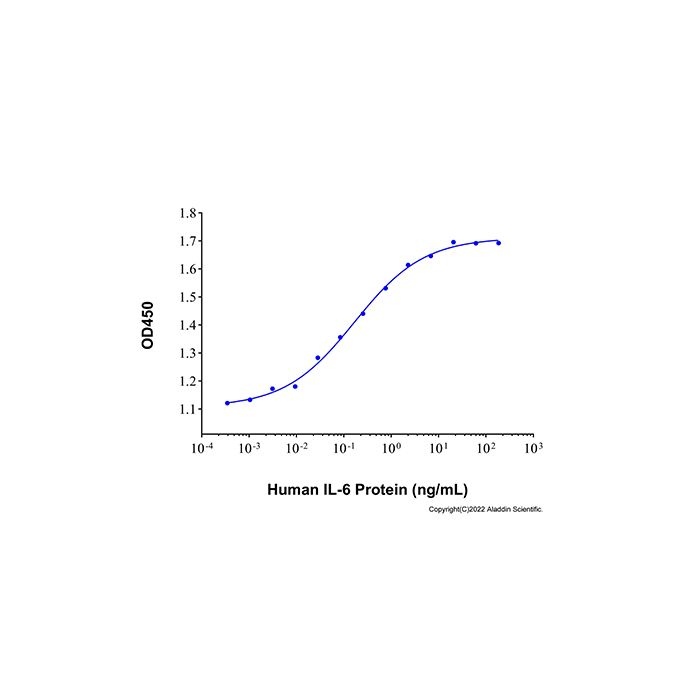
Measured in a cell proliferation assay using TF‑1 human erythroleukemic cells. The ED50 for this effect is 0.17 ng/mL.
23.5 kDa, under reducing conditions; 22.7 & 50.0 kDa, under non-reducing conditions.
分子类型
蛋白质
产品线
生物产品
储存与运输
物理形态
冻干(Lyophilized)
储存缓冲液
Lyophilized from PBS, pH7.4
浓度
见COA
复溶
We recommend that this vial be briefly centrifuged prior to opening to bring the contents to the bottom. Reconstitute at 0.5 mg/mL in sterile distilled water. Stock solutions should be apportioned into working aliquots and stored at ≤ -20 °C. Further dilutions should be made in appropriate buffered solutions.
储存条件
-20°C储存,避免反复冻融
运输条件
超低温运输
稳定性与储存
-20℃保存 12个月;复溶后建议分装,避免反复冻融。
图片
Recombinant Human IL-6 Protein (rp302374) - Protein Bioactivity
Measured in a cell proliferation assay using TF‑1 human erythroleukemic cells. The ED₅₀ for this effect is 0.17 ng/mL.
Recombinant Human IL-6 Protein (rp302374) - SDS-PAGE
3 μg/lane of Recombinant Human IL-6 Protein was resolved with SDS-PAGE under reducing (R) and non-reducing (N) conditions and visualized by Coomassie® Blue staining, showing a band at 23.5 kDa under reducing conditions and 22.7 & 50.0 kDa under non-reducing conditions.
There are multiple pairs of disulfide bonds in the protein sequence. Disulfide bonds cause the protein to present as a polymer in a non-reducing conditions (Uniprot ID: P05231).

 ZJ25F1129512


 危险品化学品经营许可证(带存储)