储存缓冲液:0.01M sodium phosphate and 0.02% ProClin 300; pH 7.2
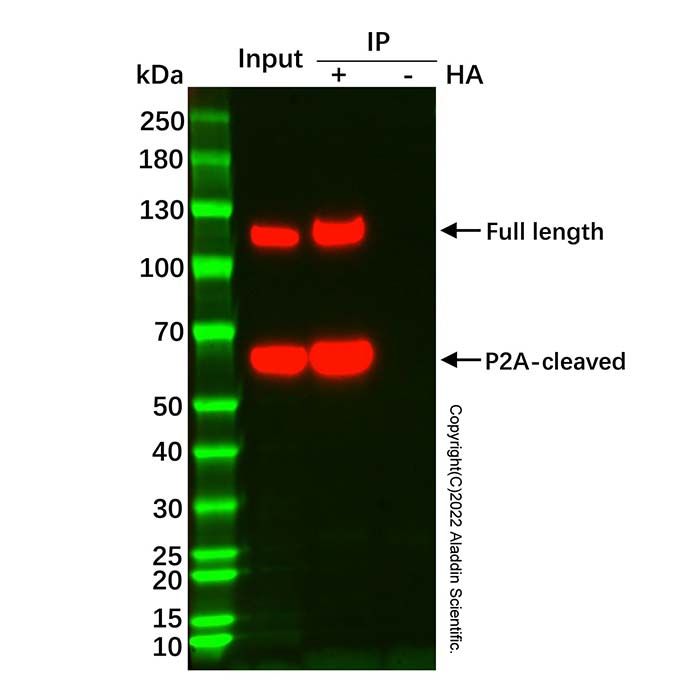
本制品是由高质量的HA小鼠单克隆抗体与微米级羧基磁珠共价偶联而成,本产品具有快速的磁响应性,超顺磁性、良好的分散性、粒径均一、极低的非特异结合和丰富的结合位点等特点,可用于带有HA标签的蛋白免疫沉淀(IP)、免疫共沉淀(Co-IP)或纯化。
| 项目 | 技术参数 | | 微球基质 | 高聚物磁性微球 | | 配体 | HA tag 单克隆抗体 | | 亚型 | Mouse IgG2b | | 粒径 | 1 μm | | 磁珠浓度 | 10 mg/mL | | 储存缓冲液 | 0.01M sodium phosphate (pH 7.2) and 0.02% ProClin 300 |
|
产品特点:
1.非特异吸附低:与国内外大多数的同类产品相比,本制品磁珠粒径小,不易产生非特异吸附。本制品每毫升磁珠悬浊液含约10mg磁珠,含有不少于0.5mg Anti-HA抗体,该磁珠基本不会识别任何抗原。使用量参考正常抗体免疫磁珠的用量。
2.使用便捷:本制品储存在特殊保护液中,不含甘油,可以通过磁性吸附实现快速高效的分离,无需离心操作
使用说明:
1. 样品的制备
a. 选择合适的裂解液,用于制备细胞或组织的裂解液。需要确保裂解液的pH为6-8。
b. 具体的细胞或组织样品裂解的制备步骤请参考裂解液的使用说明。制备好的裂解液上清宜置于冰上或4ºC存放,随后即可用于免疫沉淀或免疫共沉淀、标签蛋白的纯化等操作。新制备的样品,建议尽量当天完成免疫沉淀等后续操作,如样品不能当天使用,也可适当分装后-80ºC冻存。
2. Anti-HA磁珠的准备
由于Anti-HA磁珠储存在特殊保护液中,所以需要在加入样品前适当洗涤。
a. 用移液器轻轻吹打重悬Anti-HA磁珠,按照每500μl样品10μl或20μl磁珠悬浊液,取适量Anti-HA磁珠至一洁净离心管中,加入1×TBS至最终体积为约0.5ml。
b. 用移液器轻轻吹打重悬Anti-HA磁珠。磁分离,去除上清。重复上述步骤两次。
c. 按照初始体积的量,用1×TBS重悬Anti-HA磁珠。
3. 免疫沉淀(Immunoprecipitation, IP)
a. 加入磁珠与孵育。按照每500μl蛋白样品加入10μl或20μl磁珠悬浊液的比例加入Anti-HA磁珠,置于侧摆摇床或旋转混合仪上,室温孵育2小时或4ºC孵育过夜。注:孵育过程中,如果磁珠发生聚团或呈片状属正常现象,不会影响实验结果。
b. 磁分离。孵育完毕后,磁分离,去除上清。注:可保留部分上清液,用于检测免疫沉淀的效果。
c. 洗涤。加入500μl的1×TBS,用移液器轻轻吹打重悬Anti-HA磁珠。磁分离,去除上清。重复洗涤三次。注:也可通过检测洗涤上清液的OD280来判断是否洗涤完全,若OD280>0.05,应适当增加洗涤次数。
4. 洗脱
操作者可根据后期检测的需要选择不同的洗脱方法。变性洗脱适用于 Western blot 分析。非变性洗脱被中和后,适用于酶法或功能测定。
a. 变 性 洗 脱:
此方法洗脱的样品适用于SDS-PAGE检测。向洗涤后样品中加入20 µL 1×SDS-PAGE 上样缓冲液(可用5×上样缓冲液进行稀释)混合均匀,100℃加热10 min。待冷却后,置于磁力架上分离1min。收集上清,进行SDS-PAGE检测。
b. 非变性洗脱:
此方法洗脱的样品保持原有的生物活性,可用于后期功能分析。向洗涤后样品中加入50 µL 洗脱缓冲液 ,混匀后置于旋转混合仪上,室温孵育5分钟,孵育完毕后,置于磁力架上分离1min,将上清转移到新的离心管中,并立刻加入5μL Neutralization Buffer ,适当混匀,将洗脱产物pH调节至中性,用于后期功能分析。
注:
a.为了获得最大的洗脱效率,可重复该洗脱步骤若干次,并将相同样品合并。
b.洗脱并中和的蛋白及其复合物置于4ºC待用或者-20ºC或-80ºC长期保存。
c.酸性洗脱法虽然高效,但仍可能低于变性洗脱法。
d.由于目的蛋白的差异可能对酸性洗脱法的洗脱效率有一定的影响,如果对洗脱效率的要求比较高,可对洗脱液的pH进行一定的调整,相应的中和液的pH值或量也要进行一定的调整,具体需要自行优化相关实验条件。也可以考虑采用效率可能更高的多肽竞争洗脱法或效率预期最高的变性洗脱法,后者的缺点是在变性条件下进行洗脱,可能会对后续对于蛋白活性有要求的实验产生影响。
注意事项:
1..本产品需维持pH为6-8,避免高速离心和干燥;请勿长时间置磁珠于磁场中,否则可能会引起磁珠聚团。
2.本产品使用前要适当充分重悬,混匀操作须轻柔,不宜剧烈涡旋震荡等,避免抗体变性等。
3.在免疫沉淀或纯化时,建议设置阳性和阴性对照组。
4.蛋白样品收集后宜尽快完成纯化工作,并应始终放置在4ºC或冰浴,以减缓蛋白降解或变性。为有效抑制蛋白降解,可以在蛋白样品中添加适量的蛋白酶抑制剂混合物。
5.如果使用真空泵等仪器吸取上清液,须注意真空泵的吸液强度,以免吸力过大而吸取到聚集的磁珠。
6.酸性溶液洗脱时磁珠可能会发生聚集,属于正常现象,不影响磁珠的正常使用。0.1%的非离子型去垢剂(如Triton X-100、Tween-20或NP-40)可有效防止磁珠聚集,并且不会影响磁珠的抗体结合效率。
7.高浓度的DTT、巯基乙醇、盐酸胍等对本产品与标签蛋白的结合可能有一定影响,但Western及IP细胞裂解液、RIPA裂解液或NP-40裂解液等都完全适用。
8.本产品仅限于专业人员科研使用。 为了您的安全和健康,请穿实验服并戴一次性手套操作。
This product is prepared by covalently coupling high-quality mouse monoclonal Antibody against HA to micron-sized carboxyl magnetic beads. It features rapid magnetic responsiveness, superparamagnetism, good dispersibility, uniform particle size, extremely low non-specific binding, and abundant binding sites. It can be used for immunoprecipitation (IP), co-immunoprecipitation (Co-IP), or purification of Flag-tagged proteins.
| Parameter | Specification | | Bead Matrix | Polymer magnetic beads | | Ligand | HA tag Mouse mAb | | Isotype | Mouse IgG2b | | Particle Size | 1 μm | | Bead Concentration | 10 mg/mL | | Storage Buffer | 0.01M sodium phosphate (pH 7.2) and 0.02% ProClin 300 |
|
Product Features:
1.Low non-specific adsorption: Compared with most similar products domestically and abroad, the magnetic beads in this product are smaller in particle size and less prone to non-specific adsorption. Each milliliter of the magnetic bead suspension contains approximately 10 mg of magnetic beads and no less than 0.5 mg of Anti-HA Antibodies. These magnetic beads essentially do not recognize any Antigens. The recommended usage volume follows that of normal Antibody-conjugated magnetic beads.
2.Convenient to use: This product is stored in a special protective solution, free of glycerol, and enables rapid and efficient separation through magnetic adsorption without the need for centrifugation.
Instructions for Use
1.Sample Preparation
a. Select an appropriate lysis buffer for preparing cell or tissue lysates. Ensure that the pH of the lysis buffer is between 6 and 8.
b. For specific steps on preparing cell or tissue lysates, refer to the instructions provided with the lysis buffer. The supernatant of the prepared lysate should be stored on ice or at 4ºC and can then be used for operations such as immunoprecipitation (IP), co-immunoprecipitation (Co-IP), or purification of tagged proteins. For newly prepared samples, it is recommended to complete subsequent operations such as IP on the same day if possible. If the samples cannot be used on the same day, they can be appropriately aliquoted and stored at -80ºC.
2.Preparation of Anti-HA Magnetic Beads
Since Anti-HA magnetic beads are stored in a special protective solution, they need to be appropriately washed before being added to the sample.
a. Gently resuspend the Anti-HA magnetic beads by pipetting. According to the ratio of 10 μl or 20 μl of magnetic bead suspension per 500 μl of sample, transfer an appropriate amount of Anti-HA magnetic beads to a clean centrifuge tube and add 1×TBS to a final volume of approximately 0.5 ml.
b. Gently resuspend the Anti-HA magnetic beads by pipetting. Perform magnetic separation and remove the supernatant. Repeat this step twice.
c. Resuspend the Anti-HA magnetic beads in 1×TBS to the original volume.
3.Immunoprecipitation (IP)
a. Add magnetic beads and incubate. Add Anti-HA magnetic beads at a ratio of 10 μl or 20 μl of magnetic bead suspension per 500 μl of protein sample. Place on a rocking platform or rotary mixer and incubate at room temperature for 2 hours or at 4ºC overnight. Note: During incubation, if the magnetic beads aggregate or form a sheet, it is normal and will not affect the experimental results.
b. Magnetic separation. After incubation, perform magnetic separation and remove the supernatant. Note: A portion of the supernatant can be retained for detecting the efficiency of immunoprecipitation.
c. Washing. Add 500 μl of 1×TBS and gently resuspend the Anti-HA magnetic beads by pipetting. Perform magnetic separation and remove the supernatant. Repeat the washing step three times. Note: The completeness of washing can also be judged by detecting the OD280 of the washing supernatant. If OD280 > 0.05, the number of washes should be appropriately increased.
4.Elution
This kit provides two elution protocols. The operator can choose the appropriate method based on downstream application requirements. Denaturing elution is suitable for Western blot analysis, while non-denaturing elution—after neutralization—is applicable for enzymatic assays or functional studies.
a. Denaturing Elution:
Samples eluted using this method are suitable for SDS-PAGE analysis. Add 20 µL of 1×SDS-PAGE loading buffer (prepared by diluting 5×loading buffer, if applicable) to the washed sample after. Mix thoroughly and heat at 100°C for 10 minutes. After cooling, place the tube on a magnetic rack for 1 minute. Collect the supernatant for SDS-PAGE analysis.
b. Non-denaturing Elution:
This method preserves the native biological activity of the eluted samples for subsequent functional analysis. Add 50 µL of elution buffer to the washed sample after. Mix and incubate on a rotator at room temperature for 5 minutes. After incubation, place the tube on a magnetic rack for 1 minute. Transfer the supernatant to a new microcentrifuge tube and immediately add 5 µL of neutralization buffer. Mix well to adjust the pH of the eluate to neutral for subsequent functional analysis.
Notes:
a. To maximize elution efficiency, repeat the elution step and pool the eluates.
b. Eluted and neutralized proteins/complexes can be stored at 4°C for immediate use or at -20°C/-80°C for long-term storage.
c. Although acidic elution is efficient, it may be less effective than denaturing elution.
d. Elution efficiency of the acidic method may vary depending on the target protein. If high elution efficiency is critical, optimize the pH of the elution buffer (with corresponding adjustments to the neutralization buffer). Alternatively, consider using potentially more efficient methods such as peptide competition elution or the highly efficient denaturing elution. Note that denaturing conditions may impact subsequent experiments requiring protein activity.
Precautions:
1.This product should be maintained at a pH of 6-8, and high-speed centrifugation and drying should be avoided. Do not leave the magnetic beads in a magnetic field for an extended period, as this may cause them to aggregate.
2.Prior to using this product, it should be adequately and gently resuspended. Mixing operations should be gentle and not involve vigorous vortexing or shaking to prevent Antibody denaturation.
3.It is recommended to set up positive and negative control groups during immunoprecipitation or purification procedures.
4.After collecting protein samples, it is advisable to complete the purification process as soon as possible and keep them at 4ºC or on ice at all times to slow down protein degradation or denaturation. To effectively inhibit protein degradation, an appropriate amount of protease inhibitor cocktail can be added to the protein samples.
5.When using instruments such as a vacuum pump to aspirate the supernatant, pay attention to the suction strength of the vacuum pump to avoid aspirating aggregated magnetic beads due to excessive suction.
6.Aggregation of magnetic beads may occur during elution with acidic solutions, which is a normal phenomenon and does not affect their normal use. A 0.1% non-ionic detergent (such as Triton X-100, Tween-20, or NP-40) can effectively prevent magnetic bead aggregation without affecting their Antibody-binding efficiency.
7.High concentrations of DTT, mercaptoethanol, guanidine hydrochloride, etc., may have certain effects on the binding of this product to tagged proteins. However, Western and IP cell lysis buffers, RIPA lysis buffer, or NP-40 lysis buffer are all fully suitable.
8.This product is intended solely for research use by professionals. For your safety and health, please wear a lab coat and disposable gloves during operation

 ZJ26F0535541


 危险品化学品经营许可证(带存储)