瑞氏色素 (Eosin Methylene blue according to Wright) 是酸性染料伊红 (Eosin) 和碱性染料亚甲蓝(Methylene Blue) 组成的复合染料,是浅绿色粉末,复合中性染色剂,对原生质的染色有区别,嗜中性、嗜碱性和嗜酸性部分的作用,主要用于显微镜涂片用染色剂,如血、骨髓的染色、血液中寄生虫染色(原虫、利什曼原虫、血丝虫等)。
细胞的染色既有物理的吸附作用,又有化学的亲和作用,各种细胞成分化学性质不同,对各种染料的亲和力也不一样。因此,用本染料液染色后,在同一血片上,可以看到各种不同的色彩,例如血红蛋白,嗜酸性颗粒为碱性蛋白质,与酸性染料伊红结果,染粉红色,称为嗜酸性物质;细胞核蛋白和淋巴细胞胞浆为酸性,与碱性染料美蓝或天青结合,染紫蓝色,称为嗜碱性物质;中性颗粒呈等电状态与伊红和美蓝均可结合,染淡紫色,称为中性物质。
pH对细胞染色有影响。细胞各种成分均不蛋白质,由于蛋白质系两性电解质,所带电荷随溶液pH而定,在偏酸性环境中下在电荷增多,易与伊红结合,染色偏红;在偏三性环境中负电荷增多,易与美蓝或天青结合,染色偏蓝。因此细胞染色对氢离子浓度十分敏感,染色用正经片必须清洁,无酸碱污染。配制顼特液必须用优质甲醇,稀释染色必须用缓冲液,冲洗用水应近中性,否则可导致各种细胞染色反应异常,以致识别困难,甚至造成错误。
Wright Stain Solution (ready-to-use)以进口瑞氏色素为主要原料,通过研磨配制而成,能呈现出清晰的细胞染色效果。该染液可以直接使用,无需任何配制过程,染液中加微量中性甘油,防止甲醇挥发或氧化,同时也可使血细胞染色较清晰。本产品仅适用于科研实验,不可做他用。
自备材料:
1、载玻片
2、蒸馏水
3、染色架
4、显微镜
操作步骤(仅供参考):
1、常规方法制备血液涂片或骨髓涂片或细菌涂片,待涂片自然干燥。
2、将血液涂片或骨髓涂片置于染色架上。
3、滴加 Wright Stain 覆盖涂片,室温染色,轻轻晃动玻片或采用其他方式混合,室温静置。
4、用自来水或蒸馏水从玻片一端轻轻冲洗。
5、干燥。
6、镜检:先用低倍镜观察血涂片,再用油镜。
染色结果:
细菌、细胞核
| 蓝色
|
嗜酸性颗粒
| 粉红或橘红色
|
淋巴细胞、嗜碱性粒细胞胞质
| 紫蓝色或蓝色
|
完全成熟红细胞
| 粉红色 |
注意事项:
1、血液涂片或骨髓涂片应厚薄均匀,以免影响染色效果。
2、涂片染色中,请勿先去除染液或直接对涂片用力冲洗。不能先倒掉染液,以免染料沉着于涂片上。
3、染色液可重复使用,但不能多次重复,若有沉淀物应过滤后使用。
4、染色过深可用甲醇或酒精适当脱色,最好不复染。
5、如果染色过深或过浅,应调整染色时间或工作液浓度。
6、pH值对染色有一定影响,载玻片应清洁、无酸碱污染,以免影响染色效果。
7、为了您的安全和健康,请穿实验服并戴一次性手套操作。
Eosin Methylene blue according to Wright is a composite dye consisting of the acidic dye eosin and the basic dye methylene blue. It appears as a pale green powder and acts as a neutral stain, capable of differentially staining components of the protoplasm. It exerts specific staining effects on neutrophilic, basophilic, and eosinophilic cellular parts, and is primarily used as a microscopic staining agent for smears, such as staining of blood, bone marrow, and blood-borne parasites (including protozoa, Leishmania, filarial worms, etc.).
Cell staining involves both physical adsorption and chemical affinity. Different cellular components possess distinct chemical properties, resulting in varying affinities for different dyes. Thus, after staining with this dye solution, a variety of colors can be observed on the same blood smear. For instance, hemoglobin and eosinophilic granules are alkaline proteins; they react with the acidic dye eosin to stain pink and are therefore referred to as eosinophilic substances. Nuclear proteins and the cytoplasm of lymphocytes are acidic; they bind to the basic dyes methylene blue or azure to stain purple-blue and are thus called basophilic substances. Neutrophilic granules are in an isoelectric state, enabling them to bind to both eosin and methylene blue, resulting in a pale purple stain, and they are known as neutrophilic substances.
The pH of the staining environment has a significant impact on cell staining. All cellular components are proteins, which are amphoteric electrolytes. The net charge carried by proteins is determined by the pH of the solution. In an acidic environment, proteins carry more positive charges, making them prone to binding with eosin and leading to a reddish stain. In an alkaline environment, proteins carry more negative charges, facilitating binding with methylene blue or azure and resulting in a bluish stain. Therefore, cell staining is highly sensitive to hydrogen ion concentration. Slides used for staining must be clean and free from acid-base contamination. High-quality methanol must be used for preparing Wright's stain solution. Buffered solutions should be employed for diluting the stain, and the washing water should be nearly neutral. Failure to adhere to these requirements can cause abnormal staining reactions of various cells, leading to difficulties in identification and even diagnostic errors.
Wright Stain Solution (ready-to-use) is formulated by grinding high-quality imported Wright's stain as the primary raw material, delivering clear and distinct cell staining results. This stain solution is ready for direct use without any prior preparation. A trace amount of neutral glycerol is added to the solution to prevent methanol from volatilizing or oxidizing, while also enhancing the clarity of blood cell staining. This product is intended for research use only and not for any other purposes.
Materials to Be Prepared by User:
1. Glass slides
2. Distilled water
3. Staining racks
4. Microscopes
Operating Procedures (For Reference Only):
1. Prepare blood smears, bone marrow smears or bacterial smears using standard protocols, and allow the smears to air dry naturally.
2. Place the prepared smears onto the staining racks.
3. Add drops of Wright Stain to completely cover the smear surface. Stain at room temperature, gently agitate the slide or mix using other appropriate methods, then let it stand undisturbed at room temperature.
4. Rinse one end of the slide gently with tap water or distilled water.
5. Allow the slide to dry.
6. Microscopic Examination: First examine the smear under the low-power objective lens, then switch to the oil immersion objective lens for detailed observation.
Staining Results:
Bacteria, cell nuclei
| Blue
|
Eosinophilic granules
| Pink or orange-red
|
Cytoplasm of lymphocytes and basophils
| Purple-blue or blue
|
Fully mature red blood cells
| Pink |
Precautions:
1. Blood smears or bone marrow smears should be of uniform thickness to avoid affecting the staining results.
2. During smear staining, do not remove the stain first or rinse the smear vigorously directly. Never pour off the stain prematurely, as this may cause dye precipitation on the smear.
3. The staining solution can be reused but not for excessive times. If sediment appears, filter the solution before use.
4. For over-stained smears, appropriate destaining can be performed with methanol or ethanol, and restaining is not recommended if possible.
5. If the staining is too dark or too light, adjust the staining duration or the concentration of the working solution accordingly.
6. pH has a certain impact on staining. Glass slides must be clean and free from acid-base contamination to prevent adverse effects on the staining results.
7. For your safety and health, wear a lab coat and disposable gloves during the operation.


 ZJ26F0332394

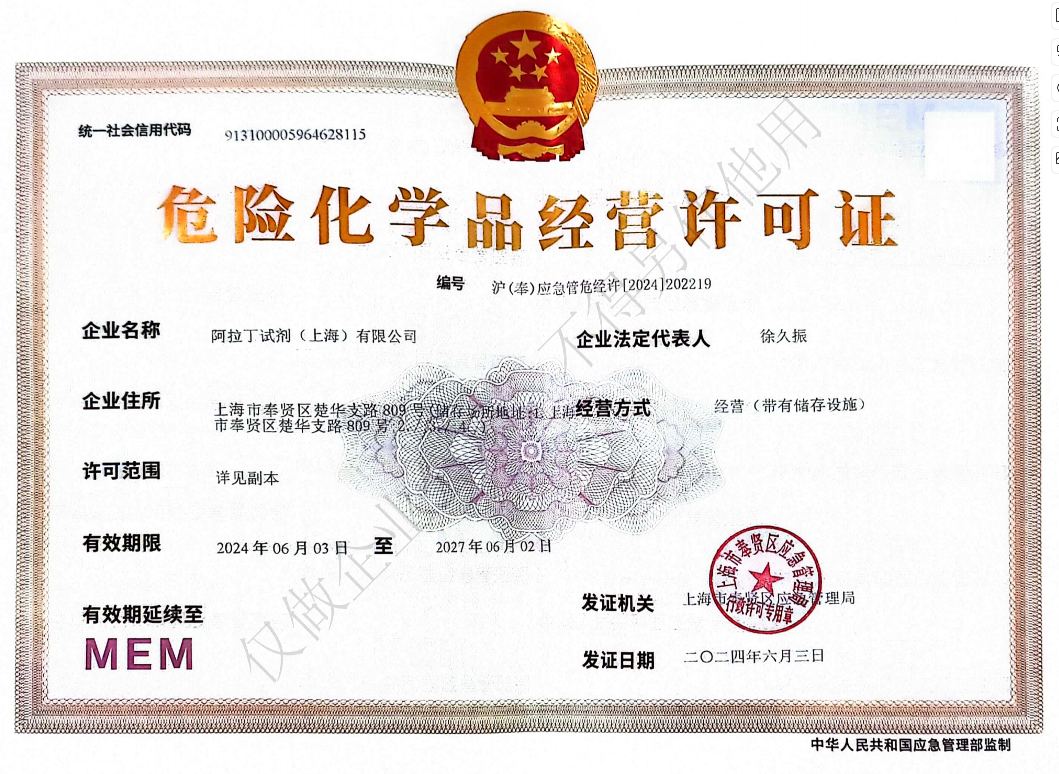 危险品化学品经营许可证(带存储)