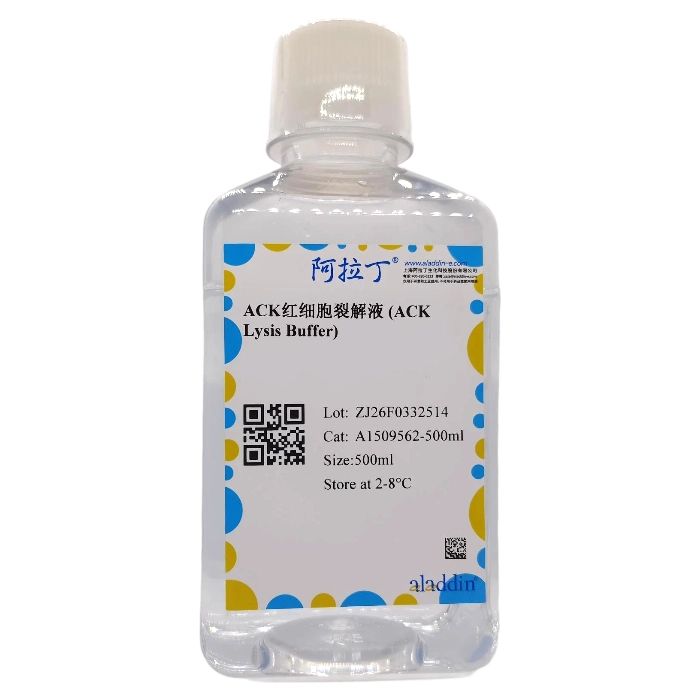
在生物科研领域经常需要去除红细胞,去除红细胞的方法有多种,如ACK Lysis Buffer、Tris-氯化铵红细胞裂解液、Gey's Lysis Buffer,ACK红细胞裂解液 (Red Blood Cell Lysis Buffer)也称ACK Lysis Buffer,是一种从人、鼠或其他哺乳动物等体内的组织样品或血液中裂解并去除无核红细胞的溶液,其主要有效成分为 NH₄Cl。
ACK Lysis Buffer经过优化配方,在裂解无核红细胞的同时几乎不损伤淋巴细胞 (Lymphocyte)或其它有细胞核的细胞;对于裂解、去除有细胞核红细胞,例如鸟或禽类的红细胞,效果不佳,裂解类似细胞时,不建议采用。本裂解液经过滤除菌,经过ACK Lysis Buffer处理过的血液或组织细胞样品可以用于后续的细胞培养、细胞融合以及核酸或蛋白的提取及各种常规的分析和检测。该试剂仅用于科研领域,不适用于临床诊断或其他用途。
自备材料:
1、胰蛋白酶、PBS、HBSS、生理盐水或无血清培养液
2、离心机
操作步骤 (仅供参考):
(一)组织细胞样本的常规操作
1、制备细胞悬液: 新鲜组织经过胰蛋白酶或胶原酶等消化处理,通过适当方法制备成细胞悬液,离心弃上清。
2、裂解: 加入3-5倍细胞沉淀体积的ACK Lysis Buffer,轻柔吹打混匀,裂解1-2min;本操作步骤在4℃条件下操作更佳,亦可在室温下操作。
3、离心: 4℃,400-500g离心5min,弃红色上清,如无低温离心机,本步骤亦可在室温下操作。
4、如果发现红细胞裂解不完全,可以重复上述步骤2和步骤3各1次。
5、洗涤:根据实验要求加入适量PBS、HBSS、生理盐水或无血清培养液,轻柔混匀重悬沉淀,4℃ 400-500g离心2-3min,弃上清,该离心步骤亦可在室温下操作,所加入的PBS、HBSS、生理盐水或无血清培养液的量一般应大于细胞沉淀体积的5倍以上。
6、如有必要,重复上述步骤5,共洗涤1-2次。
7、根据实验需要用适当溶液重悬细胞沉淀,进行计数、培养等后续实验。
(二)组织细胞样本的快速操作 (无需洗涤)
1、制备细胞悬液:新鲜组织经过胰蛋白酶或胶原酶等消化处理,通过适当方法制备成细胞悬液,离心弃上清。
2、裂解:加入细胞5倍细胞沉淀体积的ACK Lysis Buffer,轻柔吹打混匀,裂解1-2min;本操作步骤在4℃条件下操作更佳,亦可在室温下操作。
3、加入15-20ml PBS、HBSS、生理盐水或无血清培养液,轻柔混匀。
4、离心:4℃ 400-500g离心5min,弃红色上清,本离心步骤亦可在室温下操作。
5、如果发现红细胞裂解不完全,可以重复上述步骤2-4各1次。
6、根据实验需要用适当溶液重悬细胞沉淀,进行计数、培养等后续实验。
(三)血液样本的常规操作
1、取新鲜抗凝血,400-500g离心5min,弃上清。
2、 裂解: 加入6-10倍细胞沉淀体积的ACK Lysis Buffer,轻柔吹打混匀,裂解1-5min;本操作步骤在4℃条件下操作更佳,亦可在室温下操作(特别提醒:对于鼠的血液,裂解1-2min已经足够,对于人的外周血,宜延长裂解时间至4-5min,并且裂解过程中轻轻摇动以促进红细胞裂解) 。
3、离心: 4℃ 400-500g离心5min,弃红色上清,如无低温离心机,本步骤亦可在室温下操作。
4、如果发现红细胞裂解不完全,可以重复上述步骤2和步骤3各1次。
5、洗涤: 根据实验要求加入适量PBS、HBSS、生理盐水或无血清培养液,轻柔混匀重悬沉淀。4℃ 400-500g离心2-3min,弃上清,该离心步骤亦可在室温下操作,所加入的PBS、HBSS、生理盐水或无血清培养液的量一般应大于细胞沉淀体积的5倍以上。
6、根据实验需要用适当溶液重悬细胞沉淀,进行计数、培养等后续实验。
注意: 对于微量或少量的血液样本,可以不用第1步操作,可直接加入10倍血液体积的ACK Lysis Buffer进行第2步操作,并在4℃或室温裂解4-15min;对于鼠的血液,裂解4-5min已经足够;对于人的外周血,宜延长裂解时间至10min,但通常不宜超过15min,并且裂解过程中宜适当摇动以促进红细胞裂解。
(四)血液样本的快速操作 (无需洗涤)
1、新鲜抗凝血中加入10倍体积的ACK Lysis Buffer,轻轻吹打混匀,裂解4-15min;本操作步骤在4℃条件下操作更佳,亦可在室温下操作(特别提醒:对于鼠的血液,裂解4-5min已经足够;对于人的外周血,宜延长裂解时间至10min,但通常不宜超过15min,并且裂解过程中宜适当摇动以促进红细胞裂解)。
2、加入20-30ml PBS、HBSS、生理盐水或无血清培养液,轻柔混匀。
3、400-500g离心5min,弃红色上清,4℃离心效果更佳。
4、如果发现红细胞裂解不完全,可以重复上述1-3步骤1次。
5、根据实验需要用适当溶液重悬细胞沉淀,进行计数、培养等后续实验。
注意事项:
1、制备细胞悬液时应根据实验需要,不一定要制备成单细胞悬液。
2、后续试验如果是用于细胞培养,操作过程中应注意无菌操作,尽量在超净工作台内操作。
3、离心步骤尽量在4℃离心机上操作。
4、常规步骤与快速步骤的区别在于:常规步骤多了一步洗涤过程的离心,可以节省洗涤液的用量,并且洗涤效果也更好,不需要大体积的离心管;快速步骤少了一次离心过程,洗涤效果略差一些,同时需要大体积的离心管。
5、离心洗涤后,通常极微量的红细胞不会影响后续的检测。
6、如果经过ACK Lysis Buffer处理后的样品后续用于总RNA的提取,在处理细胞时不必使用DEPC处理的溶液,即无需在该操作中特意去除RNase。
7、试剂开封后请尽快使用,以防影响后续实验效果。
8、为了您的安全和健康,请穿实验服并戴一次性手套操作。
附录(转速rpm与离心力g计算公式):
g=r×11.18×10⁻⁶×rpm2
式中: r 为有效离心半径,即从离心机轴心到离心管桶底的长度,单位为厘米。
例如: 转速为3000rpm,有效离心半径为10cm,则离心力为10×11.18×10-6×30002=1006.2(×g)。
Product Introduction
In the field of biological research, it is often necessary to remove red blood cells. There are various methods for red blood cell removal, such as ACK Lysis Buffer, Tris-ammonium chloride red blood cell lysis buffer, and Gey's Lysis Buffer. ACK Red Blood Cell Lysis Buffer, also known as ACK Lysis Buffer, is a solution used to lyse and remove enucleated red blood cells from tissue samples or blood of humans, mice, or other mammals. Its main active component is NH₄Cl (ammonium chloride).
The formula of ACK Lysis Buffer has been optimized. It can lyse enucleated red blood cells while causing almost no damage to lymphocytes or other nucleated cells. However, it has poor efficacy in lysing and removing nucleated red blood cells, such as those from birds or poultry, and is not recommended for use with such cells. This lysis buffer is sterilized by filtration. Blood or tissue cell samples treated with ACK Lysis Buffer can be used for subsequent experiments including cell culture, cell fusion, nucleic acid or protein extraction, as well as various routine analyses and detections. This reagent is for research use only and not intended for clinical diagnosis or any other purposes.
Materials to Be Prepared by Users
1. Trypsin, PBS (Phosphate Buffered Saline), HBSS (Hank's Balanced Salt Solution), normal saline or serum-free culture medium
2. Centrifuge
Operating Procedures (For Reference Only)
(1) Routine Operation for Tissue Cell Samples
1. Prepare cell suspension: Digest fresh tissues with trypsin, collagenase, or other suitable enzymes, prepare a cell suspension using appropriate methods, and centrifuge to discard the supernatant.
2. Lysis: Add 3-5 times the volume of the cell pellet of ACK Lysis Buffer, gently pipette to mix well, and lyse for 1-2 minutes. This step works better when performed at 4℃, but can also be carried out at room temperature.
3. Centrifugation: Centrifuge at 400-500×g for 5 minutes at 4℃, and discard the red supernatant. If a low-temperature centrifuge is not available, this step can also be performed at room temperature.
4. If red blood cell lysis is incomplete, repeat steps 2 and 3 once each.
5. Washing: Add an appropriate amount of PBS, HBSS, normal saline, or serum-free culture medium according to experimental requirements, gently mix to resuspend the pellet, and centrifuge at 400-500×g for 2-3 minutes at 4℃. Discard the supernatant. This centrifugation step can also be performed at room temperature. The volume of added PBS, HBSS, normal saline, or serum-free culture medium should generally be more than 5 times the volume of the cell pellet.
6. If necessary, repeat step 5 above for 1-2 washes in total.
7. Resuspend the cell pellet with an appropriate solution according to experimental needs, and proceed with subsequent experiments such as cell counting and culture.
(2) Rapid Operation for Tissue Cell Samples (No Washing Required)
1. Prepare cell suspension: Digest fresh tissues with trypsin, collagenase, or other suitable enzymes, prepare a cell suspension using appropriate methods, and centrifuge to discard the supernatant.
2. Lysis: Add 5 times the volume of the cell pellet of ACK Lysis Buffer, gently pipette to mix well, and lyse for 1-2 minutes. This step works better when performed at 4℃, but can also be carried out at room temperature.
3. Add 15-20 mL of PBS, HBSS, normal saline, or serum-free culture medium, and gently mix well.
4. Centrifugation: Centrifuge at 400-500×g for 5 minutes at 4℃, and discard the red supernatant. This centrifugation step can also be performed at room temperature.
5. If red blood cell lysis is incomplete, repeat steps 2-4 once each.
6. Resuspend the cell pellet with an appropriate solution according to experimental needs, and proceed with subsequent experiments such as cell counting and culture.
(3) Routine Operation for Blood Samples
1. Take fresh anticoagulated blood, centrifuge at 400-500×g for 5 minutes, and discard the supernatant.
2. Lysis: Add 6-10 times the volume of the cell pellet of ACK Lysis Buffer, gently pipette to mix well, and lyse for 1-5 minutes. This step works better when performed at 4℃, but can also be carried out at room temperature.
Important Note: For mouse blood, 1-2 minutes of lysis is sufficient. For human peripheral blood, it is advisable to extend the lysis time to 4-5 minutes and gently shake during lysis to facilitate red blood cell lysis.
3. Centrifugation: Centrifuge at 400-500×g for 5 minutes at 4℃, and discard the red supernatant. If a low-temperature centrifuge is not available, this step can also be performed at room temperature.
4. If red blood cell lysis is incomplete, repeat steps 2 and 3 once each.
5. Washing: Add an appropriate amount of PBS, HBSS, normal saline, or serum-free culture medium according to experimental requirements, gently mix to resuspend the pellet. Centrifuge at 400-500×g for 2-3 minutes at 4℃, and discard the supernatant. This centrifugation step can also be performed at room temperature. The volume of added PBS, HBSS, normal saline, or serum-free culture medium should generally be more than 5 times the volume of the cell pellet.
6. Resuspend the cell pellet with an appropriate solution according to experimental needs, and proceed with subsequent experiments such as cell counting and culture.
Note: For trace or small-volume blood samples, step 1 can be omitted. Directly add 10 times the blood volume of ACK Lysis Buffer and proceed to step 2, lysing at 4℃ or room temperature for 4-15 minutes. For mouse blood, 4-5 minutes of lysis is sufficient. For human peripheral blood, it is advisable to extend the lysis time to 10 minutes, but generally not more than 15 minutes, and the sample should be shaken appropriately during lysis to facilitate red blood cell lysis.
(4) Rapid Operation for Blood Samples (No Washing Required)
1. Add 10 times the volume of ACK Lysis Buffer to fresh anticoagulated blood, gently pipette to mix well, and lyse for 4-15 minutes. This step works better when performed at 4℃, but can also be carried out at room temperature.
Important Note: For mouse blood, 4-5 minutes of lysis is sufficient. For human peripheral blood, it is advisable to extend the lysis time to 10 minutes, but generally not more than 15 minutes, and the sample should be shaken appropriately during lysis to facilitate red blood cell lysis.
2. Add 20-30 mL of PBS, HBSS, normal saline, or serum-free culture medium, and gently mix well.
3. Centrifuge at 400-500×g for 5 minutes, and discard the red supernatant. Centrifugation at 4℃ yields better results.
4. If red blood cell lysis is incomplete, repeat steps 1-3 once.
5. Resuspend the cell pellet with an appropriate solution according to experimental needs, and proceed with subsequent experiments such as cell counting and culture.
Precautions
1. When preparing the cell suspension, it is not necessary to prepare a single-cell suspension unless required by the experiment.
2. If the subsequent experiment involves cell culture, sterile operation should be strictly followed, and the process should be conducted in a clean bench as much as possible.
3. Centrifugation steps should be performed in a 4℃ centrifuge whenever possible.
4. The difference between the routine procedure and the rapid procedure is as follows: the routine procedure includes an additional centrifugation step during washing, which can save the amount of washing solution, achieve better washing effect, and does not require large-volume centrifuge tubes; the rapid procedure omits one centrifugation step, resulting in a slightly poorer washing effect and requiring large-volume centrifuge tubes.
5. After centrifugation and washing, trace amounts of residual red blood cells usually do not affect subsequent detection.
6. If the samples treated with ACK Lysis Buffer are to be used for total RNA extraction, it is not necessary to use DEPC-treated solutions during the operation, i.e., there is no need to specifically remove RNase in this process.
7. Please use the reagent as soon as possible after opening to avoid affecting the results of subsequent experiments.
8. For your safety and health, please wear a lab coat and disposable gloves during operation.
Appendix (Calculation Formula for Converting Rotation Speed (rpm) to Centrifugal Force (×g))
g = r × 11.18 × 10⁻⁶ × rpm²Where:r = effective centrifugal radius, i.e., the distance from the center of the centrifuge rotor to the bottom of the centrifuge tube, in centimeters (cm).
Example: When the rotation speed is 3000 rpm and the effective centrifugal radius is 10 cm, the centrifugal force is calculated as follows:10 × 11.18 × 10⁻⁶ × 3000² = 1006.2 (×g)

 ZJ26F0737192


 危险品化学品经营许可证(带存储)