
计算溶液所需的质量、体积或浓度。
有货
BioReagent,生物染色剂,用于显微镜 级 ,适用于对基线干扰要求严格的色谱和分析工作流程。
避光,室温。常规运输 。请查阅批次 COA 获取详细规格。
SDS、COA、产品数据表及规格说明书均可下载。可通过批号查询获取批次 COA。
在色谱分析、有机合成和交叉偶联反应领域已被 137 篇同行评审文献引用。
钙在人体内大量存在,构成骨骼作为支持人体的支架,在分泌、运送、肌肉收缩、神经传导等也起重要作用。钙在机体内以两种形式存在,一种是离子钙,存在血液循环内,即所谓血钙;另一种是结合钙,和蛋白、碳酸或磷酸结合而沉着在组织内。除骨骼和牙齿外,正常时钙渗透在所有组织和细胞中,一般不以固体状态出现在组织内。但在某些情况下,钙析出成固体并沉着于组织内,则为病理性钙盐沉着。沉着的钙盐主要是磷酸钙,其次为碳酸钙。钙盐通常是单折射的,但草酸钙是双折射的。当使用 HE 染色时,钙一般呈紫蓝色。许多染料可以于钙形成螯合物,包括茜素红S、红紫素、核固红等。
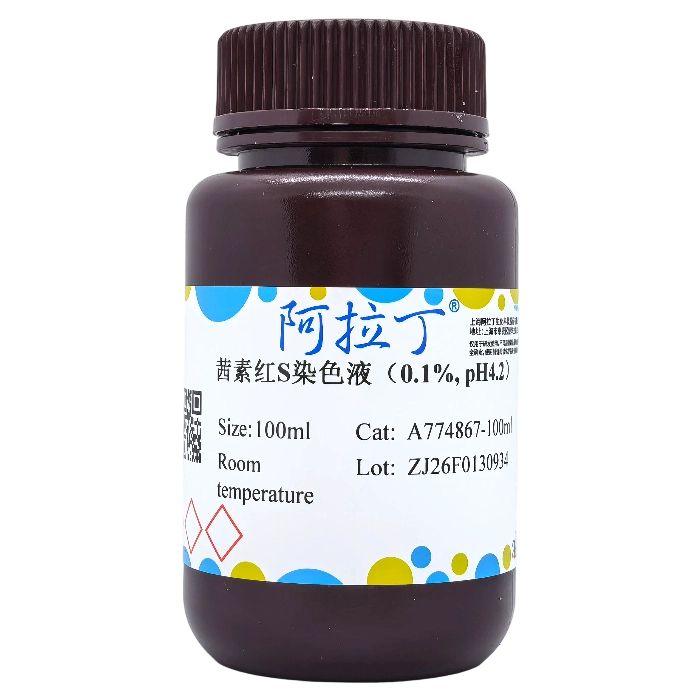
茜素红S染色是一种常用的染色方法,广泛用于成骨细胞分化、骨细胞或组织病理生理的研究。茜素红S(Alizarin Red S, 简称ARS),别名茜素磺酸钠、茜素胭脂红,CAS号为130-22-3,分子式为C₁₄H₇NaO₇S,分子量为342.25。茜素红S是一种蒽醌类衍生物,能和多种金属离子螯合生成稳定的橙红色或深红色的复合物,是一种良好的金属指示剂,也可作为吸光度法测定金属离子的显色剂,还可作为酸碱指示剂,或用于极谱法测定金属离子。在组织学和组织病理学中,由于茜素红S可与碳酸钙或磷酸钙中的钙盐螯合形成橙红色复合物,而常用于染色或定位组织中的钙质沉积。
使用说明
1、组织固定于10%中性福尔马林或乙醇,常规脱水包埋。
2、切片至95%乙醇。
3、载玻片竖立放置,彻底风干。
4、切片入含茜素红S染色液的染缸,浸染5~20min(见注意事项 1)。
5、蒸馏水快速冲洗。
6、(可选)复染液复染,蒸馏水冲洗3次。
7、常规脱水透明,中性树胶封固。
染色结果
| 钙沉积物 | 橙红色 |
| 背景 | 根据复染液的颜色不同而不同 |
注意事项
1、茜素红S染色时间要根据钙盐的含量来确定。可在显微镜下观察,见钙盐呈较深的橙红色即取出水洗,如染色时间过长,就出现弥散现象,一般1~2min即可。
2、经过茜素红S染色液染色后,钙沉积物是双折射的。
3、复染液采用固绿时,背景呈绿色。复染液采用 Mayer 苏木素时,细胞核呈蓝色。
4、茜素红S法在辨别和检测少量钙时特别有用,如检查肾中的异常钙化(尿钙过多)。
5、为了您的安全和健康,请穿实验服并戴一次性手套操作。
Calcium is abundant in the human body, forming the skeleton that serves as the supporting framework. It also plays important roles in secretion, transport, muscle contraction, and nerve conduction. Calcium exists in the body in two forms: one is ionic calcium, present in the bloodstream and referred to as blood calcium; the other is bound calcium, which combines with proteins, carbonates, or phosphates and deposits in tissues. Aside from bones and teeth, calcium normally permeates all tissues and cells and generally does not appear as a solid within tissues. However, under certain conditions, calcium may precipitate as a solid and deposit in tissues, leading to pathological calcification. The deposited calcium salts are primarily calcium phosphate, followed by calcium carbonate. Calcium salts are usually monorefringent, but calcium oxalate is birefringent. When stained with HE, calcium typically appears purplish-blue. Many dyes can form chelates with calcium, including Alizarin Red S, purpurin, nuclear fast red, and others.
Alizarin Red S staining is a commonly used staining method widely employed in the study of osteoblast differentiation, bone cells, or tissue pathophysiology. Alizarin Red S (abbreviated as ARS), also known as sodium alizarinsulfonate or alizarin carmine, has a CAS number of 130-22-3, molecular formula C₁₄H₇NaO₇S, and molecular weight 342.25. Alizarin Red S is an anthraquinone derivative that can chelate with various metal ions to form stable orange-red or deep red complexes. It serves as an excellent metal indicator, a chromogenic agent for spectrophotometric determination of metal ions, an acid-base indicator, and is used in polarographic determination of metal ions. In histology and histopathology, because Alizarin Red S can chelate with calcium salts in calcium carbonate or calcium phosphate to form an orange-red complex, it is often used to stain or localize calcium deposits in tissues.
Instructions for Use
1.Fix tissue in 10% neutral formalin or ethanol, followed by routine dehydration and embedding.
2.Section to 95% ethanol.
3.Place slides upright and allow to dry completely.
4.Immerse sections in a staining jar containing Alizarin Red S staining solution for 5–20 minutes (see Note 1).
5.Rinse quickly with distilled water.
6.(Optional) Counterstain with a counterstaining solution, then rinse with distilled water three times.
7.Routine dehydration and clearing, mount with neutral balsam.
Staining Results
| Calcium deposits | Orange‑red |
| Background | Varies depending on the counterstain used |
Notes
1.The staining time with Alizarin Red S should be determined based on the calcium salt content. Observe under a microscope and remove the slide for washing when calcium salts appear a deep orange‑red. Over‑staining may cause diffusion; typically, 1–2 minutes is sufficient.
2.After staining with Alizarin Red S, calcium deposits are birefringent.
4.The Alizarin Red S method is particularly useful for identifying and detecting small amounts of calcium, such as examining abnormal calcification in the kidneys (hypercalciuria).
5.For your safety and health, please wear a lab coat and disposable gloves during operation.
| pH | 4.2 |
|---|
H315: 引起皮肤刺激
H319: 引起严重眼睛刺激
H335: 可能引起呼吸道刺激
P261: 避免吸入灰尘/烟雾/气体/雾/蒸汽/喷雾
P305+P351+P338: 如进入眼睛:用水小心冲洗几分钟。如戴隐形眼镜并可方便地取出,取出隐形眼镜。继续冲洗。
P280: 戴防护手套/穿防护服/戴防护眼罩/戴防护面具。
P302+P352: 如皮肤沾染:用水充分清洗。
P321: 特殊处理(请参阅此标签上的...)。
P405: 密闭存放
P501: 将内容物/容器处理到。。。
P264: 处理后要彻底洗手。
P271: 仅在室外或通风良好的地方使用。
P304+P340: 如误吸入:将人转移到空气新鲜处,保持呼吸舒适体位。
P403+P233: 存放在通风良好的地方。保持容器密闭。
P362+P364: 脱掉沾污的衣服,清洗后方可重新使用。
P264+P265: 处理后彻底洗手[和…]。不要触摸眼睛。
P337+P317: 如果眼睛刺激持续:寻求医疗帮助。
P332+P317: 如果出现皮肤刺激:请寻求医疗帮助。
P319: 如果你感到不适,请寻求医疗帮助。
通过匹配包装上的批号来查找并下载产品的 COA,每批产品都进行了严格的验证,您可放心使用!
| 批号(Lot Number) | 证书类型 | 货号 |
|---|---|---|
 ZJ26F0130934 |
分析证书 | A774867 |
我们的级别选择指南涵盖了目录中所有的变体的纯度、稳定剂状态和应用适用性。
查看 BioReagent 级别指南 → 查看 Biological Stain 级别指南 → 查看 for Microscopy 级别指南 →

 危险品化学品经营许可证(带存储)