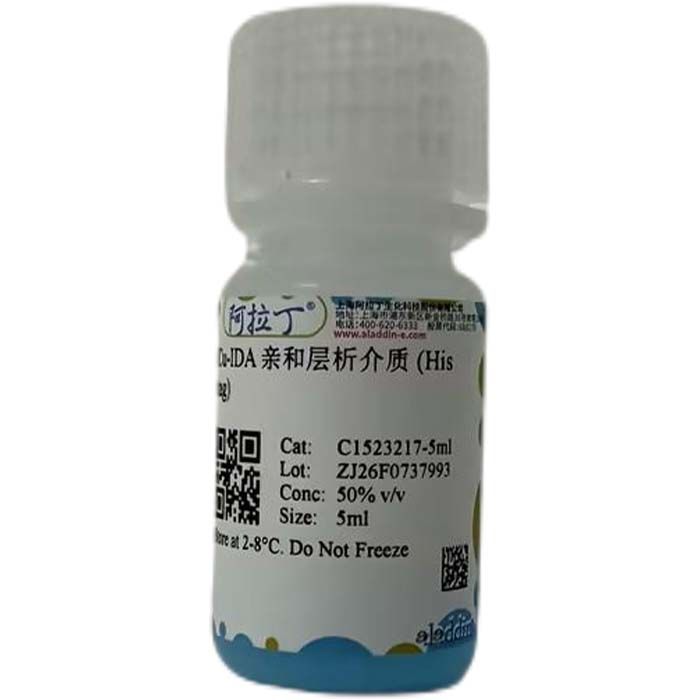
Cu IDA 亲和层析介质 (His tag) 适用于各种表达来源(如大肠杆菌、酵母、昆虫细胞和哺乳动物细胞)的组氨酸标签(6×His-tagged)蛋白的纯化。该介质以4%琼脂糖凝胶为基质,通过化学方法偶联三配位的亚氨基二乙酸(IDA),再螯合铜离子(Cu²⁺)。但铜离子易受小分子进攻,被还原或螯合,从而破坏结构,失去结合能力。 铜离子的结合强度高于镍离子,镍离子亲和效果不好时可以选择Cu IDA 亲和层析介质 (His tag)具体性能见表1。
阿拉丁Cu IDA 亲和层析介质 (His tag) 储存在20%乙醇的1×PBS中,凝胶和保护液的体积比为1:1,我司产品规格为实际凝胶的体积。
表1: Cu IDA 亲和层析介质 (His tag) 产品性能
| 项目 | 性能 |
|---|
| 基质 | 4%琼脂糖凝胶 | | 载量 | >20 mg 6×His-tagged protein/ml 介质 | | 微球粒径 | 45–165 μm | | 最大压力 | 0.1 MPa, 1 bar | | 储存缓冲液 | 含20%乙醇的1×PBS | | 储存温度 | 2–8℃ |
|
1. 纯化流程
1.1 缓冲液的准备
可使用下列推荐缓冲液,也可根据自己的使用习惯配置不同的缓冲液体系,基本原理就是低咪唑上样,高咪唑洗脱。推荐使用中性偏碱缓冲液(pH7-8),如磷酸盐缓冲液。可加入 0.3-0.5 M 氯化钠减少非特异性吸附。在蛋白结合力弱的条件下避免使用 Tris-HCl。应避免使用螯合剂 EDTA 和柠檬酸盐缓冲液。缓冲液在使用前最好用 0.22 μm 或者 0.45 μm 滤膜过滤除菌。具体配置方法见表 2。
表2. 可溶性组氨酸标签蛋白纯化缓冲液配方
| 缓冲液 | 体积 | 配方 |
|---|
| Lysis Buffer | 1 L | 50 mM NaH₂PO₄(7.80 g NaH₂PO₄·2H₂O)
300 mM NaCl(17.54 g NaCl)
10 mM imidazole(0.68 g imidazole)
用NaOH调节pH至8.0,过滤除菌 | | Wash Buffer | 1 L | 50 mM NaH₂PO₄(7.80 g NaH₂PO₄·2H₂O)
300 mM NaCl(17.54 g NaCl)
20 mM imidazole(1.36 g imidazole)
用NaOH调节pH至8.0,过滤除菌 | | Elution Buffer | 1 L | 50 mM NaH₂PO₄(7.80 g NaH₂PO₄·2H₂O)
300 mM NaCl(17.54 g NaCl)
250 mM imidazole(17.0 g imidazole)
用NaOH调节pH至8.0,过滤除菌 |
|
1.2 样品准备
1.2.1 细菌或酵母表达的蛋白
① 挑取单菌落到培养基中,根据载体使用说明,加入相应浓度的诱导剂诱导相应的时间。
② 表达结束后,培养液于7,000 rpm(7,500×g)离心15 min收集菌体。按菌体:Lysis Buffer = 1:10(W/V)加入Lysis Buffer,并加入终浓度1 mM PMSF。加入溶菌酶(工作浓度0.2–0.4 mg/mL;若宿主含pLysS或pLysE可省略)。可加其他蛋白酶抑制剂,但不得影响结合。
③ 悬浮菌体沉淀(若菌液浓,可加10 μg/mL RNase A和5 μg/mL DNase I),冰上超声破碎至澄清。
④ 破碎液于10,000 rpm(15,000×g),4℃离心20–30 min。取上清,冰上备用或-20℃保存。
1.2.2 酵母、昆虫和哺乳细胞分泌表达的可溶性蛋白
① 细胞培养液于5,000 rpm(3,800×g)离心10 min,收集上清。若上清不含EDTA、组氨酸、还原剂等,可直接上柱;否则需用Lysis Buffer透析。
② 大量体积上清可先经硫酸铵沉淀浓缩,再用Lysis Buffer透析后上柱。
1.3 Cu IDA 亲和层析介质 (His tag)的装填
① 取重力层析柱,装入下垫片,加纯水润洗,关闭下出口。
② Cu IDA 亲和层析介质 (His tag)悬液混匀,吸取适量浆液加入柱中(介质实际体积占悬液一半),打开下出口流干保护液。
③ 加适量纯水冲洗介质,流干后关闭下出口。
④ 装入润洗后的上垫片,确保垫片与填料无空隙且水平。
⑤ 装填后可立即平衡,暂不用则加保护液,2-8℃保存。
1.4 样品纯化流程
1.4.1 孵育法纯化
① 根据纯化的样品量,取适量Cu IDA 亲和层析介质 (His tag)加入离心管中,1000 rpm离心1 min,吸弃上清;也可加入重力柱中,流干保护液。
② 向离心管中加入5倍介质体积的Lysis Buffer清洗介质,1000 rpm离心1 min,吸弃上清;如使用重力柱,则直接在重力柱中清洗,直接重力流干Lysis Buffer;重复两次以上。
③ 加入样品,封闭离心管或重力柱管,4℃振荡孵育2–4 h或者37℃孵育30 min–2 h。
④ 孵育结束后,1000 rpm离心1 min,吸弃上清,或过滤收集介质,上清保留作为流穿,用于电泳鉴定。
⑤ 用5倍介质体积的Wash Buffer清洗介质,1000 rpm离心1 min或重力柱管过滤,去除上清(注意不要吸到介质),重复3–5次,中间建议更换新离心管。必要时可以调整咪唑的浓度进行洗涤。
⑥ 加入3–5倍柱体积的Elution Buffer进行洗脱,室温孵育10–15 min,1000 rpm离心1 min或重力柱管收集洗脱液,可重复2–3次。
1.4.2 重力柱法纯化
① 将装填好的Cu IDA 亲和层析介质 (His tag)重力柱用5倍柱体积Lysis Buffer进行平衡,使填料处于与目的蛋白相同的缓冲液体系下,重复2–3次。
② 将样品加到平衡好的重力柱中,样品保留时间至少2 min,保证样品和介质充分接触,收集流出液,可以反复上样增加结合效率。
③ 用10–15倍柱体积的Wash Buffer进行洗涤,去除非特异性吸附的杂蛋白,收集洗涤液。必要时可以调整咪唑的浓度进行洗涤。
④ 使用5–10倍柱体积的Elution Buffer洗脱,分段收集,每一个柱体积收集一管,分别检测,既可以保证所有结合的目的蛋白被洗脱,又可以得到高纯度和高浓度的蛋白。
柱后处理:洗脱结束后,用Lysis Buffer冲洗3倍柱体积,纯水冲洗5倍柱体积,再用20%乙醇冲洗2个柱体积,最后将介质置于2–8℃保存。
1.5 SDS-PAGE检测
将使用纯化产品得到的样品(包括流出组分、洗杂组分和洗脱组分)以及原始样品使用SDS-PAGE检测纯化效果。
2. 在位清洗(CIP)
当填料使用过程中发现反压过高或者填料上面出现明显的污染时,需要进行在位清洗操作(Cleaning-in-Place,CIP)。
建议按照下面操作去除填料上残留的污染物,如沉淀蛋白、疏水蛋白和脂蛋白等。
① 去除强疏水结合的蛋白、脂蛋白和脂类:
用30%异丙醇清洗5–10个柱体积,接触15–20 min,再用10倍柱体积去离子水洗。也可用含0.1–0.5%非离子去污剂的0.1 M醋酸溶液,接触1–2 h,然后用70%乙醇洗5个柱体积,最后用10倍柱体积去离子水洗。
② 去除离子作用结合的蛋白:
用1.5 M NaCl溶液清洗10–15 min,再用去离子水洗10个柱体积。清洗后可用20%乙醇冲洗2个柱体积,于2–8℃保存。
3. 填料再生
组氨酸标签蛋白亲和纯化填料所带的铜离子不需要经常螯合去除和重新挂铜离子。当填料使用过程中发现颜色变浅,或者填料载量明显变低时,需要进行对填料进行铜离子剥离和重新挂铜离子,也就是填料再生。将填料装填在合适的层析柱内,按照下面操作流程进行铜离子剥离和重新挂铜离子。
① 使用5倍柱体积去离子水清洗填料;
② 使用5倍柱体积100 mM EDTA(pH 8.0)剥落铜离子;
③ 使用10倍柱体积去离子水清洗填料;
④ 使用0.5 M NaOH清洗5倍柱体积,停留10–15 min;
⑤ 使用去离子水清洗填料,直至pH中性;
⑥ 使用3–5倍柱体积100 mM CuSO₄再生挂铜;
⑦ 使用10倍柱体积去离子水清洗;
填料再生后,可以立即使用,如不立即使用,需要将填料悬浮于等体积的20%乙醇中,置于2–8℃保存。
Cu IDA Affinity Chromatography Medium (His‑tag) is suitable for the purification of histidine‑tagged (6×His‑tagged) proteins from various expression sources, including E. coli, yeast, insect cells, and mammalian cells. The medium is based on 4% agarose gel as the matrix, onto which tridentate iminodiacetic acid (IDA) is chemically coupled, and then copper ions (Cu²⁺) are chelated. However, copper ions are susceptible to attack by small molecules, and can be reduced or chelated, thereby disrupting the structure and losing binding capacity. The binding strength of copper ions is higher than that of nickel ions. When nickel ion affinity is not satisfactory, Cu IDA Affinity Chromatography Medium (His‑tag) can be selected. Specific performance is shown in Table 1.
Aladdin’s Cu IDA Affinity Chromatography Medium (His‑tag) is stored in 1×PBS containing 20% ethanol, with a gel‑to‑preservative solution volume ratio of 1:1. Our product specifications refer to the actual gel volume.
Table 1: Performance specifications of Cu IDA Affinity Chromatography Medium (His‑tag)
Parameter
| Specification |
|---|
| Matrix | 4% agarose gel | | Capacity | >20 mg 6×His‑tagged protein/mL medium | | Bead size | 45–165 μm | | Maximum pressure | 0.1 MPa, 1 bar | | Storage buffer | 1×PBS with 20% ethanol | | Storage temperature | 2–8 °C |
|
2. Purification Protocol
2.1 Buffer Preparation
You may use the recommended buffers below or prepare your own buffer systems according to your preferences. The basic principle is low‑imidazole loading and high‑imidazole elution. It is recommended to filter all buffers through a 0.22 μm or 0.45 μm membrane before use.
Table 2: Buffer formulations for soluble His‑tagged protein purification
| Buffer | Volume | Composition |
|---|
| Lysis Buffer | 1 L | 50 mM NaH₂PO₄ (7.80 g NaH₂PO₄·2H₂O)
300 mM NaCl (17.54 g NaCl)
10 mM imidazole (0.68 g imidazole)
Adjust pH to 8.0 with NaOH, filter sterilise. | | Wash Buffer | 1 L | 50 mM NaH₂PO₄ (7.80 g NaH₂PO₄·2H₂O)
300 mM NaCl (17.54 g NaCl)
20 mM imidazole (1.36 g imidazole)
Adjust pH to 8.0 with NaOH, filter sterilise. | | Elution Buffer | 1 L | 50 mM NaH₂PO₄ (7.80 g NaH₂PO₄·2H₂O)
300 mM NaCl (17.54 g NaCl)
250 mM imidazole (17.0 g imidazole)
Adjust pH to 8.0 with NaOH, filter sterilise. |
|
2.2 Sample Preparation
2.2.1 Proteins expressed in bacteria or yeast (intracellular soluble)
1.Pick a single colony into culture medium and add the appropriate concentration of inducer according to the vector instructions for the required induction time.
2.After expression, centrifuge the culture at 7,000 rpm (7,500×g) for 15 min to collect the cell pellet. Resuspend the pellet in Lysis Buffer at a ratio of 1:10 (w/v) and add PMSF to a final concentration of 1 mM. Add lysozyme (working concentration 0.2–0.4 mg/mL; this may be omitted if the host strain carries pLysS or pLysE). Other protease inhibitors may be added provided they do not interfere with protein binding.
3.Resuspend the cell pellet thoroughly (if the cell suspension is very viscous, RNase A at 10 μg/mL and DNase I at 5 μg/mL may be added). Disrupt the cells on ice by sonication until the suspension becomes clear.
4.Centrifuge the lysate at 10,000 rpm (15,000×g) for 20–30 min at 4 °C. Collect the supernatant and keep it on ice for immediate use or store at –20 °C.
2.2.2 Secreted soluble proteins from yeast, insect, and mammalian cells
1.Centrifuge the cell culture medium at 5,000 rpm (3,800×g) for 10 min and collect the supernatant. If the supernatant contains no EDTA, histidine, reducing agents, etc., it can be loaded directly onto the column. If such substances are present, dialyse against Lysis Buffer before loading.
2.For large volumes of supernatant, concentrate by ammonium sulphate precipitation and then dialyse against Lysis Buffer before loading onto the column.
2.3 Packing of Cu-IDA Affinity Resin (His tag)
1.Place the lower frit into a suitable gravity column, rinse the column and frit with distilled water, and close the bottom outlet.
2.Mix the Cu-IDA Affinity Resin (His tag) suspension thoroughly and pipette the appropriate amount of slurry into the column (the actual gel volume is half of the suspension volume). Open the bottom outlet to drain the preservative solution.
3.Wash the medium with a suitable volume of distilled water and allow it to drain by gravity. Close the bottom outlet.
4.Insert the pre‑rinsed upper frit, ensuring no air gap between the frit and the medium and that it is level.
5.The packed column can be equilibrated immediately. If not used immediately, cover with preservation solution and store at 4–30 °C.
2.4 Purification Procedures
2.4.1 Batch (incubation) purification
1.According to the sample volume, take an appropriate amount of Cu-IDA Affinity Resin (His tag) into a centrifuge tube and centrifuge at 1,000 rpm for 1 min, then aspirate the supernatant. Alternatively, place the medium in a gravity column and allow the preservative solution to drain.
2.Wash the medium with 5 bed volumes of Lysis Buffer, centrifuge at 1,000 rpm for 1 min, and aspirate the supernatant. If using a gravity column, wash directly in the column by gravity flow. Repeat this washing step at least twice.
3.Add the sample, close the tube or gravity column, and incubate with shaking at 4 °C for 2–4 h, or at 37 °C for 30 min–2 h.
4.After incubation, centrifuge at 1,000 rpm for 1 min and aspirate the supernatant, or filter to collect the medium. Keep the supernatant as flow‑through for SDS‑PAGE analysis.
5.Wash the medium with 5 bed volumes of Wash Buffer, centrifuge at 1,000 rpm for 1 min or filter in a gravity column, and remove the supernatant (be careful not to disturb the medium). Repeat this washing step 3–5 times, and it is recommended to change to a fresh tube in between. The imidazole concentration in the wash buffer can be adjusted if necessary.
6.Elute with 3–5 bed volumes of Elution Buffer. Incubate at room temperature for 10–15 min, then centrifuge at 1,000 rpm for 1 min or collect the eluate from the gravity column. This elution step can be repeated 2–3 times.
2.4.2 Gravity column purification
1.Equilibrate the packed Cu-IDA Affinity Resin (His tag) gravity column with 5 bed volumes of Lysis Buffer, repeating 2–3 times, so that the medium is in the same buffer system as the target protein.
2.Apply the sample to the equilibrated column and allow a residence time of at least 2 min to ensure sufficient contact between the sample and the medium. Collect the flow‑through; the sample can be reapplied to increase binding efficiency.
3.Wash with 10–15 bed volumes of Wash Buffer to remove non‑specifically bound contaminants. Collect the wash fractions. The imidazole concentration can be adjusted if needed.
4.Elute with 5–10 bed volumes of Elution Buffer and collect fractions in separate tubes (one column volume per tube). Assay each fraction to ensure complete elution of bound target protein while obtaining high purity and concentration.
Post‑elution treatment: After elution, rinse the column with 3 bed volumes of Lysis Buffer, followed by 5 bed volumes of distilled water, and finally 2 bed volumes of 20% ethanol. Store the medium at 2–8 °C.
2.5 SDS‑PAGE Analysis
Analyze the purity of the purified product by SDS‑PAGE using the collected fractions (flow‑through, wash, and elution fractions) alongside the original sample.
3. Cleaning‑in‑Place (CIP)
Perform CIP when the column back‑pressure becomes excessively high or when visible contamination of the medium occurs.
Removal of strongly hydrophobically bound proteins, lipoproteins, and lipids:
Wash with 5–10 bed volumes of 30% isopropanol, with a contact time of 15–20 min, followed by 10 bed volumes of distilled water. Alternatively, use an acidic or alkaline solution containing a detergent, e.g., 0.1 M acetic acid containing 0.1–0.5% non‑ionic detergent, with a contact time of 1–2 h. After detergent treatment, wash with 5 bed volumes of 70% ethanol to completely remove the detergent, then rinse with 10 bed volumes of distilled water.
Removal of ionically bound proteins:
Wash with 1.5 M NaCl for 10–15 min, followed by 10 bed volumes of distilled water. After cleaning, the column can be rinsed with 2 bed volumes of 20% ethanol and stored at 2–8 °C.
4. Resin Regeneration
The copper ions on the His‑tag affinity medium do not need to be stripped and re‑charged frequently. Regeneration is required only when the medium colour becomes noticeably lighter or when the binding capacity significantly decreases. To strip and re‑charge copper ions, pack the medium in a suitable chromatography column and follow the procedure below:
1.Wash with 5 bed volumes of distilled water.
2.Strip copper ions with 5 bed volumes of 100 mM EDTA (pH 8.0).
3.Wash with 10 bed volumes of distilled water.
4.Wash with 5 bed volumes of 0.5 M NaOH and allow to stand for 10–15 min.
5.Wash with distilled water until the effluent reaches neutral pH.
6.Re‑charge with 3–5 bed volumes of 100 mM CuSO₄.
7.Wash with 10 bed volumes of distilled water.
After regeneration, the medium can be used immediately. If not used immediately, suspend it in an equal volume of 20% ethanol and store at 2–8 °C.

 ZJ26F0737993


 危险品化学品经营许可证(带存储)