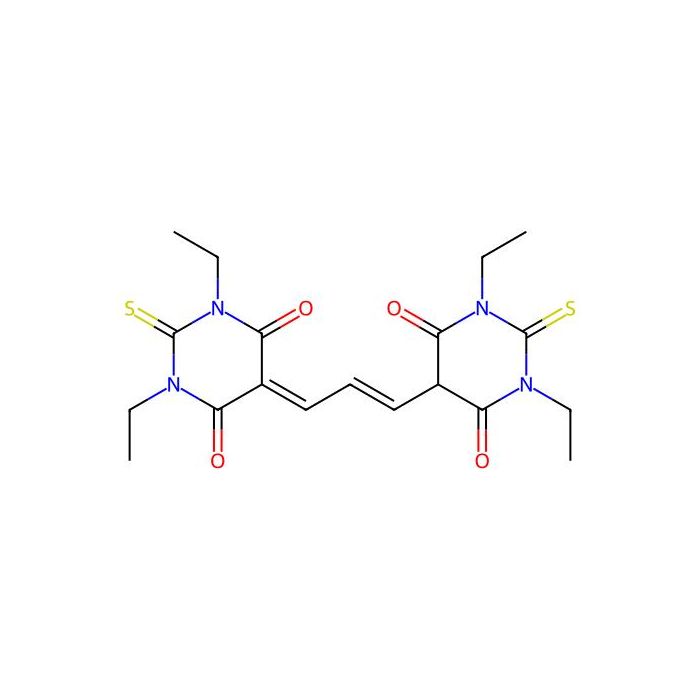
DiSBAC2(3) 是一种膜电位敏感的透过性磷脂阴离子荧光染料,其在细胞膜两边的分布取决于细胞膜电位,因此可根据其荧光强度的变化反应细胞膜电位的变化。细胞发生去极化时染料进入细胞,细胞内荧光强度增加,细胞发生超极化时染料从细胞内排出,荧光强度降低。该探针属于慢响应膜电位探针,其光学响应幅度远远大于快速响应探针(通常每mV荧光变化1%),因此DiSBAC2(3)在细胞内可以更快地进入膜内,并且对膜电位的变化更为敏感,适用于检测膜电位的快速变化,如自由呼吸活动,离子通道通透性,药物结合和其他因素引起的非兴奋性细胞的平均膜电位变化。由于整体带负电荷,DiSBAC2(3) 染料会被线粒体排阻,因而比碳氰酸酯更适合测定细胞膜电位。
物理性质和指标:
Ex (nm) ………………538
Em(nm) ………………555
注意事项:溶解性是在室温下测定的,如果温度过低,可能会影响其溶解性。
其他说明:为了您的安全和健康,请穿实验服并戴一次性手套操作。
实验方法(仅供参考):
1. 准备细胞:
1.1 贴壁细胞:在检测前一天进行细胞铺板,96 孔板细胞数建议为 4-8×10⁴ 个 / 孔 / 100μL。
1.2 非贴壁细胞:将细胞离心,重悬于 HBSS 和 MP 染色工作液中(见下文步骤 2.2),调整细胞数至 1.25-2.5×10⁵ 个 / 孔 / 100ul(96 孔板)。
2. DiSBAC2(3) 染料工作液:
2.1 使用无水 DMSO,将粉末溶解为 10 至 30 mM 的 DiSBAC2(3) 溶液。
注意:制备完的母液应及时使用,剩余部分请分装于 - 20℃保存,避光,且避免反复冻融。
2.2 准备 2× 的 DiSBAC2(3) 染料溶液:将染料母液平衡至室温。使用 HHBS 或其他合适的缓冲液,稀释母液至 20 至 40μM,即为 2× DiSBAC2(3) 染料溶液。准备 pH 为 7 的 0.04-0.08% 的 Pluronic F-127 和 2mM 台盼红,将它们混合均匀即为染色工作液。该染色工作溶液在室温下至少稳定 2 小时。
3. 膜电位测定:
3.1 向细胞中加入 100μl / 孔(96 孔板)DiSBAC2(3) 染料工作液。
注 1:如果您的筛选化合物会干扰培养基或血清且细胞可在无血清溶液中正常生长,则需要在加入 DiSBAC2(3) 染料之前,用等体积的 HHBS 缓冲液替换生长培养基。
注 2:染色后请勿清洗细胞。
3.2 置于培养箱中孵育 30 至 60 分钟。
注意:在某些情况下,在室温下孵育 30 至 60 分钟可能会更好。
3.3 使用 HHBS 或所需的缓冲液制备复合板。
3.4 通过检测 Ex/Em=540/590 nm 的荧光强度进行膜电位测定。
储液配置:

【注意】
●我司产品为非无菌包装,若用于细胞培养,请提前做预处理,除去热原细菌,否则会导致染菌。
●部分产品我司仅能提供部分信息,我司不保证所提供信息的权威性,以上数据仅供参考交流研究之用。
DiSBAC2(3) is a permeable anionic phospholipid fluorescent dye sensitive to membrane potential. Its distribution across the cell membrane depends on the membrane potential; thus, changes in its fluorescence intensity can reflect alterations in membrane potential. Upon cell depolarization, the dye permeates into the cell, increasing intracellular fluorescence intensity. During cell hyperpolarization, the dye is extruded from the cell, resulting in reduced fluorescence intensity.
This probe belongs to slow-response membrane potential probes, whose optical response amplitude is far larger than that of fast-response probes (typically a 1% fluorescence change per mV). Therefore, DiSBAC2(3) penetrates cell membranes faster and exhibits higher sensitivity to shifts in membrane potential. It is suitable for detecting rapid membrane potential fluctuations, such as spontaneous electrical activity, ion channel permeability, average membrane potential variations in non-excitable cells induced by drug binding and other factors. Carrying an overall negative charge, DiSBAC2(3) is excluded by mitochondria, making it more ideal for plasma membrane potential measurement than carbocyanine dyes.
Physical Properties & Specifications
Excitation wavelength (Ex, nm) ………………538
Emission wavelength (Em, nm) ………………555
Notes: Solubility data was measured at room temperature; low temperature may impair solubility.
Additional Safety Instructions
For personal safety and health, laboratory coats and disposable gloves must be worn during all handling procedures.
Experimental Protocol (For Reference Only)
1. Cell Preparation
1.1 Adherent cells: Plate cells one day prior to detection. The recommended seeding density for 96-well plates is 4–8×10⁴ cells per well in 100 μL medium.
1.2 Suspension cells: Centrifuge the cell pellet and resuspend cells in HBSS and MP staining working solution (see Step 2.2 below). Adjust cell density to 1.25–2.5×10⁵ cells per well in 100 μL for 96-well plates.
2. Preparation of DiSBAC2(3) Staining Working Solution
2.1 Dissolve the dye powder in anhydrous DMSO to prepare a stock solution at a concentration of 10–30 mM DiSBAC2(3).
Caution: Use the prepared stock solution promptly. Aliquot any remaining stock, store at −20 °C protected from light, and avoid repeated freeze-thaw cycles.
2.2 Prepare 2× DiSBAC2(3) dye solution: Equilibrate the dye stock solution to room temperature. Dilute the stock with HHBS or other appropriate buffer to a final concentration of 20–40 μM to obtain 2× DiSBAC2(3) dye solution. Prepare a mixture containing 0.04–0.08% Pluronic F-127 (pH 7) and 2 mM trypan red; thoroughly combine with the 2× dye solution to yield the complete staining working solution. This working solution remains stable for a minimum of 2 hours at room temperature.
3. Membrane Potential Measurement
3.1 Add 100 μL of DiSBAC2(3) staining working solution per well (96-well plate) to the cells.
Note 1: If your screening compounds interfere with culture medium or serum, and cells can grow normally in serum-free medium, replace the growth medium with an equal volume of HHBS buffer before adding DiSBAC2(3) dye.
Note 2: Do not wash cells after staining.
3.2 Incubate cells in a cell incubator for 30–60 minutes.
Caution: Room-temperature incubation for 30–60 minutes may yield superior results under certain experimental conditions.
3.3 Prepare compound plates using HHBS or your required buffer system.
3.4 Quantify membrane potential by measuring fluorescence intensity at Ex/Em = 540/590 nm.
Stock Solution Preparation

Important Warnings
• This product is supplied non-sterile. If used for cell culture, perform pre-treatment to remove pyrogens and bacteria in advance to prevent microbial contamination.
• Only partial technical information can be provided for some products. The company does not warrant the authority or accuracy of the provided data; all values are for research reference and academic communication only.

 ZJ26F0838394


 危险品化学品经营许可证(带存储)