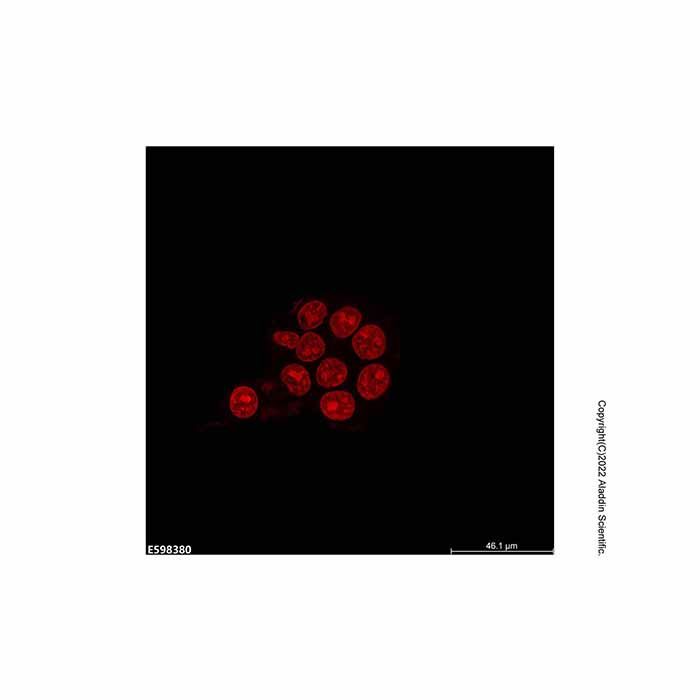
Ethidium Homodimer-I (EthD-l)是一种高亲和性的荧光核酸染料,与DNA或 RNA结合后,可以使荧光增强30多倍。用于哺乳动物、细菌、酵母和真菌的染色。EthD-1带有较强正电荷,所以该染料不能穿过细胞膜进行活细胞染色,但是能穿过死细胞膜的无序区域而到达细胞核并且嵌入DNA双链从而产生红色荧光。因此EthD-I可以准确的检测溶液中的核酸或者解体细胞中的核酸,是一种较灵敏的核酸染色剂。
应用范围
核酸染色
产品特点
1. 荧光亮度:发光时间久,不易淬灭;
2. 选择灵活方便:可搭配我司其它试剂使用,方便灵活。
产品参数
1. 外观:可溶于 DMSO和MeOH的红色固体
2. Ex/Em:528/617 nm (结合DNA)
3. CAS号:61926-22-5
4. 分子式:C₄₆H₅₀Cl₄N₈
5. 分子量:856.75
操作步骤
注:该操作说明适用于大多数细胞,但不同的细胞类型、细胞密度、使用的培养基以及其他一些因素都有可能影响染色效果,本说明仅供参考。
1. 储存液的制备:取适量DMSO加入到EthD-I中,配制成2 mM储液,该储存液可于-20℃稳定保存一年。
2. 将20 μL 2 mM储液加入到10 mL无菌的组织培养级别的D-PBS中,充分涡旋混匀,使其终浓度为4 μM (推荐浓度为0.1~10 μM,不同细胞系建议梯度设置确定最佳染色浓度)。
3. 吸取上述配制好的工作液100~150 μL加入到细胞盖玻片上使其完全覆盖。孵育最好是在含有盖子的盘子里防止染色液挥发。
4. 室温避光孵育30~45 min,若染色液浓度过高或温度过低可适当减少孵育时间。
5. 向一个新的显微镜载玻片上加入10 μL D-PBS.
6. 使用尖镊子小心且迅速将载有细胞的盖玻片倒置加在含有D-PBS的载玻片上,为了防止染色液挥发,用干净透明的指甲油封住载玻片四周。
7. 在荧光显微镜下观察细胞染色情况。
注意事项
1.使用前请将产品瞬时离心至管底,再进行后续实验。
2.荧光染料均存在淬灭问题,请尽量注意避光,以减缓荧光淬灭。
3.本产品仅限于科研,不得用于临床诊断或治疗,不得用于食品或药品,不得存放于普通住宅内。
4.为了您的安全和健康,请穿实验服并戴一次性手套操作。
FAQ
1. 问:如何为该试剂染色实验准备死细胞对照?
答:有两种简单的方法。一种是通过60℃放置20分钟热灭活细胞。第二种是将细胞放入70%乙醇,乙醇固定的细胞可以在四度冰箱中长时间保存直到使用,可达好几年。
2. 问:可以染单链 DNA吗?
答:可以的,除了可以染单链 DNA以外,还可以用于dsDNA、RNA、寡核苷酸和三链DNA的染色。
Ethidium Homodimer-I (EthD-I) is a high-affinity fluorescent nucleic acid dye. Upon binding to DNA or RNA, its fluorescence is enhanced more than 30‑fold. It is used for staining mammalian cells, bacteria, yeast and fungi. EthD-I carries strong positive charge, so it cannot cross the cell membrane to stain live cells. However, it can penetrate the disordered regions of dead cell membranes to reach the cell nucleus and intercalate into double‑stranded DNA, thereby producing red fluorescence. Therefore, EthD-I can accurately detect nucleic acids in solution or in lysed cells, making it a sensitive nucleic acid stain.
Application
Nucleic acid staining
Product Features
1. Fluorescence performance: long‑lasting luminescence and low quenching tendency;
2. Flexible and convenient use: compatible with other reagents from our company for flexible applications.
Product Parameters
1. Appearance: red solid, soluble in DMSO and MeOH
2. Ex/Em: 528/617 nm (when bound to DNA)
3. CAS No.: 61926-22-5
4. Formula: C₄₆H₅₀Cl₄N₈
5. Molecular weight: 856.75
Protocol
Note: This protocol is suitable for most cells. However, different cell types, cell densities, culture media and other factors may affect staining results. This protocol is for reference only.
1. Preparation of stock solution: Add an appropriate amount of DMSO to EthD-I to prepare a 2 mM stock solution. This stock solution can be stably stored at −20 °C for one year.
2. Add 20 μL of 2 mM stock solution to 10 mL of sterile tissue‑culture‑grade D‑PBS, and mix thoroughly by vortexing to a final concentration of 4 μM (recommended range: 0.1–10 μM; gradient optimization is recommended for different cell lines to determine optimal staining concentration).
3. Pipette 100–150 μL of the prepared working solution onto the cell coverslip to ensure full coverage. Incubation is preferably performed in a covered dish to prevent evaporation of the staining solution.
4. Incubate at room temperature for 30–45 minutes in the dark. Incubation time may be shortened appropriately if the staining concentration is too high or the temperature is too low.
5. Add 10 μL of D‑PBS onto a new microscope slide.
6. Using fine tweezers, carefully and quickly invert the cell‑bearing coverslip onto the slide with D‑PBS. To prevent evaporation, seal the edges of the coverslip with clear, transparent nail polish.
7. Observe cell staining under a fluorescence microscope.
Precautions
1. Briefly centrifuge the product to the bottom of the tube before use prior to subsequent experiments.
2. All fluorescent dyes are subject to photobleaching; protect from light as much as possible to slow fluorescence quenching.
3. This product is for research use only. It is not intended for clinical diagnosis or therapy, or for use in food or pharmaceutical products, and shall not be stored in ordinary residential premises.
4. For your safety and health, please wear a lab coat and disposable gloves during operation.
FAQ
1. Q: How to prepare dead cell controls for staining with this reagent?
A: Two simple methods are available. One is heat inactivation of cells by incubation at 60 °C for 20 minutes. The second is fixation of cells in 70% ethanol. Ethanol‑fixed cells can be stored long‑term at 4 °C until use, for up to several years.
2. Q: Can it stain single‑stranded DNA?
A: Yes. In addition to single‑stranded DNA, it can also be used for staining dsDNA, RNA, oligonucleotides and triple‑stranded DNA.

 ZJ26F0434841


 危险品化学品经营许可证(带存储)