
Kinetic Matching in Photoredox/Nickel C(sp²)–C(sp³) Coupling: Radical Generation, Nickel-Species Stability, and Photon Flux
Kinetic Matching in Photoredox/Nickel C(sp²)–C(sp³) Coupling: Radical Generation, Nickel-Species Stability, and Photon Flux
1 Why Does Photoredox/Nickel Coupling Involve Kinetic Matching?
1.1 Two activation processes converge within the same reaction
In 2014, Tellis, Primer, and Molander reported a photoredox/nickel dual-catalytic cross-coupling involving organotrifluoroborates. Conventional organoboron cross-coupling relies on a two-electron transmetalation process, whereas transmetalation of C(sp³) organoboron reagents is often relatively slow. In this study, single-electron transfer (SET) oxidation of organotrifluoroborates was used to generate carbon-centered radicals, which then entered the Ni catalytic cycle, thereby establishing a single-electron transmetalation pathway.[1]
In the same year, Zuo, Ahneman, Chu, Terrett, Doyle, and MacMillan reported the decarboxylative coupling of carboxylic acids with aryl halides. The authors proposed two interconnected catalytic cycles: the photoredox cycle is responsible for generating carbon-centered radicals from carboxylates, while the Ni catalytic cycle is responsible for aryl halide activation and C–C bond formation.[2]
In the working mechanism favored by the authors of that study, with the ligands omitted for clarity, the Ni-catalyzed portion can be represented as follows:
C–C bond-forming sequence
Ni(0) + Ar–X → Ar–Ni(II)–X → Ar–Ni(III)(R)–X → Ar–R + Ni(I)–X
The three consecutive steps correspond to:
Oxidative addition → capture of R• → reductive elimination
Here, Ar denotes an aryl group, R• denotes a carbon-centered radical, and X denotes a halogen.
The resulting Ni(I) species is subsequently reduced by the reduced-state photocatalyst, regenerating the Ni catalyst:
Ni(I)–X + Ir(II) → Ni(0) + Ir(III)
This step is an SET process.[2]
In this working mechanism, Ni(0) first undergoes oxidative addition with Ar–X to generate a Ni(II)–aryl species. The latter captures R• to form a Ni(III) intermediate, which undergoes reductive elimination to generate Ar–R and Ni(I). Reduced Ir(II) then reduces Ni(I) back to Ni(0), while regenerating Ir(III). The original paper also discussed an alternative pathway involving oxidative addition of the aryl halide to Ni(I), but based on the electrochemical data and known Ni reactivity available at the time, the authors favored the Ni(0)/Ni(II)/Ni(III)/Ni(I) pathway described above.[2]
This reaction mode has an important kinetic characteristic: carbon-centered radicals and catalytically active Ni species are generated separately and subsequently undergo productive convergence. The rates of formation, steady-state concentrations, and deactivation rates of both types of species can affect the final coupling efficiency.
1.2 Kinetic matching primarily involves three factors
Kinetic factor | Key question | Effect on coupling |
Radical generation | Through what process is R• formed? How rapidly is it generated? Are competing pathways present? | Determines the flux of radical generation and the steady-state radical concentration |
Catalytically active Ni species | How rapidly are Ni intermediates formed, how long do they persist, and do they undergo decomposition or aggregation? | Determines the opportunity for R• to enter a productive bond-forming pathway |
Photon supply | How many photons can the system utilize per unit time? | Can affect SET, radical generation, and certain Ni oxidation-state interconversions |
The chemical meaning of “matching” here is that productive C–C bond formation must compete effectively, on the relevant timescale, with radical side reactions, decomposition of Ni intermediates, and catalyst deactivation.
2 The Rate of Radical Generation Determines How the C(sp³) Fragment Enters the Coupling Reaction
2.1 Silyl radicals activate alkyl bromides through XAT
In 2016, Zhang, Le, and MacMillan reported a photoredox/nickel cross-electrophile coupling of alkyl bromides with aryl bromides.[3]
The authors proposed that the excited-state Ir photocatalyst oxidizes bromide to generate Br•. Br• then undergoes hydrogen-atom transfer (HAT) from tris(trimethylsilyl)silane to generate a silyl radical. The silyl radical subsequently undergoes halogen-atom transfer (XAT) with the alkyl bromide to generate the target alkyl radical.[3]
The key radical-generation step can be represented as:
R₃Si• + R–Br → R₃Si–Br + R•
The rate at which a silyl radical abstracts a halogen atom from an alkyl halide can approach the diffusion-controlled limit. At the same time, formation of the strong Si–Br bond provides a substantial thermodynamic driving force. The bond dissociation energies (BDEs) cited in the original paper are approximately 96 kcal·mol⁻¹ for Me₃Si–Br and approximately 69 kcal·mol⁻¹ for the C(sp³)–Br bond in bromoethane.[3]
Thus, alkyl bromides can be rapidly converted to R• through XAT, and radical generation does not have to rely entirely on direct photocatalytic reduction of the C–Br bond. The activation pathway of the radical precursor and the rate of that process therefore become important factors controlling the supply of R•.
2.2 α-Silyl amines illustrate how the rates of competing pathways affect chemoselectivity
Dong, Badir, Zhang, and Molander investigated the photoredox/nickel coupling of α-silyl amines with aryl halides in 2021.[4]
The α-silyl amine undergoes SET oxidation to form an amine radical cation, followed by rapid carbonate-promoted α-desilylation to regioselectively generate an α-amino radical. The authors proposed that this radical is subsequently captured by Ni(0) to form an alkyl–Ni(I) species, followed by oxidative addition of the aryl halide and C–C bond formation.[4]
An important feature of this system is the chemistry that occurs after SET.
After formation of the radical cation, the α-silyl amine can generate the target α-amino radical through rapid α-desilylation; by comparison, α-C–H deprotonation of a conventional secondary-amine radical cation is slower. Control experiments in the study showed that the α-silyl amine can form the C–C coupling product, whereas the corresponding secondary amine is more prone to C–N coupling.[4]
Accordingly, the effectiveness of a radical precursor involves at least three consecutive factors:
1. Can SET occur efficiently?
2. After SET, can fragmentation, desilylation, or atom transfer rapidly generate the target R•?
3. Does formation of the target radical have favorable kinetics relative to competing pathways?
The redox potential of the radical precursor provides information about the feasibility of SET, whereas the rates of the subsequent chemical steps following SET further determine which radical is actually formed and how rapidly it is generated.
3 The Lifetime of Ni Intermediates Determines Whether Radicals Can Be Efficiently Captured
The additive study reported by Prieto Kullmer and co-workers in Science in 2022 provided relatively direct experimental evidence for the kinetic relationship between the rate of radical generation and the lifetime of Ni intermediates.[5]
The researchers found that addition of phthalimide to photoredox/nickel decarboxylative arylation substantially improved the performance of a range of substrates that had previously shown low reaction efficiency. Mechanistic studies further indicated that the additive has two important effects: stabilizing the Ni–aryl oxidative addition intermediate and increasing the concentration of Ni species capable of continuing to participate in catalysis.[5]
3.1 Radical capture competes directly with OAC decomposition
In a model system involving a nonactivated carboxylic acid, the aryl bromide was completely consumed in the absence of phthalimide, accompanied by substantial protodehalogenation. Upon addition of phthalimide, protodehalogenation was suppressed and the desired cross-coupling became the major reaction. For this substrate combination, the yield increased from 23% without the additive to 81% in the presence of phthalimide.[5]
The authors subsequently investigated the Ni–aryl oxidative addition complex (OAC). In the presence of potassium phthalimide, an OAC that persisted for several hours could be formed; in the absence of this ligand, protodehalogenation and reductive homocoupling products were predominantly observed. The structure of this OAC was subsequently confirmed through independent synthesis.[5]
Once the OAC has formed, the two competing pathways can be represented as follows:
Productive pathway:
OAC + R• → radical capture → C–C bond-forming process
Nonproductive pathway:
OAC → unimolecular decomposition → dehalogenation or other byproducts
If only these two local competing pathways are considered, the rate of radical capture can be expressed as:
v(cap) = k(cap) × [OAC] × [R•]
The rate of unimolecular OAC decomposition can be expressed as:
v(dec) = k(dec) × [OAC]
where:
· v(cap): rate of radical capture;
· v(dec): rate of OAC decomposition;
· k(cap): bimolecular rate constant for the reaction between the radical and the OAC;
· k(dec): unimolecular rate constant for OAC decomposition;
· [R•]: radical concentration;
· [OAC]: concentration of the oxidative addition complex.
The kinetic competition between these two pathways is therefore:
v(cap) / v(dec) = k(cap) × [R•] / k(dec)
This relationship describes the local competition between radical capture and unimolecular OAC decomposition after the OAC has already formed; it is not the overall rate law for the entire photoredox/nickel dual-catalytic system. The 2022 study explicitly noted that lower steady-state concentrations of both alkyl radicals and OACs reduce the rate of radical capture by Ni, allowing this process to be competitively challenged by unimolecular OAC decomposition.[5]
This relationship shows that:
① When [R•] decreases, radical capture becomes slower relative to OAC decomposition;
② When k(dec) decreases, the lifetime of the OAC increases, giving the radical a longer effective time window for capture.
Thus, the ability to generate R• and the ability of R• to enter the coupling process efficiently are two distinct kinetic issues. When the rate of radical supply decreases, the proportion of OAC undergoing decomposition may increase even if the system is still capable of generating R•.
3.2 Nonactivated carboxylic acids directly illustrate the kinetic coupling between radical generation and OAC lifetime
The study further compared the reaction behavior of activated and nonactivated carboxylic acids.
Stern–Volmer quenching experiments showed that nonactivated carboxylic acids quenched the excited-state photocatalyst more slowly. The authors therefore reasoned that slower quenching would decrease the rate of alkyl-radical formation; at the same time, formation of the reduced Ir photocatalyst would also be slower. They further inferred that Ni reduction and OAC formation would consequently also become slower.[5]
The resulting kinetic relationship is:
Slower photocatalyst quenching
→ slower R• generation and slower formation of reduced Ir
→ slower Ni reduction and OAC formation
→ lower steady-state concentrations of R• and OAC
→ lower overall rate of radical capture by the OAC
→ greater competitive contribution from unimolecular OAC decomposition
This causal sequence constitutes the central mechanistic basis used in the 2022 study to explain the lower reaction efficiency of nonactivated carboxylic acids.[5]
An important parameter altered by phthalimide is OAC stability. The authors proposed that the phthalimide anion can act as a ligand, maintaining a higher degree of coordination saturation at the OAC and reducing decomposition triggered by carboxylate ligand exchange.[5]
In situ photochemical fluorine-19 nuclear magnetic resonance (^19F NMR) experiments further supported this interpretation. In the absence of phthalimide, no ^19F NMR signal that could be clearly assigned to the OAC was observed; after addition of phthalimide, a signal consistent with the independently synthesized OAC was detected, indicating a substantial increase in the steady-state concentration of the OAC.[5]
These results lead to a kinetic conclusion:
When the rate of radical supply decreases, extending the lifetime of a Ni intermediate can increase the time window during which the radical can react productively with that intermediate.
Thus, improved coupling efficiency can arise either from acceleration of the productive reaction or from suppression of competitive decomposition.
4 Total Ni Loading Is Not Equivalent to the Concentration of Catalytically Active Ni
In addition to OAC decomposition, Ni catalysts can enter nonproductive states through the formation of low-valent Ni aggregates.
The 2022 study found that, in another set of model reactions, the reaction gradually deactivated over approximately the first 100 min and reached a state in which essentially no further product was formed when phthalimide was absent; in the presence of phthalimide, however, the reaction continued. Combined with Hammett experiments, the authors proposed that this behavior was associated with a gradual decrease in the concentration of catalytically active Ni capable of undergoing oxidative addition.[5]
Low-valent Ni oligomers were considered an important source of this deactivation. Such low-valent Ni species are known to exhibit low reactivity toward oxidative addition of aryl halides when present in aggregated states.[5]
To test this interpretation, the researchers independently prepared the low-valent Ni dimer [(dtbbpy)NiBr]₂, where dtbbpy is 4,4′-di-tert-butyl-2,2′-bipyridine.
When this dimer was used directly in the model reaction described above, only trace amounts of the desired product were obtained, indicating that the Ni dimer itself has very low catalytic activity in this system. After addition of phthalimide, the yield of the desired product increased to 31%. On this basis, the authors proposed that, at least under these experimental conditions, phthalimide can convert a portion of inactive oligomeric Ni species back into monomeric Ni species capable of participating in catalysis.[5]
Accordingly, Ni in the reaction can be divided into two categories:
Ni state | Chemical meaning |
Total Ni | Total amount of all Ni species present in the system |
Catalytically active Ni | Ni species currently capable of continuing through oxidative addition, radical capture, or subsequent catalytic steps |
The total Ni concentration is not equivalent to the concentration of catalytically active Ni.
Even when a fixed molar percentage of Ni is added at the beginning of the reaction, some of the Ni may enter nonproductive states over the course of the reaction through aggregation, ligand exchange, or other decomposition processes. Consequently, the concentration of Ni that remains capable of participating in the catalytic cycle may gradually decrease.[5]
This finding explains the time-dependent deactivation observed in some photoredox/nickel coupling reactions: product formation proceeds normally at the beginning of the reaction, but the reaction gradually slows or even stalls as the proportion of catalytically active Ni decreases.
5 Photon Flux Can Become a Controlling Factor for the Overall Reaction Rate
In addition to radical generation and Ni catalysis, light-driven electron transfer introduces a third kinetic factor: effective photon supply.
In 2024, Wan, Capaldo, Djossou, and co-workers reported a photocatalytic C(sp²)–C(sp³) Suzuki–Miyaura coupling of alkyl boranes with aryl bromides and conducted systematic initial-rate studies on a model system.[6]
5.1 The model system operates in a photon-limited regime
The authors examined how the rate of the model reaction depended on the concentrations of the substrate, Ni catalyst, and base.
The results showed that, under the optimized conditions, the model reaction operated in a photon-limited regime, in which the overall reaction rate was governed primarily by the number of photons available to the system; zero-order kinetic behavior was observed with respect to the other reaction components examined.[6]
This means that, within the experimental range investigated, increasing the concentration of the substrate, Ni, or base does not correspondingly increase the overall reaction rate because the principal rate limitation lies in the light-driven process.
Accordingly, for systems of this type, the following parameters can directly affect reaction kinetics:
① Incident light intensity;
② Matching between the light-source wavelength and absorption by the reaction system;
③ Reactor optical path length;
④ Effective photon flux received by the system.
Light irradiation conditions therefore become an integral part of the reaction kinetics.
5.2 Upon changing the substrate, rate control can shift to oxidative addition
The study also showed that photon-flux limitation does not remain unchanged under all substrate conditions.
For electron-deficient aryl bromides, Hammett-type correlations were consistent with a photon-limited regime; when the substrate was changed to the electron-rich 4-bromoanisole, the rate-determining step shifted to oxidative addition.[6]
Thus, the same catalytic system can exhibit different principal rate limitations:
Slower effective photon supply
→ the light-driven process controls the overall reaction rate
Slower oxidative addition of the aryl halide
→ Ni oxidative addition becomes the principal rate limitation
These results demonstrate that the rate-controlling step depends on the specific substrate and reaction conditions and is not an invariant property of a particular class of photoredox/nickel coupling reactions.
6 The Role of Continuous-Flow Scale-Up Is Directly Related to Photon Transfer
After establishing that the batch model reaction operated in a photon-limited regime, the 2024 study further employed continuous-flow photochemistry.[6]
The authors noted that microreactors can provide higher effective photon fluxes, thereby accelerating reactions limited by photon supply. The researchers subsequently integrated alkene hydroboration with photoredox/nickel coupling and achieved a 25 mmol-scale reaction in continuous flow while reducing the Ni and photocatalyst loadings to 5 mol% and 2 mol%, respectively.[6]
For the model reaction, an 86% ^1H NMR yield was obtained under continuous-flow conditions with a residence time of only 10 min; in the telescoped hydroboration–coupling process, the residence time in the photoreactor was 48 min.[6]
These results illustrate a clear mechanistic–engineering relationship:
Kinetic experiments identify photon-supply limitation → reactor design improves photon transfer → higher reaction rate and greater throughput
Therefore, for systems that have already been confirmed to be photon-flux-limited, a substantial decrease in reaction rate upon scale-up from a small-scale reaction should prompt further examination of whether changes in reactor dimensions have altered the optical path length and effective photon flux.
The benefit of continuous flow depends on the rate-limiting factors operating in the specific system and does not imply that all photochemical reactions will exhibit the same degree of improvement under continuous-flow conditions.
7 The Order in Which Radicals Enter the Ni Cycle Differs among Photoredox/Nickel Systems
Kinetic matching does not correspond to a single fixed Ni catalytic cycle.
The working mechanism employed in the 2014 study by Zuo and co-workers was:
Ar–X oxidative addition → capture of R• by Ni(II)–aryl → Ni(III) → reductive elimination to form the C–C bond.[2]
By contrast, the 2021 α-silyl amine study proposed:
R• association with Ni(0) → alkyl–Ni(I) → Ar–X oxidative addition → Ni(III) → C–C bond formation.[4]
The 2024 alkyl-borane study likewise proposed a working mechanism in which the radical enters the Ni cycle first. Under irradiation, the alkyl radical initially combines with a low-valent Ni species to form alkyl–Ni(I), which then undergoes oxidative addition with an aryl bromide before proceeding to reductive elimination.[6]
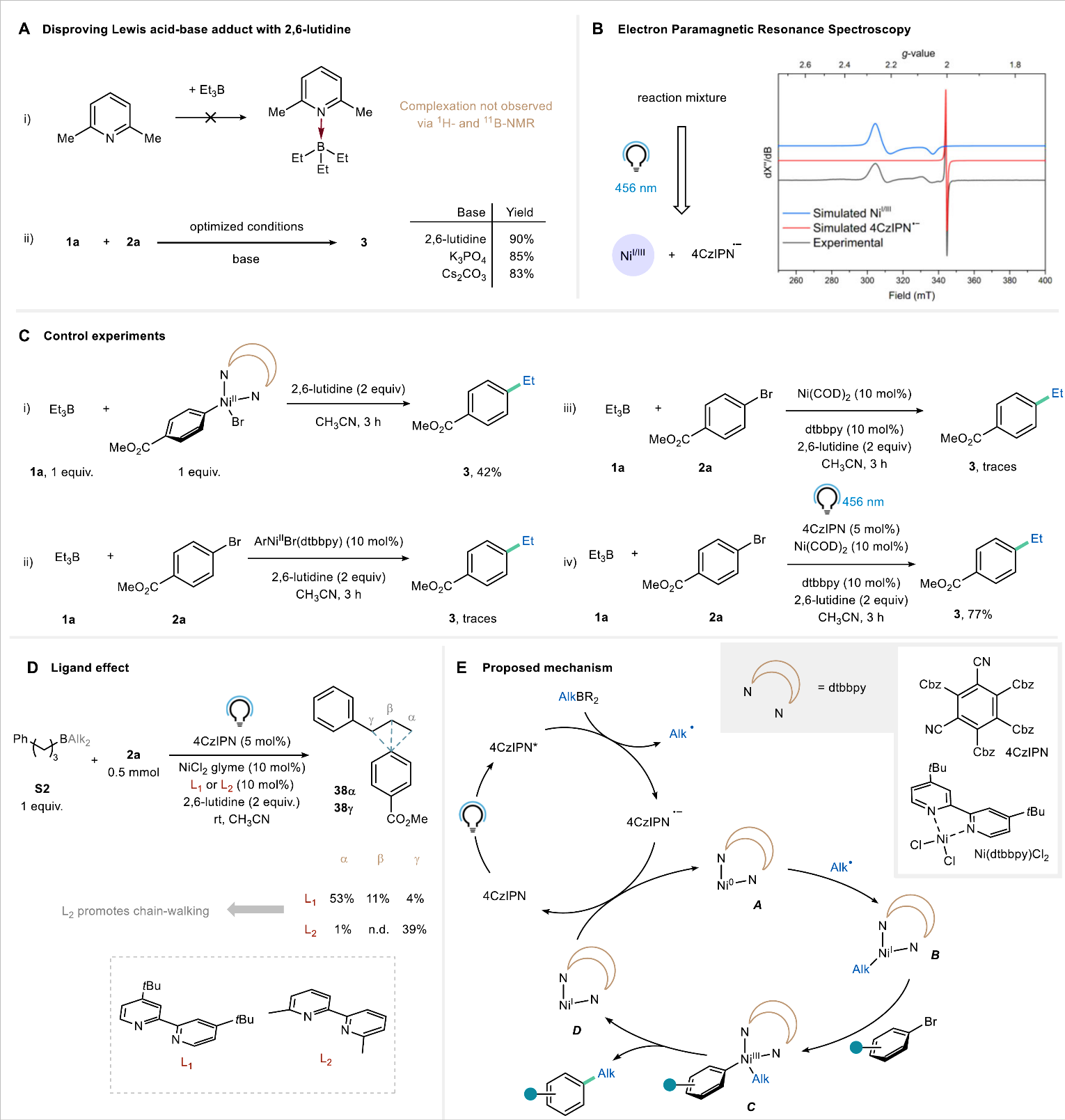
The figure above shows mechanistic studies of photocatalytic/Ni-catalyzed C(sp²)–C(sp³) coupling involving alkyl boranes. A, coordination study of 2,6-lutidine and triethylborane; B, electron paramagnetic resonance experiments; C, control experiments; D, ligand effects; E, the reaction mechanism proposed by the authors. Figure source: Wan, T. et al. Nature Communications 2024, 15, 4028, Fig. 4.
Panels A–D show mechanistic experiments used by the authors to investigate the reaction pathway, while panel E presents the working mechanism proposed on the basis of the experimental results and related literature. In this mechanism, an alkyl radical first combines with low-valent Ni species A to form alkyl–Ni(I) species B. Species B then undergoes oxidative addition with the aryl bromide to form species C, followed by reductive elimination leading to product formation.[6]
Therefore, “kinetic matching between radicals and nickel” cannot be restricted to the idea that “R• must arrive before Ar–Ni(II) decomposes.”
The carbon-centered radical must react sufficiently rapidly with the Ni species that, in the specific reaction under consideration, is capable of proceeding into the productive C–C bond-forming pathway, allowing productive coupling to compete effectively with Ni decomposition, Ni aggregation, and radical side reactions. The specific Ni oxidation states involved and the sequence of individual elementary steps must be determined on the basis of mechanistic evidence for the corresponding reaction system.
8 How Can Kinetic Problems Be Identified from Experimental Observations?
The studies discussed above allow common manifestations of low yield or reaction stalling to be further categorized into different kinetic problems.
Experimental observation | Process that merits particular examination | Literature basis |
The aryl halide is substantially consumed while significant protodehalogenation product is formed | Whether the already formed Ni–aryl OAC decomposes before radical capture | [5] |
The reaction proceeds normally at first, but product formation gradually stalls | Whether catalytically active Ni gradually forms inactive low-valent Ni aggregates | [5] |
A nonactivated carboxylic acid reacts much less efficiently than an activated carboxylic acid | Whether slower photocatalyst quenching lowers the steady-state concentrations of R• and OAC | [5] |
The reaction becomes substantially slower with an electron-rich aryl bromide | Whether oxidative addition of the aryl halide becomes an important rate limitation | [5,6] |
Changing the concentration of the substrate, Ni, or base has little effect on the initial rate | Kinetic experiments are needed to determine whether the system is operating in a photon-limited regime | [6] |
A system confirmed to be photon-limited becomes substantially slower upon scale-up | Changes in optical path length and effective photon flux caused by the change in reactor geometry should be examined | [6] |
These experimental observations alone cannot establish a specific mechanism, but they can help distinguish whether subsequent investigation should focus primarily on radical generation, Ni-intermediate stability, Ni deactivation, or photon transfer.
Two types of behavior are particularly important to distinguish:
① The aryl halide undergoes little or no conversion
In this case, particular attention should be paid to oxidative addition of the aryl halide, formation of catalytically active Ni, and whether the overall photochemical process is functioning effectively.
② The aryl halide is substantially consumed, but dehalogenation products are formed predominantly
In this case, the aryl halide has already entered the reaction pathway, making the stability of subsequent Ni intermediates and the rate of radical capture more important considerations. The OAC study reported in Science in 2022 is an example of this latter situation.[5]
9 The Core of Kinetic Matching Is the Competition between Productive and Deactivation Pathways
Taken together, the studies discussed above show that the kinetics of photoredox/nickel C(sp²)–C(sp³) coupling can be understood from three perspectives.
9.1 Radicals must be generated at an appropriate rate and with appropriate selectivity
Processes such as XAT, decarboxylation, and α-desilylation determine how R• is generated and how rapidly it is formed. The α-silyl amine study further demonstrates that kinetic competition among different post-SET chemical pathways can alter the ultimate bond-forming selectivity.[3,4]
9.2 Catalytically active Ni must maintain sufficient lifetime and concentration before productive reaction occurs
OAC decomposition directly competes with radical capture, while aggregation of low-valent Ni decreases the effective concentration of Ni capable of participating in the catalytic cycle. Stabilizing the OAC or converting inactive oligomeric Ni species back into catalytically active species can both alter the competition between productive reaction pathways and deactivation pathways.[5]
9.3 Photon supply can alter rate control across the overall system
Under photon-limited conditions, effective photon flux can control the overall reaction rate; when oxidative addition of the aryl halide becomes substantially slower, the principal rate limitation can instead shift to the Ni catalytic process.[6]
Accordingly, kinetic matching in photoredox/nickel coupling can be summarized as follows:
The rate of radical generation, the formation and lifetime of catalytically active Ni species, and the effective photon supply collectively determine the kinetic advantage of productive C–C bond formation relative to Ni decomposition, Ni aggregation, and other competing reactions.
For a specific reaction, knowing that a particular intermediate “can form” is only the first level of information. It is also necessary to determine:
How rapidly it forms, how long it persists, and, during the period in which it exists, whether the productive reaction or competitive deactivation pathway has the more favorable kinetic profile.
This constitutes the central concept for understanding kinetic matching in photoredox/nickel C(sp²)–C(sp³) coupling.
10 Classification and Research Applications of Representative Chemicals Related to Kinetic Studies of Photoredox/Nickel C(sp²)–C(sp³) Coupling
Table 1. Photocatalysts, Nickel Catalytic Systems, and Reagents for Modulating Nickel Intermediates
Category | CAS No. | Aladdin Catalog No. | Name | Specification or Purity | Product Features and Applications |
Organic photocatalyst | 1416881-52-1 | 2,4,5,6-Tetra(9H-carbazol-9-yl)isophthalonitrile | ≥99% (HPLC) | Used for visible-light-induced single-electron transfer, radical generation from α-silyl amines and alkylboron compounds, and studies of initial rates, photon supply, and catalytic-cycle kinetics in photoredox/nickel coupling. | |
Iridium photocatalyst | 870987-63-6 | (4,4′-Di-tert-butyl-2,2′-bipyridine)bis[3,5-difluoro-2-[5-(trifluoromethyl)-2-pyridyl-κN]phenyl-κC]iridium(III) hexafluorophosphate | ≥99% | Used for visible-light photoredox single-electron transfer, decarboxylation of carboxylic acids, and radical activation of halides, as well as for studying kinetic coupling between radical generation and changes in nickel oxidation states. | |
Bidentate nickel ligand | 72914-19-3 | 4,4′-Di-tert-butyl-2,2′-bipyridine | ≥98% | Forms bidentate coordination complexes with nickel centers and is used to modulate the electronic properties of nickel species, oxidative addition, radical capture, reductive elimination, and the stability of low-valent nickel species. | |
Nickel catalyst precursor | 29046-78-4 | Nickel(II) chloride dimethoxyethane complex | ≥98% | Used with bipyridine ligands to generate nickel catalytic systems in situ for light-driven coupling of aryl bromides with alkylboron compounds, as well as for studies of catalyst concentration, initial rates, and photon-flux effects. | |
Nickel catalyst precursor | 28923-39-9 | Nickel(II) bromide, dimethoxyethane adduct | ≥97% | Used as a Ni(II) precursor in combination with nitrogen-containing bidentate ligands to construct photoredox/nickel catalytic systems for studies of radical capture, nickel oxidation-state interconversion, and the relative reactivity of different nickel sources. | |
Pre-coordinated nickel catalyst | 1894189-67-3 | 4,4′-Di-tert-butyl-2,2′-bipyridine nickel bromide | ≥97% | Used for photoredox/nickel C–C bond formation involving carbon-centered radicals such as α-amino radicals, and for studying radical capture, oxidative addition, and catalytic-cycle behavior of pre-coordinated nickel species. | |
Zero-valent nickel catalyst | 1295-35-8 | Bis(1,5-cyclooctadiene)nickel(0) | ≥96% | Used as a source of low-valent nickel for mechanistic studies of aryl-halide oxidative addition, radical capture, and the order in which different nickel oxidation states enter the catalytic cycle. | |
Nickel-intermediate-stabilizing additive | 85-41-6 | Phthalimide | ≥99% | Used to stabilize nickel–aryl oxidative addition complexes, suppress protodehalogenation and decomposition of nickel intermediates, and investigate low-valent nickel aggregation, catalyst deactivation, and reaction recovery. | |
Reagent for nickel-intermediate coordination studies | 1074-82-4 | Potassium phthalimide | ≥98% | Used in coordination and stability studies of nickel–aryl oxidative addition complexes, to extend the lifetimes of related nickel intermediates, and to support NMR monitoring and radical-capture experiments. |
Table 2. Radical Precursors, Alkyl-Fragment Sources, and Radical-Generating Reagents
Category | CAS No. | Aladdin Catalog No. | Name | Specification or Purity | Product Features and Applications |
Alkylboron radical precursor | 97-94-9 | Triethylborane solution | 2.0 M in diethyl ether | Used as a model alkylboron substrate that generates ethyl radicals through a light-driven process, for studies of radical-generation rates, photon flux, and the kinetics of radical convergence with low-valent nickel species. | |
Alkene hydroboration reagent | 14044-65-6 | B110263 | Borane–tetrahydrofuran complex | 1.0 M in THF, containing 5 mmol sodium borohydride stabilizer | Used for alkene hydroboration to prepare alkylboron intermediates for subsequent photoredox/nickel arylation, and for studies of telescoped hydroboration–photocoupling and continuous-flow reactions. |
Regioselective hydroboration reagent | 280-64-8 | 9-Borabicyclo[3.3.1]nonane | 0.5 M in THF | Used for alkene hydroboration and generation of alkylboron intermediates, supporting studies of regioselective hydroboration of different alkene substrates and subsequent photoredox/nickel C–C coupling. | |
Decarboxylative radical precursor | 15761-39-4 | Boc-L-proline | ≥99% | Used as a protected α-amino acid radical precursor that forms an α-amino radical through photooxidation and decarboxylation, for studies of decarboxylative photoredox/nickel arylation and radical capture. | |
Activated carboxylic-acid radical precursor | 1148-11-4 | N-Carbobenzyloxy-L-proline | ≥98% | Used for decarboxylative radical generation from protected amino acids and as a carboxylic-acid model with a relatively high photocatalyst-quenching rate, for studying the kinetic relationship between radical-generation rates and capture by nickel oxidative addition complexes. | |
Nonactivated carboxylic-acid radical precursor | 3400-45-1 | Cyclopentanecarboxylic acid | ≥98% | Used as a model nonactivated carboxylic-acid substrate to study photocatalyst quenching, the rate of decarboxylative radical generation, radical steady-state concentrations, and competition with nickel-intermediate decomposition. | |
Heterocyclic carboxylic-acid radical precursor | 5337-03-1 | Tetrahydropyran-4-carboxylic acid | ≥98% (GC) | Used for decarboxylative arylation of nonactivated heterocyclic carboxylic acids and for studying nickel-intermediate stability, radical capture, and substrate scope under conditions of slow radical generation. | |
Organotrifluoroborate radical precursor | 329976-73-0 | Potassium benzyltrifluoroborate | ≥95% | Used to generate benzyl radicals through single-electron oxidation, and to study single-electron activation of organoboron compounds, radical delivery into the nickel catalytic cycle, and aryl–alkyl C–C bond formation. | |
Silyl-radical source | 1873-77-4 | Tris(trimethylsilyl)silane | ≥90%, contains 0.05% Tetrabromobisphenol A as stabilize | Used to generate silyl radicals and promote halogen-atom transfer from alkyl bromides, for studies of alkyl-radical generation rates, halogen-atom-transfer efficiency, and productive convergence between radicals and nickel species. | |
Model alkyl bromide substrate | 25637-16-5 | 4-Bromotetrahydropyran | ≥97% | Used as a model substrate for halogen-atom transfer; activation by silyl radicals generates a tetrahydropyranyl radical for studies of photoredox/nickel cross-electrophile coupling and radical-generation mechanisms. | |
Precursor for α-silyl amine synthesis | 18243-41-9 | (Bromomethyl)trimethylsilane | ≥95% | Used to prepare α-silyl amine radical precursors, supporting studies of α-amino radical generation by desilylation following single-electron oxidation and of selectivity between C–C and C–N bond formation. |
Table 3. Model Aryl Halide Substrates and Electronic-Effect Studies
Category | CAS No. | Aladdin Catalog No. | Name | Specification or Purity | Product Features and Applications |
Electron-rich aryl bromide | 104-92-7 | 4-Bromoanisole | ≥99% | Used to study the effect of electron-donating substituents on the rate of nickel oxidative addition and to compare reaction kinetics under photon-supply-limited and oxidative-addition-controlled conditions. | |
Aryl iodide | 624-31-7 | 4-Iodotoluene | ≥99% | Used as an aryl electrophile in decarboxylative photoredox/nickel coupling to study aryl-halide oxidative addition, radical capture, and reductive elimination leading to aryl–alkyl C–C bond formation. | |
Model electron-deficient aryl bromide substrate | 619-42-1 | Methyl 4-bromobenzoate | ≥98% (GC) | Used as a model aryl bromide in photoredox/nickel coupling, suitable for coupling with alkyl bromides and alkylboron compounds, initial-rate measurements, and comparisons among conditions employing different radical sources. | |
Trifluoromethyl-substituted aryl bromide | 402-43-7 | 4-Bromobenzotrifluoride | ≥98% | Used for studies of oxidative addition of electron-deficient aryl bromides, substituent electronic effects, formation of nickel–aryl intermediates, and time-dependent changes in nickel catalytic activity. | |
Cyano-substituted aryl bromide | 623-00-7 | 4-Bromobenzonitrile | ≥97% (GC) | Used in photoredox/nickel coupling of electron-deficient aryl bromides and for studies of nitrile functional-group tolerance, aryl electronic effects, and nickel oxidative-addition reactivity. |
Table 4. Bases, Reaction Media, and Reagents for Modulating Kinetic Conditions
Category | CAS No. | Aladdin Catalog No. | Name | Specification or Purity | Product Features and Applications |
Alcohol reaction solvent | 67-56-1 | Methanol | Ultradry grade, ≥99.9%, water ≤30 ppm | Used as a reaction medium for photoredox/nickel coupling of alkylboron compounds, supporting low-water-content reaction systems composed of borane derivatives, bases, nickel catalysts, and photocatalysts. | |
Polar aprotic reaction solvent | 75-05-8 | A1522466 | Acetonitrile (ACN) | Electronic grade, UP grade, ≥99.5% | Used as a reaction medium for photoredox/nickel coupling of alkylboron compounds with aryl bromides, and suitable for studies of initial rates, irradiation conditions, and continuous-flow photochemistry. |
Anhydrous ether reaction solvent | 109-99-9 | T1491789 | Tetrahydrofuran (THF) | Anhydrous grade, ≥99.9%, unstabilized, H₂O ≤30 ppm | Used in photoredox/nickel coupling of α-silyl amines, borane solutions, and hydroboration processes, supporting studies of reaction conditions involving moisture-sensitive boron reagents, nickel species, and radical precursors. |
Highly polar aprotic reaction solvent | 872-50-4 | N-Methyl-2-pyrrolidone (NMP) | Anhydrous grade, ≥99.5% | Used under photoredox/nickel coupling conditions for certain α-silyl amines and poorly soluble substrates, and for studying the effects of solvent polarity on dissolution of reaction components, radical generation, and coupling efficiency. | |
Inorganic base | 584-08-7 | P485463 | Potassium carbonate | Anhydrous grade, reagent grade, high purity, ≥99% | Used in the desilylation process following single-electron oxidation of α-silyl amines and for controlling photoredox/nickel coupling conditions, enabling studies of radical-generation pathways and C–C bond-forming selectivity. |
Sterically hindered organic base | 108-48-5 | 2,6-Lutidine | Distilled grade, ≥99% | Used to control basic conditions in photoredox/nickel coupling of alkylboron compounds and to investigate interactions between the base and alkylboron species and their effects on reaction kinetics. | |
Cesium inorganic base | 534-17-8 | Cesium carbonate | purum p.a., ≥98% (T) | Used in decarboxylative photoredox/nickel coupling and base-comparison experiments, supporting carboxylate formation, radical generation, and studies of catalytic behavior under different cation conditions. | |
Organic base | 1122-58-3 | 4-Dimethylaminopyridine | ≥99% | Used under photoredox/nickel coupling conditions for alkylboron compounds derived from borabicyclononane, supporting control of the basic environment, conversion of alkylboron species, and studies of aryl–alkyl bond formation. | |
Strong organic base for mechanistic studies | 29166-72-1 | 2-tert-Butyl-1,1,3,3-tetramethylguanidine | ≥95% | Used to control basic conditions in the formation of nickel oxidative addition complexes and stoichiometric mechanistic experiments, supporting studies of nickel-intermediate stability, decomposition, and competition with radical capture. |
Note: The products listed above are representative Aladdin products relevant to scientific research. Their specific applications should be determined in conjunction with product specifications, batch COAs, and the target reaction or evaluation system. Additional information on product specifications, grades, and COAs can be found on the Aladdin website by searching by “product name/CAS/catalog number.”
References
[1] Tellis, J. C.; Primer, D. N.; Molander, G. A. Single-Electron Transmetalation in Organoboron Cross-Coupling by Photoredox/Nickel Dual Catalysis. Science 2014, 345, 433–436. DOI: 10.1126/science.1253647.
[2] Zuo, Z.; Ahneman, D. T.; Chu, L.; Terrett, J. A.; Doyle, A. G.; MacMillan, D. W. C. Merging Photoredox with Nickel Catalysis: Coupling of α-Carboxyl sp³-Carbons with Aryl Halides. Science 2014, 345, 437–440. DOI: 10.1126/science.1255525.
[3] Zhang, P.; Le, C. C.; MacMillan, D. W. C. Silyl Radical Activation of Alkyl Halides in Metallaphotoredox Catalysis: A Unique Pathway for Cross-Electrophile Coupling. J. Am. Chem. Soc. 2016, 138, 8084–8087. DOI: 10.1021/jacs.6b04818.
[4] Dong, W.; Badir, S. O.; Zhang, X.; Molander, G. A. Accessing Aliphatic Amines in C–C Cross-Couplings by Visible Light/Nickel Dual Catalysis. Org. Lett. 2021, 23, 4250–4255. DOI: 10.1021/acs.orglett.1c01207.
[5] Prieto Kullmer, C. N.; Kautzky, J. A.; Krska, S. W.; Nowak, T.; Dreher, S. D.; MacMillan, D. W. C. Accelerating Reaction Generality and Mechanistic Insight through Additive Mapping. Science 2022, 376, 532–539. DOI: 10.1126/science.abn1885.
[6] Wan, T.; Capaldo, L.; Djossou, J.; Staffa, A.; de Zwart, F. J.; de Bruin, B.; Noël, T. Rapid and Scalable Photocatalytic C(sp²)–C(sp³) Suzuki–Miyaura Cross-Coupling of Aryl Bromides with Alkyl Boranes. Nat. Commun. 2024, 15, 4028. DOI: 10.1038/s41467-024-48212-5.
For more related articles, see below:
New Synthesis Method of New Nickel Reagent and Boric Acid (Ester)
Application of Graphene in Photocatalysis
Nicewicz Photoredox Catalysts for Anti-Markovnikov Alkene Hydrofunctionalization
Experimental Judgment and Condition Selection for Visible-Light Catalysis in Organic Synthesis
Organic Photoredox Catalysts for Visible Light-Driven Polymer and Small Molecule Synthesis


 危险品化学品经营许可证(带存储)