ProPrime Taq DNA Polymerase 是通过基因工程技术对野生型 Taq 酶进行多位点突变获得的突变体酶。与野生型相比,该酶对模板亲和性更高、抗抑制性更强,对临床样品中的内源和外源干扰物具有很强的耐受性,可实现全血直扩、粪便样本粗提物直扩、植物样本粗提物直扩,能有效减少样本前处理和 DNA 提取等步骤。
该酶扩增速率快,适用于快速 PCR;检测灵敏度高,适用于低模板检测。
可用于探针法荧光定量 PCR 检测项目。
该抗体酶使用三个单克隆抗体进行修饰,同时封闭 Taq 酶 5’-3’的聚合活性和 5’-3’外切活性。高温加热前,抗体对聚合酶活性的封闭可有效抑制低温条件下由引物的非特异性退火或引物二聚体引起的非特异性扩增,提升扩增的特异性和扩增效率。抗体对外切活性的封闭可以减少低温条件下对荧光探针的切割,保证 qPCR 的基线平稳,获得比较好的 S 型扩增曲线。
扩增反应体系加热到 95℃并持续 2.5 分钟时,修饰的抗体变性脱落,释放出 Taq 酶的聚合活性和外切活性,因此无需特殊失活处理,在常规 PCR 反应条件下即可使用。
搭配改良的扩增 buffer 使用,能快速热激活,有效增加反应产物量,提高 PCR 反应的灵敏度、特异性和抗干扰性。
适用范围
热启动法进行 qPCR 扩增、全血直扩、抗干扰扩增、快速 PCR、ARMS。
注意事项
1. 对于大多数扩增反应,起始变性时间设为 95℃、2.5 分钟即可;若模板复杂,可适当调整变性时间。
2. 延伸时间需根据 PCR 产物长度确定,例如扩增人基因组 DNA 的 2kb 片段时,延伸时间最快可达 15 秒。复杂模板(如选用全血模板扩增),可适当延长延伸时间。
其他注意事项
1. 以全血为模板进行 PCR 扩增时,全血加入体积建议控制在反应体系体积的 20%(v/v)以内。
2. 用于荧光定量 PCR 时,全血加入体积建议 ≤5%(v/v) 反应体积,过多的血样加入会影响荧光信号的收集。
使用方法
1. 反应体系配制前准备
1.1 室温 / 4℃溶解并混匀反应所需的各种溶液,置于冰浴上或冰盒内。建议反应液体分装使用,避免反复冻融。
1.2 反应体系配制可根据项目需要按比例调整体积,保持终浓度一致即可。
1.3 参考下表设置荧光定量 PCR 反应体系,建议荧光定量 PCR 反应体系的配制在冰浴或在冰盒上进行:
| 组分 | 加入体积 | 终浓度 |
|---|
| 5×GN Buffer(without Mg²⁺) | 10 μL | 1× | | dNTPs(25 mM each) | 0.4 μL | 0.2 mM | | Template DNA | 5~10 μL | — | | Forward Primer(10 µM) | 1 μL | 0.2 µM | | Reverse Primer(10 µM) | 1 μL | 0.2 µM | | Probe(10 µM) | 0.5 μL | 0.1 µM | ProPrime Taq DNA Polymerase(5U/μL)
| 0.5 μL | 2.5U/50μL | | MgCl₂(100 mM) | 1 μL | 2 mM | | ddH₂O | To 50μL | — | | 总体积 | 50μL | — |
|
* 对于不同类型的模板在 50µL 反应体积中推荐用量如下:
哺乳动物基因组 DNA:0.1~1 µg;
大肠杆菌基因组 DNA:10~100 ng;
质粒 DNA:0.1~10 ng;
1.4 Mg²⁺推荐用量为 2mM~6mM。
1.5 配制过程中应避免剧烈震荡,用移液器轻轻吹打混匀或轻微 Vortex 混匀,室温离心数秒。
反应程序
1. 常规定性 PCR(以扩增 1 kb 目的片段为例)
| 步骤名称 | 温度 | 时间 | 循环数 |
|---|
| 热激 | 95℃ | 2min30s | 1 | | 变性 | 95℃ | 20s | 30~35 | | 退火 | 55℃ | 20s | 30~35 | | 延伸 | 72℃ | 40s | 30~35 | | 延伸 | 72℃ | 7min | 1 | | 保存 | 12℃ | ∞ | 1 |
|
2. 荧光定量 PCR
| 步骤名称 | 温度 | 时间 | 循环数 |
|---|
| 热激 | 95℃ | 2min30s | 1 | | 变性 | 95℃ | 15s | 35~40 | | 退火 + 延伸 | 55℃ | 40s | 35~40
|
|
a. PCR 反应的设置需根据模板、引物、PCR 产物的长度和 GC 含量等条件的不同设定不同的 PCR 反应条件,包括温度、时间和循环数等。
b. 延伸的时间设置需根据 PCR 产物的长度进行设置,通常每 kb 产物的延伸时间最快为 15s。例如 PCR 产物的长度为 1kb,则延伸时间可以设置为 15s,PCR 产物的长度为 2kb,则延伸时间可以设置为 30s,如效果不佳,可再适当延长至 45s,其他长度片段以此类推。
实验用例
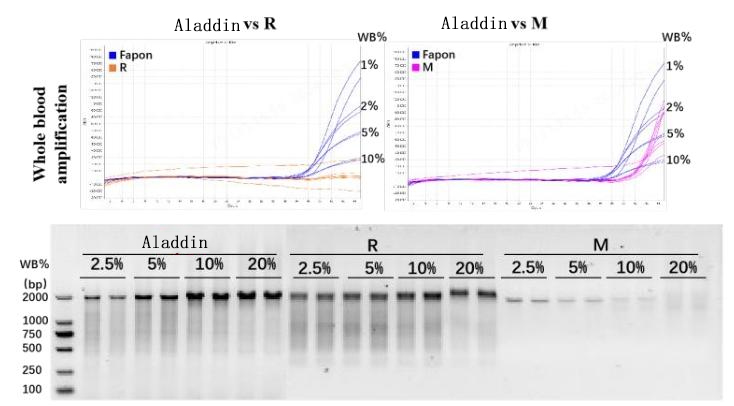
1. 在全血直扩中,比较两个竞品和Aladdin Taq DNA Polymerase 对 全血的耐受性,结果显示Aladdin Taq DNA Polymerase 拥有更强的 全血耐受性,qPCR 项目上可以耐受10%的全血,PCR 项目上可耐 受20%的全血。
2. 以λDNA 为模板,扩增1kb 的目的片段, Aladdin 抗体酶的扩增 灵敏度更高,低模板扩增效率明显由于两个竞品。

3. 以人基因组DNA 为模板,扩增2 kb 目的片段, Aladdin抗体酶可以在更短的延伸时间内扩增出目的片段,平均延申速率为7.5s/kb,适用于快速PCR。

ProPrime Taq DNA Polymerase is a mutant enzyme obtained by site-directed mutagenesis of wild-type Taq enzyme using genetic engineering techniques. Compared with the wild-type, this enzyme has higher affinity for templates and stronger resistance to inhibitors. It exhibits high tolerance to endogenous and exogenous interferents in clinical samples, enabling direct amplification of whole blood, crude extracts from fecal samples, and crude extracts from plant samples, which effectively reduces steps such as sample pretreatment and DNA extraction.This enzyme has a fast amplification rate, making it suitable for rapid PCR; it also has high detection sensitivity, which is applicable for low-template detection.
It can be used in probe-based quantitative real-time PCR (qPCR) detection assays.
This antibody-modified enzyme is modified with three monoclonal antibodies, which simultaneously block the 5’-3’ polymerase activity and 5’-3’ exonuclease activity of Taq enzyme. Before high-temperature heating, the blocking effect of the antibodies on the polymerase activity can effectively inhibit non-specific amplification caused by non-specific annealing of primers or primer dimers under low-temperature conditions, thereby improving the specificity and efficiency of amplification. The blocking effect of the antibodies on the exonuclease activity can reduce the cleavage of fluorescent probes under low-temperature conditions, ensuring a stable baseline in qPCR and obtaining a good S-shaped amplification curve.
When the amplification reaction system is heated to 95°C for 2.5 minutes, the modified antibodies denature and dissociate, releasing the polymerase activity and exonuclease activity of Taq enzyme. Therefore, no special inactivation treatment is required, and the enzyme can be used under conventional PCR reaction conditions.
When used with the improved amplification buffer, it can be quickly thermally activated, effectively increasing the amount of reaction products and improving the sensitivity, specificity, and anti-interference ability of the PCR reaction.
Scope of Application
Hot-start qPCR amplification, direct whole blood amplification, anti-interference amplification, rapid PCR, and ARMS (Amplification Refractory Mutation System)
Precautions
- For most amplification reactions, the initial denaturation time can be set at 95°C for 2.5 minutes. If the template is complex, the denaturation time can be adjusted appropriately.
- The extension time should be determined according to the length of the PCR product. For example, when amplifying a 2kb fragment of human genomic DNA, the extension time can be as fast as 15 seconds. If it is a complex template (such as using whole blood as a template for amplification), the extension time can be appropriately prolonged.
Other Precautions
- When performing PCR amplification using whole blood as a template, the volume of whole blood added is recommended to be controlled within 20% (v/v) of the reaction system volume.
- When used for quantitative real-time PCR (qPCR), the volume of whole blood added is recommended to be ≤ 5% (v/v) of the reaction volume; excessive addition of blood samples will affect the collection of fluorescent signals.
Usage Method
Preparation before Reaction System Configuration
1.1 Dissolve and mix all solutions required for the reaction at room temperature or 4°C, then place them on an ice bath or in an ice box. It is recommended to aliquot the reaction solutions for use to avoid repeated freezing and thawing.
1.2 The volume of the reaction system can be adjusted proportionally according to the project requirements, as long as the final concentration of each component remains consistent.
1.3 Refer to the table below to set up the quantitative real-time PCR (qPCR) reaction system. It is recommended that the preparation of the qPCR reaction system be carried out on an ice bath or in an ice box:
| Component | Volume Added | Final Concentration |
|---|
| 5×GN Buffer (without Mg²⁺) | 10 μL | 1× | | dNTPs (25 mM each) | 0.4 μL | 0.2 mM | | Template DNA | 5 - 10 μL | — | | Forward Primer (10 μM) | 1 μL | 0.2 μM | | Reverse Primer (10 μM) | 1 μL | 0.2 μM | | Probe (10 μM) | 0.5 μL | 0.1 μM | | ProPrime Taq DNA Polymerase (5U/μL) | 0.5 μL | 2.5 U/50 μL | | MgCl₂ (100 mM) | 1 μL | 2 mM | | ddH₂O | To 50 μL | — | | Total Volume | 50 μL | — |
|
*Recommended amounts of different types of templates in a 50 μL reaction volume are as follows:
Mammalian genomic DNA: 0.1 - 1 μg
E. coli genomic DNA: 10 - 100 ng
Plasmid DNA: 0.1 - 10 ng
1.4 The recommended amount of Mg²⁺ is 2 mM - 6 mM.
1.5 Vigorous shaking should be avoided during the preparation process. Mix the solution by gently pipetting up and down or slightly vortexing, then centrifuge at room temperature for a few seconds.
Reaction Procedure
1. Conventional Qualitative PCR (taking the amplification of a 1 kb fragment as an example)
| Step Name | Temperature | Time | Number of Cycles |
|---|
| Heat Shock | 95°C | 2min30s | 1 | | Denaturation | 95°C | 20s | 30 - 35 | | Annealing | 55°C | 20s | 30 - 35 | | Extension | 72°C | 40s | 30 - 35 | | Extension | 72°C | 7min | 1 | | Storage | 12°C | ∞ | 1 |
|
2. Fluorescent Quantitative PCR
| Step Name | Temperature | Time | Number of Cycles |
|---|
| Heat Shock | 95°C | 2min30s | 1 | | Denaturation | 95°C | 15s | 35 - 40 | | Annealing + Extension | 55°C | 40s | 35 - 40 |
|
a. The settings of the PCR reaction (including temperature, time, number of cycles, etc.) need to be adjusted according to factors such as the template, primers, length of the PCR product, and GC content.
b. The extension time should be set based on the length of the PCR product. Generally, the fastest extension time for each 1 kb of product is 15 seconds. For example, if the length of the PCR product is 1 kb, the extension time can be set to 15 seconds; if the length of the PCR product is 2 kb, the extension time can be set to 30 seconds. If the amplification effect is not ideal, the extension time can be appropriately extended to 45 seconds, and so on for fragments of other lengths.
Experimental Examples
1. In direct whole blood amplification, the tolerance to whole blood of two competing products and Aladdin Taq DNA Polymerase was compared. The results showed that Aladdin Taq DNA Polymerase had stronger tolerance to whole blood: it could tolerate 10% whole blood in qPCR projects and 20% whole blood in PCR projects.
2. Using λDNA as the template to amplify a 1 kb target fragment, Aladdin antibody-modified enzyme exhibits higher amplification sensitivity, and its amplification efficiency with low template is significantly better than that of two competing products.
3.Using human genomic DNA as the template to amplify a 2 kb target fragment, the Aladdin antibody-modified enzyme can amplify the target fragment in a shorter extension time, with an average extension rate of 7.5 seconds per kilobase (s/kb), making it suitable for rapid PCR.


 ZJ26F0333689


 危险品化学品经营许可证(带存储)