Hotstart HiTaq DNA Polymerase是一种化学基团修饰的耐热性Taq DNA聚合酶,高温加热前,化学修饰基团与Taq酶结合,抑制聚 合酶的活性,避免了引物延伸的非特异性扩增或引物二聚体的产生,增强了DNA扩增的特异性、灵敏度和稳定性,可广泛适用于 常规PCR、多重PCR及巢式PCR等。经过95℃热激10 min后,该酶即可恢复活性。此外Hotstart HiTaq DNA Polymerase没有检测到 3'→5'校对外切酶活性,但具有5'→3'外切酶活性,可用于荧光定量PCR的检测。Hotstart HiTaq DNA Polymerase在常温下没有活性,便于PCR实验的常温操作。
组分表
FP1509104 | 组分 | 250U | 1KU | 5KU | 存储温度 |
FP1509104A | Hotstart HiTaq DNA Polymerase (5U/μL) | 50 μL | 200 μL | 1.0 mL | -20℃ |
FP1509104B | 5×HS HiTaq Buffer (Mg²⁺ Plus) | 1.0 mL | 4×1.0 mL | 20 mL | -20℃ |
FP1509104C | Solution I (10×) | 500 μL | 2×1.0 mL | 10 mL | -20℃ |
适用范围
适用于热启动 PCR 及 qPCR。
注意事项
引物设计
1. 引物 3'端最后一个碱基最好为 G 或者 C;
2. 引物 3'端最后 8 个碱基应避免出现连续错配;
3. 引物 3'端应避免出现发夹结构;
4. 正向引物和反向引物的 Tm 值相差不超过 1℃为佳,Tm 值调整 至 55 ~ 65℃为佳(引物 Tm 值推荐使用 Primer Premier 5 进行计算);
5. 引物额外附加序列,即与模板非配对序列,不应参与引物 Tm 值计算;
6. 引物的 GC 含量控制在 40% ~ 60%之间;
7. 引物 A、G、C、T 整体分布要尽量均匀,避免使用 GC 或者 AT 含量高的区域;
8. 引物内部或者两条引物之间避免有 5 个碱基以上的互补序列, 两条引物的 3'端避免有 3 个碱基以上的互补序列;
9. 引物设计完毕请使用 NCBI BLAST 功能检索引物特异性,以避 免非特异性扩增产生。
使用方法
溶解并混匀PCR反应所需的各种溶液,并放置于冰浴上或冰盒内。 建议反应PCR液体分装使用,避免反复冻融。参考下表设置PCR 反应:
1. PCR 反应体系的设置:
| Component | Added Volume | Final Concentration | | 5×HS HiTaq Buffer(Mg²⁺ Plus) | 4 μL | 1× | | Solution I(10×) | 2 μL | 1× | | dNTP(25mM each) | 0.16 μL | 0.2 mM | | Hotstart HiTaq DNA Polymerase(5U/μL) | 0.2 μL | — | | Forward Primer(10μM) | 0.4 μL | 0.2 μM | | Reverse Primer(10μM) | 0.4 μL | 0.2 μM | | 模板 * | 4 μL(※) | — | | ddH₂O | To 20 μL | — | | 终体积 | 20 μL |
|
|
※ 模板DNA 用量:为了保证反应的灵敏性,20 μL体系使用10⁴拷贝的靶序列作为模板,可参考下表计算需加入PCR体系的模板量。
1μg 各种来源的 DNA 对应的摩尔数
| 1 μg DNA | Mol |
|---|
| 1 kb 线性双链 DNA | 9.18×10¹¹ | | 3 kb 质粒 DNA | 2.9×10¹⁰ | | Lambda (λ) DNA | 1.9×10¹⁰ | | E.coli 基因组 DNA | 2.0×10⁸ | | 人类基因组 DNA | 3.0×10⁵ |
|
例如:纯化的人类基因组 DNA 浓度为 1μg/μL,某基因在人类基因组中拷贝数为 10,其单位体积拷贝数为:3.0×10⁵ mol/μg×1μg/μL×10 copy/mol=3.0×10⁶ copy/μL1×10⁴copy/(3.0×10⁶ copy/μL)=1/300μL即:1/300μL 浓度为 1μg/μL 的人类基因组 DNA 中含 10⁴ 拷贝该基因,稀释 300 倍后加 1μL 至 25μL PCR 体系。为保证反应的特异性,DNA 终浓度应小于 10 ng/μL,过多的 DNA 可能会出现涂抹带甚至无特异性条带。
2. 用移液器轻轻吹打混匀或轻微 Vortex 混匀,室温离心数秒,使液体积聚于管底。
3. 各设置好的 PCR 反应管置于 PCR 仪上,开始 PCR 反应。
反应程序
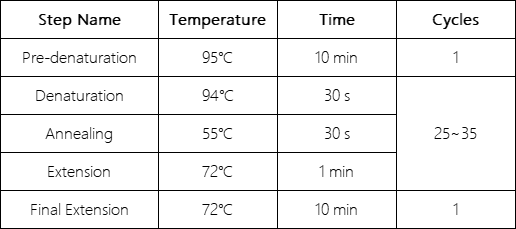
1. 常规定性 PCR(以扩增 1 kb 目的片段为例)

2. 荧光定量 PCR

a. PCR 反应的设置需根据模板、引物、PCR 产物的长度和 GC 含量等条件的不同设定不同的 PCR 反应条件包括温度、时间和循环数等。
b. STEP4 (延伸) 的时间设置需根据 PCR 产物的长度进行设置,通常每 kb 产物的延伸时间为 1 min。例如 PCR 产物的长度为 1 kb,则延伸时间可以设置为 1min,PCR 产物的长度为 2 kb,则延伸时间可以设置为 2 min,以此类推。
c. 对于初次进行的 PCR,为尽量确保可以扩增出预期的 PCR 产物,可以把循环数设置为 35。对于需进行半定量或定量的 PCR 反应循环数一定要进行适当优化,使 PCR 反应达到平台期。
Hotstart HiTaq DNA Polymerase is a thermostable Taq DNA polymerase modified with chemical groups. Before high-temperature heating, the chemical modification groups bind to the Taq enzyme, inhibiting its polymerase activity. This avoids non-specific amplification from primer extension or formation of primer dimers, enhancing the specificity, sensitivity, and stability of DNA amplification. It is widely applicable to conventional PCR, multiplex PCR, nested PCR, and other applications. The enzyme can recover its activity after heat shock at 95℃ for 10 minutes. In addition, no 3'→5' proofreading exonuclease activity is detected in Hotstart HiTaq DNA Polymerase, but it possesses 5'→3' exonuclease activity, making it suitable for quantitative real-time PCR (qPCR) detection. Hotstart HiTaq DNA Polymerase is inactive at room temperature, facilitating room-temperature operation of PCR experiments.
Component List
FP1509104 | Components | 250U | 1KU | 5KU | Storage |
FP1509104A | Hotstart HiTaq DNA Polymerase (5U/μL) | 50 μL | 200 μL | 1.0 mL | -20℃ |
FP1509104B | 5×HS HiTaq Buffer (Mg²⁺ Plus) | 1.0 mL | 4×1.0 mL | 20 mL | -20℃ |
FP1509104C | Solution I (10×) | 500 μL | 2×1.0 mL | 10 mL | -20℃ |
Application Scope
Suitable for hot-start PCR and qPCR.
Precautions
Primer Design
- The last base at the 3' end of the primer is preferably G or C.
- The final 8 bases at the 3' end of the primer should avoid consecutive mismatches.
- The 3' end of the primer should avoid forming hairpin structures.
- The Tm values of the forward and reverse primers should preferably differ by no more than 1℃, and the optimal Tm value range is 55~65℃ (Primer Premier 5 is recommended for calculating primer Tm values).
- Additional sequences of the primer, i.e., sequences not paired with the template, should not be included in the Tm value calculation.
- The GC content of the primer should be controlled between 40% and 60%.
- The overall distribution of A, G, C, and T in the primer should be as uniform as possible, avoiding regions with high GC or AT content.
- Avoid complementary sequences of more than 5 bases within a single primer or between the two primers; complementary sequences of more than 3 bases at the 3' ends of the two primers should also be avoided.
- After primer design, use the NCBI BLAST tool to verify primer specificity to prevent non-specific amplification.
Usage Method
Thaw and mix all required PCR reaction solutions thoroughly, then place on an ice bath or in an ice box. It is recommended to aliquot the PCR reaction solutions for use to avoid repeated freeze-thaw cycles. Set up the PCR reaction with reference to the table below:
- Preparation of the PCR reaction system:
| Component | Added Volume | Final Concentration | | 5×HS HiTaq Buffer(Mg²⁺ Plus) | 4 μL | 1× | | Solution I(10×) | 2 μL | 1× | | dNTP(25mM each) | 0.16 μL | 0.2 mM | | Hotstart HiTaq DNA Polymerase(5U/μL) | 0.2 μL | — | | Forward Primer(10μM) | 0.4 μL | 0.2 μM | | Reverse Primer(10μM) | 0.4 μL | 0.2 μM | Template DNA*
| 4 μL(※) | — | | ddH₂O | To 20 μL | — | Final Volume
| 20 μL |
|
|
※ Amount of Template DNA: To ensure reaction sensitivity, use 10⁴ copies of the target sequence as the template in a 20 μL reaction system. The amount of template to be added to the PCR system can be calculated with reference to the table below.
Molar Number of DNA from Various Sources per 1 μg
| 1 μg DNA | Mol |
|---|
| 1 kb linear double-stranded DNA | 9.18×10¹¹ | | 3 kb Plasmid DNA | 2.9×10¹⁰ | | Lambda (λ) DNA | 1.9×10¹⁰ | | E. coli Genomic DNA | 2.0×10⁸ | | Human Genomic DNA | 3.0×10⁵ |
|
For example: Purified human genomic DNA has a concentration of 1 μg/μL. If a gene has 10 copies in the human genome, its copy number per unit volume is calculated as: 3.0×10⁵ mol/μg × 1 μg/μL × 10 copy/mol = 3.0×10⁶ copy/μL. To obtain 10⁴ copies, the volume needed is 10⁴ copy / (3.0×10⁶ copy/μL) = 1/300 μL. That is, 1/300 μL of human genomic DNA at 1 μg/μL concentration contains 10⁴ copies of the gene. Dilute it 300-fold and add 1 μL to a 25 μL PCR system. To ensure reaction specificity, the final DNA concentration should be less than 10 ng/μL; excessive DNA may cause smearing or even non-specific bands.
2. Mix gently by pipetting up and down or slight vortexing, then centrifuge at room temperature for a few seconds to collect the liquid at the bottom of the tube.
3. Place each prepared PCR reaction tube in the PCR instrument and start the PCR reaction.
Reaction Procedure
1. Conventional Qualitative PCR (taking the amplification of a 1 kb target fragment as an example)
2. Quantitative Real-time PCR

a. PCR reaction conditions (including temperature, time, and number of cycles) should be set differently based on factors such as template, primers, length of PCR product, and GC content.
b. The time for STEP4 (Extension) should be set according to the length of the PCR product. Typically, the extension time is 1 min per kb of the product. For example, if the PCR product length is 1 kb, the extension time can be set to 1 min; if the product length is 2 kb, the extension time can be set to 2 min, and so on.
c. For the first-time PCR, set the number of cycles to 35 to maximize the chance of amplifying the expected PCR product. For semi-quantitative or quantitative PCR, the number of cycles must be properly optimized to ensure the reaction reaches the plateau phase.




 危险品化学品经营许可证(带存储)