
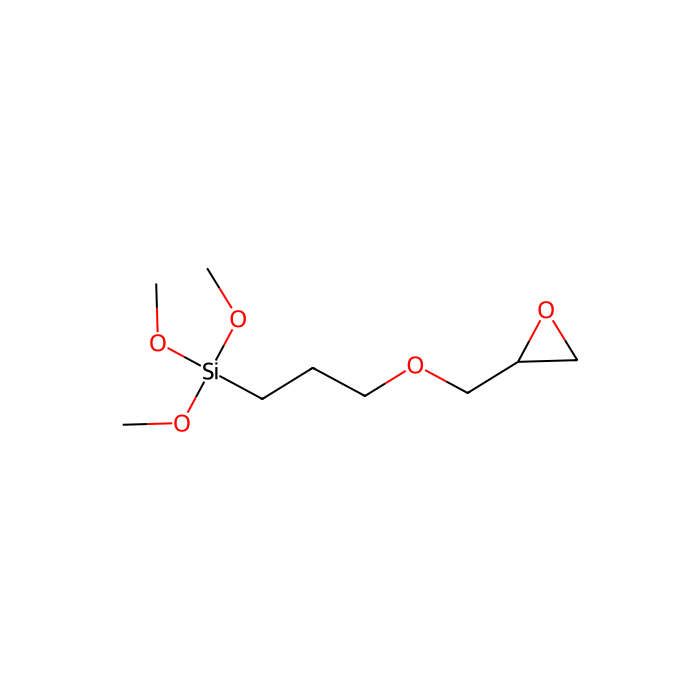
3-缩水甘油基氧基丙基三甲氧基硅烷(GPTMS)

CAS: 2530-83-8 货号: G107576 分子式: C9H20O5Si 分子量: 236.34 Beilstein号: 4308125 EC号: 219-784-2
有货
级别和纯度: ≥97%
别名
硅烷偶联剂KH-560 | γ-缩水甘油醚氧丙基三甲氧基硅烷 | 3-甘油丙基三甲氧基硅烷 | 环氧丙基3-三甲氧基硅基丙醚
储存条件
2-8°C储存,充氩
运输条件
低温运输
★
规格
库存
价格
数量
25g
G107576-25g
现货 Stock Image
¥30.90
100g
G107576-100g
现货 Stock Image
¥54.90
500g
G107576-500g
现货 Stock Image
¥181.90
2.5kg
G107576-2.5kg
现货 Stock Image
¥599.90
请输入您要添加的产品数量
🧪
为什么选择此级别

提供 ≥97% 纯度,适用于对基线干扰要求严格的色谱和分析工作流程。

🌡

储存与运输

2-8°C储存,充氩。低温运输 。请查阅批次 COA 获取详细规格。

📋

质量文档

SDS、COA、产品数据表及规格说明书均可下载。可通过批号查询获取批次 COA。

📚

文献证明

在色谱分析、有机合成和交叉偶联反应领域已被 485 篇同行评审文献引用。

概述

(3-缩水甘油基氧基丙基)三甲氧基硅烷(GPTMS)是一种双官能团有机硅烷,其一侧有三个甲氧基,另一侧有环氧环。甲氧基与玻璃基材结合紧密,从而形成了一种3D基质。环氧基可与酰胺、醇、硫醇和酸发生反应。GPTMS在水中具有很高的反应活性,可以用作二氧化硅表面和聚合物基质之间的连接剂。
应用:
GPTMS是一种广泛使用的二氧化硅前体。GPTMS与正硅酸四乙酯(TEOS)可以与壳聚糖共混,用作骨组织工程聚合物骨架的填充剂。它也可以涂覆在铝合金表面以防止腐蚀。GPTMS可用于对可用作环氧树脂基质纳米复合材料的增强材料的多壁碳纳米管(MWCNT)进行功能化修饰(包裹)。用(3-缩水甘油基氧基丙基)三甲氧基硅烷(GPTMS)对碳钢进行预处理可提高干态和湿态附着力,同时降低环氧涂层的阴极剥离率。
(3-Glycidyloxypropyl)trimethoxysilane (GPTMS) is a bifunctional organosilane with three methoxy groups on one side and an epoxy ring on the other. The methoxy groups bond tightly to the glass substrate, forming a 3D matrix. The epoxy groups react with amides, alcohols, thiols, and acids. GPTMS exhibits high reactivity in water and can be used as a linker between silica surfaces and polymer matrices.
Applications
GPTMS is a widely used silica precursor. GPTMS, combined with tetraethyl orthosilicate (TEOS) and chitosan, can be blended as a filler for polymeric skeletons in bone tissue engineering. It can also be coated onto aluminum alloy surfaces to prevent corrosion. GPTMS can be used for the functionalization (encapsulation) of multi-walled carbon nanotubes (MWCNTs), which can be used as reinforcing materials in epoxy-based nanocomposites. Pretreatment of carbon steel with (3-glycidyloxypropyl)trimethoxysilane (GPTMS) improves dry and wet adhesion while reducing the cathodic disbondment rate of epoxy coatings.

规格

别名
硅烷偶联剂KH-560 | γ-缩水甘油醚氧丙基三甲氧基硅烷 | 3-甘油丙基三甲氧基硅烷 | 环氧丙基3-三甲氧基硅基丙醚
英文别名
3-glycidoxypropyltrimethoxysilane | (3-Glycidoxypropyl)trimethoxysilane | GLYMO | GOPTS | Glycidyl 3-Trimethoxysilylpropyl Ether
规格或纯度
≥97%
英文名称
3-Glycidyloxypropyltrimethoxysilane(GPTMS)
储存条件
2-8°C储存,充氩
运输条件
低温运输
纯度
≥97%
名称和识别符
PubChem SID
EC号
219-784-2
分子类型
小分子
IUPAC Name
trimethoxy-[3-(oxiran-2-ylmethoxy)propyl]silane
INCHI
1S/C9H20O5Si/c1-10-15(11-2,12-3)6-4-5-13-7-9-8-14-9/h9H,4-8H2,1-3H3
InChi Key
BPSIOYPQMFLKFR-UHFFFAOYSA-N
Smiles
CO[Si](CCCOCC1CO1)(OC)OC
Isomeric SMILES
CO[Si](CCCOCC1CO1)(OC)OC
分子量
236.34
Beilstein号
4308125
Reaxy-Rn
4308125
Reaxys-RN link address
https://www.reaxys.com/reaxys/secured/hopinto.do?context=S&query=IDE.XRN=4308125&ln=

技术文档

📋 安全数据表 (SDS)

全面的危险、操作、储存及法规合规文件。

下载 SDS →

✅ 分析证书 (COA)

批次质量数据。输入批号以获取对应 COA。

查询 COA →

📊 产品数据表

产品规格和应用的快速参考摘要。

查看数据表 →

🔬 规格说明书

该级别的完整质量属性和验收标准。

查看规格说明 →

高级数据

系统学分类

分类树(Taxonomy Tree)

界(kingdom) 有机化合物
超类(Superclass) 有机金属化合物
类(Class) 有机准金属化合物
亚类(Subclass) 有机硅化合物
中间层级节点(Intermediate Tree Nodes) 烷氧基硅烷
直接上位类(Direct Parent) 三烷氧基硅烷
其他上位类(Alternative Parents) 硅醚  氧环化合物  有机杂硅烷  有机准金属盐  环氧物  二烷基醚  碳氢化合物衍生物  
分子骨架(Molecular Framework) 脂肪族杂单环化合物
取代基(Substituents) 脂肪族杂单环化合物 - 二烷基醚 - 乙醚 - 烃衍生物 - 有机类金属盐 - 有机氧化合物 - 有机盐 - 有机杂环化合物 - 有机杂环硅烷 - 有机氧化合物 - 氧杂环 - 氧杂环丁烷 - 硅烷醇 - 三烷氧基硅烷
描述(Description) 该化合物属于有机化合物中的三烷氧基硅烷类。这类有机硅化合物通式为RO[Si](R')(OR'')OR''''(R-R''=脂肪族有机基团)。
外部描述符(External Descriptors) 暂无
三维结构
交互式化学结构模型


作用机制
作用机制 Action Type target ID Target Name Target Type Target Organism Binding Site Name 参考文献
化学和物理性质
溶解性
Miscible with alcohols, ketones and aliphatic or aromatic hydrocarbons. Immiscible with water.
密度
1.07
敏感性
易吸潮
折光率
1.429
闪点(℉)
278.6°F
闪点(℃)
137°C
沸点
119-121°C
熔点
<-70°C
分子量
236.340 g/mol
XLogP3
氢键供体数Hydrogen Bond Donor Count
0
氢键受体数Hydrogen Bond Acceptor Count
5
可旋转键计数Rotatable Bond Count
9
精确质量Exact Mass
236.108 Da
单同位素质量Monoisotopic Mass
236.108 Da
拓扑极表面积Topological Polar Surface Area
49.500 Ų
重原子数Heavy Atom Count
15
形式电荷Formal Charge
0
复杂度Complexity
166.000
同位素原子数Isotope Atom Count
0
定义的原子立体中心计数Defined Atom Stereocenter Count
0
未定义的原子立体中心计数Undefined Atom Stereocenter Count
1
定义的键立体中心计数Defined Bond Stereocenter Count
0
未定义的键立体中心计数Undefined Bond Stereocenter Count
0
所有立体化学键的总数The total count of all stereochemical bonds
0
共价键合单元计数Covalently-Bonded Unit Count
1
安全和危险性(GHS)
象形图
GHS05,   GHS07,   GHS08
信号词
危险
危险声明

H318: 造成严重的眼睛损伤

H319: 引起严重眼睛刺激

H341: 怀疑引起遗传缺陷

H412: 对水生生物有害并具有长期持续影响

预防措施声明

P273: 避免释放到环境中。

P280: 戴防护手套/穿防护服/戴防护眼罩/戴防护面具。

P281: 根据需要使用个人防护设备。

P305+P351+P338: 如进入眼睛:用水小心冲洗几分钟。如戴隐形眼镜并可方便地取出,取出隐形眼镜。继续冲洗。

P405: 密闭存放

P501: 将内容物/容器处理到。。。

P203: 使用前,获取、阅读并遵守所有安全说明。

P264+P265: 处理后彻底洗手[和…]。不要触摸眼睛。

P305+P354+P338: 如果进入眼睛:立即用水冲洗几分钟。取下隐形眼镜(如果有的话),并且操作简单。继续冲洗。

P318: 如果暴露或担心,请就医。

P317: 寻求紧急医疗救助。

P337+P317: 如果眼睛刺激持续:寻求医疗帮助。

WGK Germany
2
RTECS
VV4025000
个人防护装备
Eyeshields,Gloves,half-mask respirator (EU),half-mask respirator (US),multi-purpose combination respirator cartridge (US)
质检证书(CoA,COO,BSE/TSE 和分析图谱)
C of A & Other Certificates(BSE/TSE, COO):
输入批号以搜索分析图谱:

通过匹配包装上的批号来查找并下载产品的 COA,每批产品都进行了严格的验证,您可放心使用!

找到75个结果

批号(Lot Number) 证书类型 货号
H2615447 分析证书 G107576
H2615448 分析证书 G107576
H2615449 分析证书 G107576
H2615450 分析证书 G107576
A2329344 分析证书 G107576
F2605237 分析证书 G107576
F2605238 分析证书 G107576
F2605236 分析证书 G107576
F2605235 分析证书 G107576
E2621410 分析证书 G107576
E2621425 分析证书 G107576
E2621428 分析证书 G107576
E2621440 分析证书 G107576
D2607421 分析证书 G107576
D2607422 分析证书 G107576
D2607423 分析证书 G107576
D2607420 分析证书 G107576
A2622439 分析证书 G107576
A2622438 分析证书 G107576
A2622430 分析证书 G107576
A2622429 分析证书 G107576
J2530390 分析证书 G107576
J2530454 分析证书 G107576
J2530455 分析证书 G107576
J2530456 分析证书 G107576
A2410207 分析证书 G107576
A2410201 分析证书 G107576
E2529393 分析证书 G107576
E2529328 分析证书 G107576
E2529329 分析证书 G107576
A2329320 分析证书 G107576
L2420614 分析证书 G107576
L2420615 分析证书 G107576
L2420616 分析证书 G107576
L2420617 分析证书 G107576
I2403435 分析证书 G107576
I2403436 分析证书 G107576
I2403437 分析证书 G107576
I2403438 分析证书 G107576
D2402234 分析证书 G107576
D2525051 分析证书 G107576
J2511115 分析证书 G107576
D2402231 分析证书 G107576
D2402232 分析证书 G107576
D2402233 分析证书 G107576
C2426199 分析证书 G107576
C2407123 分析证书 G107576
C2407139 分析证书 G107576
C2407122 分析证书 G107576
C2407121 分析证书 G107576
A2410202 分析证书 G107576
A2410204 分析证书 G107576
A2410210 分析证书 G107576
L2313353 分析证书 G107576
L2313352 分析证书 G107576
I2322106 分析证书 G107576
G2327201 分析证书 G107576
G2327200 分析证书 G107576
G2327194 分析证书 G107576
C2303775 分析证书 G107576
C2303802 分析证书 G107576
C2303761 分析证书 G107576
A2329301 分析证书 G107576
A2329319 分析证书 G107576
A2329489 分析证书 G107576
K2204487 分析证书 G107576
K2204488 分析证书 G107576
K2204489 分析证书 G107576
K2204491 分析证书 G107576
G2226567 分析证书 G107576
G2226564 分析证书 G107576
G2226563 分析证书 G107576
G2226568 分析证书 G107576
I2220115 分析证书 G107576
C2223036 分析证书 G107576
技术文档和文章
有机硅材料全景指南:结构机理、核心性能、产业链与产品分类
A Panoramic Guide to Silicone Materials: Structural Mechanisms, Core Properties, Value Chain, and Product Categories
纳米粘土在材料与配方中的应用:分散机理、性能提升与产品选型
Applications of Nanoclay in Materials and Formulations: Dispersion Mechanisms, Performance Enhancement, and Product Selection
高折射率 vs 低折射率涂层材料:从 AR/波导原理到配方与选型导航(含产品分类表A/B/C)
High-Refractive-Index vs Low-Refractive-Index Coating Materials: From AR/Waveguide Principles to a Formulation & Material-Selection Map (Including Product Category Tables A/B/C)
自组装单层(SAM)选型与方法学:以烷硫醇/Au 为主线的工艺窗口与验证排查(含选型导航及产品表1–表3)
Self-Assembled Monolayers (SAMs): Selection & Methodology Process Window and Verification/Troubleshooting Along the Alkanethiol/Au Route (with Selection Guide and Product Tables 1–3)
硅烷偶联剂耐湿热界面指南:从失效机理到证据链排查与选型(含产品表A–表C)
A Hygrothermal Interface Guide for Silane Coupling Agents: From Failure Mechanisms to Evidence-Chain Troubleshooting and Selection (with Product Tables A–C)
材料性能为何受限于界面:硅烷偶联剂的作用机理与选型导航(表1–表4)
Why Material Properties Are Limited by Interfaces: Mechanism of Action and Selection Guide for Silane Coupling Agents (Tables 1–4)
自组装单层(SAMs)与微接触印刷 / 软光刻在表面功能化和微纳图案化中的应用
Applications of Self-Assembled Monolayers (SAMs), Microcontact Printing, and Soft Lithography in Surface Functionalization and Micro/Nanopatterning
Sol-Gel(溶胶—凝胶)成膜中的硅烷前驱体:前驱体选择及其对成膜结果的影响
Silane Precursors in Sol-Gel Film Formation: Precursor Selection and Its Influence on Film-Formation Outcomes
烷基硅烷:结构特点、表面反应、应用与产品选型
Alkylsilanes: Structural Features, Surface Reactions, Applications, and Product Selection
钛酸酯偶联剂:结构特点、分类、典型应用及与硅烷偶联剂的区别
Titanate Coupling Agents: Structural Features, Classification, Typical Applications, and Differences from Silane Coupling Agents
环氧基硅烷偶联剂:结构特点、分类、典型应用与使用注意事项
Epoxy Silane Coupling Agents: Structural Features, Classification, Typical Applications, and Precautions for Use
硅烷偶联剂底涂液的配制方法与注意事项
Preparation Methods and Precautions for Silane Coupling Agent Primer Solutions
硅烷偶联剂适用于哪些填料和底材:表面羟基、界面键合与实验验证
Which Fillers and Substrates Are Suitable for Silane Coupling Agents: Surface Hydroxyls, Interfacial Bonding, and Experimental Verification
硅溶胶是什么:纳米二氧化硅分散液的作用机理、应用场景与选型要点
What Is Silica Sol: Mechanism of Action, Application Scenarios, and Selection Criteria for Nanosilica Dispersions
涂料消光剂如何构建低光泽涂层表面:机理、配方权衡与产品选型
How Matting Agents in Coatings Build Low-Gloss Coating Surfaces: Mechanisms, Formulation Trade-Offs, and Product Selection
环氧树脂:从反应型树脂到高性能材料体系
Epoxy Resin: From Reactive Resin to High-Performance Material System
环氧树脂的四类核心应用:连接、防护、承载与绝缘保护
Four Core Applications of Epoxy Resins: Bonding, Protection, Load-Bearing, and Insulation Protection
环氧树脂性能设计指南:体系组成、关键性能、工艺控制与应用选型
Guide to Epoxy Resin Performance Design: System Composition, Key Properties, Process Control, and Application Selection
聚氨酯涂料体系选型指南:木器、地坪、塑胶、汽车与工业防护应用解析
Guide to Selecting Polyurethane Coating Systems: Application Analysis for Wood, Flooring, Plastics, Automotive, and Industrial Protection
氟碳树脂涂料配方设计:树脂选型、配套体系与应用控制要点
Fluorocarbon Resin Coating Formulation Design: Resin Selection, Supporting Systems, and Key Application Control Points
从结构看硅树脂:硅氧烷骨架、M/D/T/Q 单元与涂料性能调节
Understanding Silicone Resins from Their Structure: Siloxane Backbones, M/D/T/Q Units, and Coating Performance Regulation
聚氨酯涂料配方设计与施工应用中的关键控制要点
Key Control Points in Polyurethane Coating Formulation Design and Application
硅树脂涂料配方设计:从应用工况到树脂、颜填料、固化与底材匹配
Silicone Resin Coating Formulation Design: From Application Conditions to Matching Resins, Pigments and Fillers, Curing, and Substrates
什么时候选择硅树脂?与环氧、丙烯酸、聚氨酯、氟树脂等涂料树脂的选型对比
When Should You Choose Silicone Resin? Selection Comparison with Epoxy, Acrylic, Polyurethane, Fluororesin, and Other Coating Resins
从天然纤维素到纳米晶体:CNC 的结构特性、应用方向与产业化挑战
From Natural Cellulose to Nanocrystals: Structural Characteristics, Application Directions, and Industrialization Challenges of CNC
蒙脱土如何合理改性?有机改性、无机改性与应用选型验证思路
How Should Montmorillonite Be Rationally Modified? Organic Modification, Inorganic Modification, and Application-Oriented Selection and Validation
常见水性树脂类型与应用选型指南:丙烯酸、PUD、水性环氧、水性醇酸、VAE 及相关化学品如何选择
Guide to Common Waterborne Resin Types and Application-Based Selection: How to Choose Acrylics, PUD, Waterborne Epoxy, Waterborne Alkyd, VAE, and Related Chemicals
涂料性能问题诊断与树脂改性路线选择
Diagnosis of Coating Performance Issues and Selection of Resin Modification Routes
常见树脂改性技术的结构设计逻辑:分子链结构、官能团、相结构、交联网络与杂化/功能化设计
Structural Design Logic of Common Resin Modification Technologies: Molecular Chain Structure, Functional Groups, Phase Structure, Crosslinked Networks, and Hybrid/Functional Design
涂料咬底的机理、诊断与控制:溶剂渗透、涂膜溶胀与层间失稳
Mechanism, Diagnosis, and Control of Coating Lifting: Solvent Penetration, Film Swelling, and Interlayer Instability
涂料配方中的树脂极性:从分子结构到溶解、相容、界面作用与配方设计
Resin Polarity in Coating Formulations: From Molecular Structure to Dissolution, Compatibility, Interfacial Interactions, and Formulation Design
石墨烯生物传感器的信号转换机制:从分子识别到电学/光学信号读出与材料选型
Signal Transduction Mechanism of Graphene Biosensors: From Molecular Recognition to Electrical/Optical Signal Readout and Materials Selection
聚乙烯醇1788、2488、2699有什么区别?从聚合度和醇解度看施工性、粘结强度与相对耐水性
What Are the Differences Between Polyvinyl Alcohol 1788, 2488, and 2699? Understanding Workability, Bonding Strength, and Relative Water Resistance from the Perspective of Degree of Polymerization and Degree of Hydrolysis
醛亚胺潜固化剂在单组分湿固化聚氨酯中的应用——CO₂ 气泡控制机理与配方设计要点
Application of Aldimine Latent Curing Agents in One-Component Moisture-Curing Polyurethane Systems —— Mechanism of CO₂ Bubble Control and Key Formulation Design Points
此产品的引用文献
溶液计算器
