分化作用是指组织染色后用某些特定的溶液将组织过多结合的染色剂脱去,这个过程称为分化作用,所用的溶液称为分化液。在HE染色和其他染色中常用1%盐酸乙醇作为分化液,因酸能破坏苏木素的醌型结构,使组织与色素分离而退色,再进行伊红染色,才能保证细胞核与细胞浆染色的分明。
盐酸乙醇分化液主要由盐酸、乙醇、去离子水等组成,经常用于苏木素染色、苏木素伊红染色 (HE染色)或Masson染色等涉及苏木素染色时,可缓慢地降低细胞浆等背景性的苏木素染色并使细胞核苏木素染色更清晰的溶液,是一种非常重要的辅助试剂。使用本产品可获得更好的苏木素染色效果。本产品的基本原理是在酸性条件下,可以有效洗去细胞核以外的苏木素染色,从而降低背景;同时,也可以使细胞核着色过深的区域染色适当减弱,使染色更清晰。
盐酸乙醇慢速分化液分化时间比较长,一般需要30~50秒,可以精细化控制分化效果。如果希望快速地分化,可以考虑选购盐酸乙醇快速分化液或盐酸乙醇超快速分化液,或用1%酸性乙醇分化液。该试剂仅用于科研领域,不适用于临床诊断或其他用途。
自备材料:
1、自来水或蒸馏水、4%多聚甲醛或中性福尔马林固定液、二甲苯或浸蜡脱蜡透明液
2、系列乙醇、苏木素染色液、伊红染色液、蓝化液(稀氨水、碳酸锂溶液等)、中性树胶
操作步骤(HE染色步骤,仅供参考):
1、组织脱蜡至水。
2、苏木素染色液染色3-8min。
3、自来水或蒸馏水冲洗5-10s。
4、盐酸乙醇慢速分化液分化30-50s。
5、自来水冲洗20-30s。
6、蓝化液或温水返蓝20-40s。
7、80%乙醇脱水30-60s。
8、伊红染色液(醇溶)染色20-60s。
9、梯度乙醇脱水,二甲苯或环保脱蜡透明液透明,中性树胶封片,镜检。
注意事项:
1、不同样品和不同染色要求,所需要的分化时间会有所不同。初次使用本产品建议先摸索不同分化时间,根据镜下观察结果,确定最优的分化时间。
2、染色后的分化为选做步骤,但分化后核质染色更清晰,核膜及染色质的形态结构更清楚。
3、本产品易挥发,请注意密闭保存。为避免挥发导致的使用效果下降,开启后宜尽快用完。
4、本产品有腐蚀性,操作时请小心,并注意有效防护以避免直接接触人体或腐蚀其他物品。
5、为了您的安全和健康,请穿实验服并戴一次性手套操作。
6、试剂开封后请尽快使用,以防影响后续实验效果。
Differentiation refers to the process where, after tissue staining, certain specific solutions are used to remove excess stain bound to the tissue. The solution employed in this process is called a differentiation solution. In HE staining and other staining procedures, 1% hydrochloric acid-ethanol is commonly used as a differentiation solution. This is because acid can disrupt the quinoid structure of hematoxylin, causing the separation of tissue and pigment to achieve decolorization. Subsequent eosin staining can then ensure clear distinction between the staining of cell nuclei and cytoplasm.
Hydrochloric acid-ethanol differentiation solution mainly consists of hydrochloric acid, ethanol, deionized water, and other components. It is frequently used in hematoxylin staining, hematoxylin-eosin staining (HE staining), Masson staining, and other procedures involving hematoxylin staining. It is a solution that can slowly reduce the background hematoxylin staining in cytoplasm and other areas while enhancing the clarity of hematoxylin staining in cell nuclei, serving as a crucial auxiliary reagent. The use of this product enables better hematoxylin staining results. The basic principle of this product is that under acidic conditions, it can effectively wash away hematoxylin staining outside the cell nuclei to reduce background interference. Meanwhile, it can also appropriately weaken over-darkened staining in cell nuclei, resulting in clearer staining.
Hydrochloric acid-ethanol slow differentiation solution requires a relatively long differentiation time, generally 30-50 seconds, allowing for precise control of the differentiation effect. For rapid differentiation needs, options such as hydrochloric acid-ethanol fast differentiation solution, hydrochloric acid-ethanol ultra-fast differentiation solution, or 1% acidic ethanol differentiation solution can be considered. This reagent is for research use only and not intended for clinical diagnosis or other purposes.
Materials to Be Prepared by Users
1. Tap water or distilled water, 4% paraformaldehyde or neutral formalin fixative, xylene or wax-immersed dewaxing and clearing solution
2. Serial ethanol solutions, hematoxylin staining solution, eosin staining solution, bluing solution (dilute ammonia water, lithium carbonate solution, etc.), neutral gum
Operating Procedures (HE Staining Steps, for Reference Only)
1. Dewax the tissue to water.
2. Stain with hematoxylin staining solution for 3-8 minutes.
3. Rinse with tap water or distilled water for 5-10 seconds.
4. Differentiate with hydrochloric acid-ethanol slow differentiation solution for 30-50 seconds.
5. Rinse with tap water for 20-30 seconds.
6. Blue the tissue with bluing solution or warm water for 20-40 seconds.
7. Dehydrate with 80% ethanol for 30-60 seconds.
8. Stain with alcoholic eosin staining solution for 20-60 seconds.
9. Dehydrate with gradient ethanol solutions, clear with xylene or environment-friendly dewaxing and clearing solution, mount the slide with neutral gum, and perform microscopic examination.
Precautions
1. The required differentiation time varies depending on different samples and staining requirements. For first-time users, it is recommended to test different differentiation times first and determine the optimal duration based on microscopic observation results.
2. Differentiation after staining is an optional step, but it can improve the clarity of nucleus-cytoplasm staining and enhance the visibility of nuclear membrane and chromatin morphology.
3. This product is volatile, so it should be stored in a sealed container. To prevent reduced effectiveness due to volatilization, it is advisable to use up the product as soon as possible after opening.
4. This product is corrosive. Handle with care during operation and take effective protective measures to avoid direct contact with the human body or corrosion of other items.
5. For your safety and health, wear a lab coat and disposable gloves during operation.
6. After opening, use the reagent as soon as possible to prevent adverse effects on subsequent experimental results.



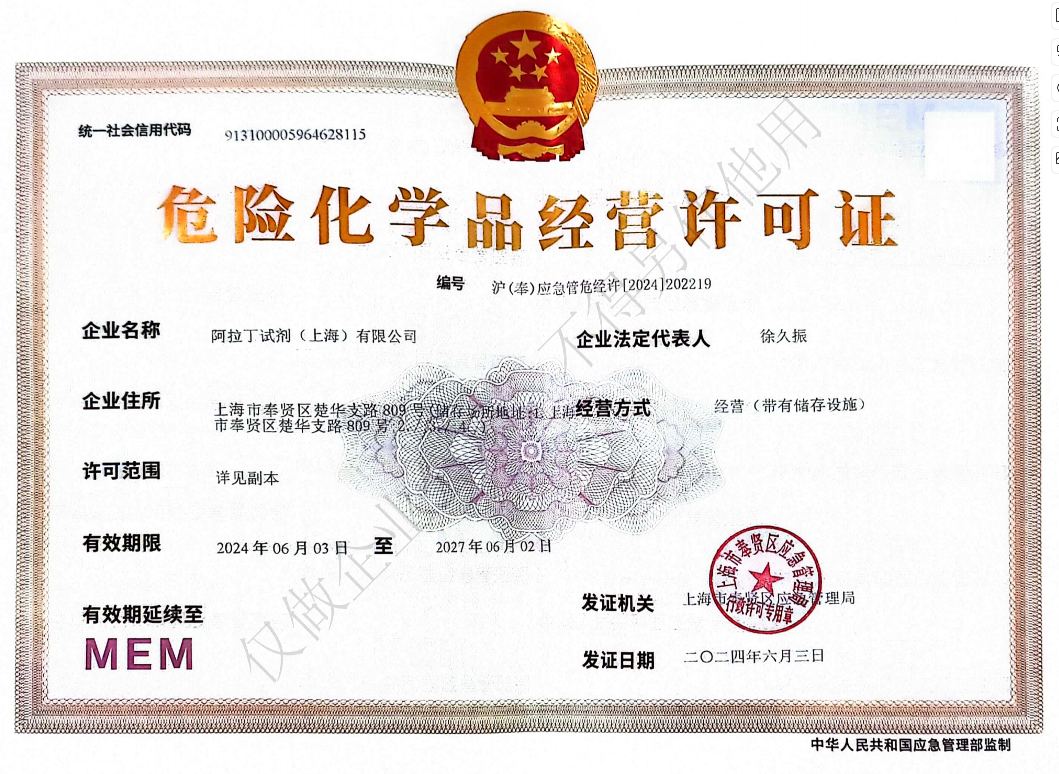 危险品化学品经营许可证(带存储)