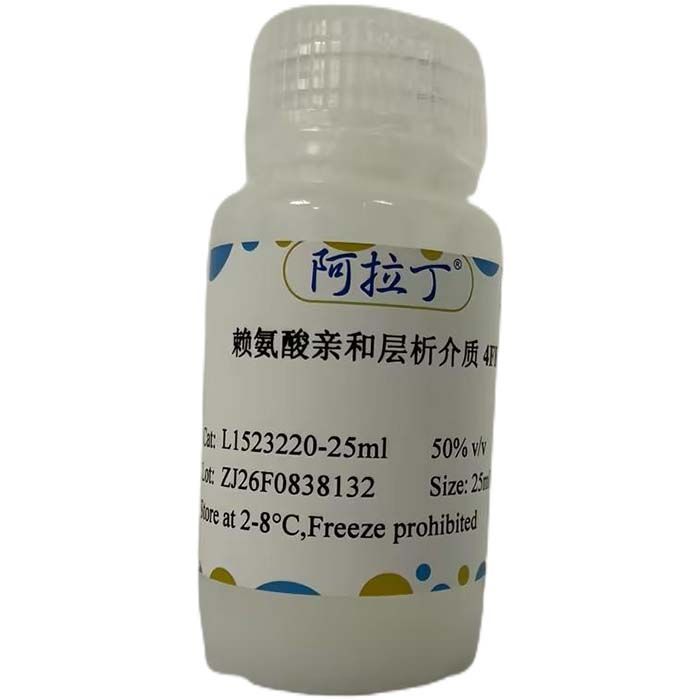
赖氨酸亲和层析介质 4FF是一种用于纯化纤维蛋白溶酶激活剂、纤维蛋白溶酶原以及核糖蛋白体核糖核酸的介质。赖氨酸是碱性氨基酸,它是纤 维蛋白溶酶激活剂的抑制剂氨基己酸类似物。赖氨酸亲和层析介质 4FF是将赖氨酸连接至高度交联的 4%琼脂糖介质上,可以在相对较高的流速 下,实现对目的蛋白的纯化。具体性能见表 1。
阿拉丁赖氨酸亲和层析介质 4FF储存在20%乙醇的1×PBS中,凝胶和保护液的体积比为1:1,我司产品规格为实际凝胶的体积。
表1:赖氨酸亲和层析介质 4FF产品性能
| 性能指标 | 参数 |
|---|
| 基质 | 高度交联的 4% 琼脂糖微球 | | 配体 | 赖氨酸 | | 配基密度 | 20-40 μmol/ml 介质 | | 粒径范围 | 45-165 μm | | 最大流速 | 300 cm/h | | pH 稳定范围 | 3-10 | | 储存缓冲液 | 含 20% 乙醇的 1×PBS | | 储存温度 | 2-8℃ |
|
1. 纯化流程
1.1 缓冲液的准备
所用水和缓冲液在使用之前建议用 0.22 μm 或 0.45 μm 滤膜过滤。
① 平衡液:50 mM phosphate buffer,pH 7.5
② 洗杂液:50 mM phosphate buffer,pH 7.5
③ 洗脱液:50 mM phosphate buffer,1-2 M NaCl,pH 7.5
④ 竞争性洗脱液:0.2 M 氨基己酸
1.2 样品准备
样品在上样前建议离心或用 0.22 μm 或 0.45 μm 滤膜过滤,减少杂质,提高蛋白纯化效率和防止堵塞柱子。
1.3 赖氨酸亲和层析介质 4FF装填
1.3.1 重力柱的装填
① 取合适规格的重力层析柱,装入下垫片,加入适量纯水润洗柱管和垫片,关闭下出口。
② 将赖氨酸亲和层析介质 4FF混合均匀,用枪头吸取适量浆液加入至重力柱中(介质实际体积占悬液的一半),打开下出口流干保护液。
③ 加入适量纯水冲洗介质,待柱管中液体重力流干后,关闭下出口。
④ 装入润洗后的上垫片,确保垫片与填料之间没有空隙,且保持水平。
⑤ 装填好的重力柱可以直接加入平衡液进行平衡,暂不使用时则加入保护液,2-8℃保存。
1.3.2 中压层析柱的装填
赖氨酸亲和层析介质 4FF被广泛应用于工业纯化,因此,涉及到各种中压色谱层析柱的填装,下面介绍填装层析柱的方法。装柱前根据层析柱直径计算柱子底面积,根据所需装柱高度计算所需介质体积,公式如下:
V = 1.15 × π × r² × h
(V:所需介质体积(ml);1.15:压缩系数;r:柱管半径(cm);h:装填高度(cm))
注意:所取悬液体积应为介质体积的两倍,因为介质体积只占悬液总体积的一半,另一半为保护液。
①用去离子水冲洗层析柱底筛板与接头,确保柱底筛板上无气泡,关闭柱底出口,并在柱底部留出 1-2 cm 的去离子水。
② 将介质悬浮起来,小心地将浆液连续地倒入层析柱中。用玻璃棒沿着柱壁倒入浆液可减少气泡的产生。
③ 如果使用储液器,应立即在层析柱和储液器中加满水,将进样分配器放置于浆液表面,连接至泵上,避免在分配器或进样管中产生气泡。
④ 打开层析柱底部出口,开启泵,使其在设定的流速下进行。最初应让缓冲液缓慢流过层析柱,然后缓慢增加至最终流速,这样可避免液压对所形成的冲击,也可以避免柱床形成的不均匀。如果达不到推荐的压力或流速,可以用你所使用泵的最大流速,这样也可以得到一个很好的装填效果。(注意:在随后的色谱程序中,不要超过最大装柱流速的 75%)当柱床高度稳定后,在最后的装柱流速下至少再上 3 倍柱床体积的去离子水。标上柱床高度。
⑤ 关闭泵,关闭层析柱出口。
⑥ 如果使用储液器,去除储液器,将分配器置于层析柱中。
⑦ 将分配器推向柱子至标记的柱床高度处。允许装柱液进入分配器,锁紧分配器接头。
⑧ 将装填好的层析柱连接至泵或色谱系统中,开始平衡。如果需要可以重新调整分配器。
1.4 样品纯化
1.4.1 孵育流纯化
① 根据纯化的样品量,取适量赖氨酸亲和层析介质 4FF加入离心管中,1000 rpm 离心 1 min,吸弃上清;也可加入重力柱中,流干保护液。
② 向离心管中加入 5 倍介质体积的平衡液清洗介质,1000 rpm 离心 1 min,吸弃上清;如使用重力柱,则直接在重力柱中清洗,直接重力流干平衡液;重复两次以上。
③ 加入样品,封闭离心管或重力柱管,4℃振荡孵育 2-4 h 或者 37℃孵育 30 min-2 h。
④ 孵育结束后,1000 rpm 离心 1 min,吸弃上清,或过滤收集介质,上清保留作为流穿,用于电泳鉴定。
⑤ 用 5 倍介质体积的洗涤液清洗介质,1000 rpm 离心 1 min 或重力柱管过滤,去除上清(注意不要吸到介质),重复 3-5 次,中间建议更换新离心管。
⑥ 加入 3-5 倍柱体积的洗脱液进行洗脱,室温孵育 5 min,1000 rpm 离心 1 min 或重力柱管收集洗脱液,可重复 2-3 次。
1.4.2 重力柱法纯化
① 将装填好的赖氨酸亲和层析介质 4FF重力柱用 5 倍柱体积平衡液进行平衡,使填料处于与目的蛋白相同的缓冲液体系下,重复 2-3 次。
② 将样品加到平衡好的重力柱中,样品保留时间至少 2 min,保证样品和介质充分接触,收集流出液,可以反复上样增加结合效率。
③ 用 10-15 倍柱体积的洗涤液进行洗涤,去除非特异性吸附的杂蛋白,收集洗涤液。
④ 使用 5-10 倍柱体积的洗脱液洗脱,分段收集,每一个柱体积收集一管,分别检测,既可以保证所有结合的目的蛋白被洗脱,又可以得到高纯度和高浓度的蛋白。
1.4.3 中压层析柱法纯化
赖氨酸亲和层析介质 4FF装填好后,可以用各种常规的中低压色谱系统。
① 将泵管道中注满去离子水。去掉上塞子,将层析柱连接至色谱系统中,打开下出口,将预装柱接到色谱系统中,并旋紧。
② 用 3-5 倍柱体积的去离子水冲洗出储存缓冲液。
③ 使用至少 5 倍柱体积的平衡液平衡色谱柱。
④ 利用泵或样品环上样。
注:样品的粘度增加使得即使上样体积很少,也会导致层析柱很大的反压。上样量不要超过柱子的结合能力。大量的样品体积也可能造成很大的反压,使得进样器更难使用。
⑤ 用洗涤液冲洗柱子,直到紫外吸收达到一个稳定的基线(一般至少 10-15 个柱体积)。
⑥ 使用 5-10 倍柱体积的洗脱液洗脱,收集洗脱液,即目的蛋白组分。介质洗脱结束后,用平衡液冲洗 5-10 柱体积,然后用纯水冲洗 5-10 个柱体积,再用 20% 乙醇冲洗 2 个柱体积,置于 2-8℃保存。
1.5 SDS-PAGE 检测
将使用纯化产品得到的样品(包括流出组分、洗杂组分和洗脱组分)以及原始样品使用 SDS-PAGE 检测纯化效果。
2. 填料再生和清洗
2.1 填料再生
① 3倍柱体积的 0.1 M Tris-HCl,0.5 M NaCl,pH 8.5 和 0.1 M 醋酸钠,0.5 M NaCl,pH 4.5 重复清洗 3 次。
② 5倍柱体积的平衡液平衡。
③ 纤维蛋白溶酶原纯化后可以用 5 倍柱体积的含有 0.2 M 氨基己酸和 1 M NaCl 的结合液清洗。
④ 核酸纯化后可以用 5 倍柱体积的含有 2 M NaCl 的结合液清洗。
2.2 填料清洗再生
未洗脱掉的变性蛋白和脂类可以用 0.1% Triton X-100,37℃清洗。然后用 5 倍柱体积结合液平衡。
2.3 填料保存
填料可以保存在含有 20% 乙醇的 1×PBS 中,2-8℃保存。
Lysine Affinity Resin 4FF is a medium designed for the purification of plasminogen activators, plasminogen, and ribosomal ribonucleic acid. Lysine is a basic amino acid and is an analogue of ε‑aminocaproic acid, which is an inhibitor of plasminogen activator. Lysine Affinity Resin 4FF consists of lysine coupled to highly cross‑linked 4% agarose beads, allowing purification of target proteins at relatively high flow rates. The specific performance characteristics are listed in Table 1.
Storage note:
Aladdin Lysine Affinity Resin 4FF is supplied in 1× PBS containing 20% ethanol. The volume ratio of gel to preservative solution is 1:1. The product specification refers to the actual settled gel volume.
Table 1: Performance specifications of Lysine Affinity Resin 4FF
| Parameter | Specification |
|---|
| Matrix | Highly cross‑linked 4% agarose microspheres | | Ligand | Lysine | | Ligand density | 20–40 μmol/mL medium | | Bead size range | 45–165 μm | | Maximum flow rate | 300 cm/h | | pH stability range | 3–10 | | Storage buffer | 1× PBS containing 20% ethanol | | Storage temperature | 2–8°C |
|
1. Purification Protocol
1.1 Preparation of buffers
It is recommended to filter all water and buffers through a 0.22 μm or 0.45 μm membrane before use.
① Equilibration buffer: 50 mM phosphate buffer, pH 7.5
② Wash buffer: 50 mM phosphate buffer, pH 7.5
③ Elution buffer: 50 mM phosphate buffer containing 1–2 M NaCl, pH 7.5
④ Competitive elution buffer: 0.2 M ε‑aminocaproic acid
1.2 Sample preparation
Prior to loading, it is recommended to centrifuge the sample or filter it through a 0.22 μm or 0.45 μm membrane to reduce particulates, improve purification efficiency, and prevent column clogging.
1.3 Packing of Lysine Affinity Resin 4FF
1.3.1 Packing a gravity column
① Take a gravity column of appropriate size, insert the lower frit, rinse the column tube and frit with an appropriate amount of pure water, and close the bottom outlet.
② Resuspend the Lysine Affinity Resin 4FF thoroughly, pipette an appropriate volume of the slurry into the gravity column (the actual medium volume is half of the slurry volume), then open the bottom outlet to let the preservative solution drain by gravity.
③ Add an appropriate amount of pure water to rinse the medium. After the liquid has drained by gravity, close the bottom outlet.
④ Insert the pre‑rinsed upper frit, ensuring that there is no air gap between the frit and the resin and that the frit is level.
⑤ The packed gravity column can be equilibrated directly with equilibration buffer. If not used immediately, add preservative solution and store at 2–8°C.
1.3.2 Packing a medium‑pressure chromatography column
Lysine Affinity Resin 4FF is widely used in industrial purification, so it is often packed into various medium‑pressure chromatography columns. The following method describes the packing procedure. Before packing, calculate the column bottom area based on the column diameter, and then calculate the required medium volume according to the desired bed height using the formula:
V = 1.15 × π × r² × h
(V = required medium volume in mL; 1.15 = compression factor; r = column radius in cm; h = packing height in cm)
Note: The volume of slurry to be taken should be twice the required medium volume, because the medium occupies only half of the slurry volume; the other half is the preservative solution.
① Rinse the column bottom frit and adapters with deionised water, ensuring that no air bubbles remain on the bottom frit. Close the column bottom outlet and leave 1–2 cm of deionised water above the bottom frit.
② Resuspend the medium and carefully pour the slurry continuously into the column. Pouring the slurry along the column wall with a glass rod can help reduce air bubbles.
③ If a reservoir is used, immediately fill the column and the reservoir with water. Place the sample distributor onto the slurry surface and connect it to the pump, avoiding air bubbles in the distributor or tubing.
④ Open the column bottom outlet and start the pump at the set flow rate. Initially, allow buffer to flow slowly through the column, then gradually increase to the final flow rate. This prevents hydraulic shocks and uneven bed formation. If the recommended pressure or flow rate cannot be reached, you may use the maximum flow rate of your pump; this can still give good packing results. (Note: In subsequent chromatographic runs, do not exceed 75% of the maximum packing flow rate.) Once the bed height is stable, wash with at least 3 column volumes of deionised water at the final packing flow rate. Mark the bed height.
⑤ Stop the pump and close the column outlet.
⑥ If a reservoir was used, remove it and place the distributor into the column.
⑦ Push the distributor down to the marked bed height. Allow packing fluid to enter the distributor, then lock the distributor adapter.
⑧ Connect the packed column to a pump or chromatography system and start equilibration. Adjust the distributor if necessary.
1.4 Sample purification
1.4.1 Batch incubation purification
① Depending on the sample volume, take an appropriate amount of Lysine Affinity Resin 4FF into a centrifuge tube, centrifuge at 1000 rpm for 1 min, and discard the supernatant. Alternatively, the medium can be placed in a gravity column and the preservative solution drained by gravity.
② Add 5 volumes of equilibration buffer (relative to the medium volume) to wash the medium. Centrifuge at 1000 rpm for 1 min and discard the supernatant; if using a gravity column, simply wash and allow the buffer to drain by gravity. Repeat this step at least twice.
③ Add the sample, seal the tube or column, and incubate with shaking at 4°C for 2–4 h or at 37°C for 30 min–2 h.
④ After incubation, centrifuge at 1000 rpm for 1 min and discard the supernatant, or filter to collect the medium. Retain the supernatant as the flow‑through fraction for electrophoresis analysis.
⑤ Wash the medium with 5 volumes of wash buffer, centrifuge at 1000 rpm for 1 min (or filter through the gravity column), and remove the supernatant (taking care not to aspirate the medium). Repeat this 3–5 times, and it is recommended to change to a new centrifuge tube in between.
⑥ Add 3–5 column volumes of elution buffer and incubate at room temperature for 5 min. Centrifuge at 1000 rpm for 1 min or collect the eluate through the gravity column. The elution step can be repeated 2–3 times.
1.4.2 Gravity column purification
① Equilibrate the packed Lysine Affinity Resin 4FF gravity column with 5 column volumes of equilibration buffer to bring the resin into the same buffer system as the target protein. Repeat this 2–3 times.
② Apply the sample to the equilibrated gravity column. The sample should have a residence time of at least 2 minutes to ensure sufficient contact between the sample and the medium. Collect the flow‑through. You may re‑load the flow‑through to increase binding efficiency.
③ Wash with 10–15 column volumes of wash buffer to remove non‑specifically bound contaminants, and collect the wash fractions.
④ Elute with 5–10 column volumes of elution buffer, collecting fractions in volumes of one column volume each. Assay each fraction individually; this ensures complete elution of all bound target protein and also allows collection of high‑purity and concentrated protein.
1.4.3 Medium‑pressure chromatography column purification
After packing, Lysine Affinity Resin 4FF can be used with a variety of conventional low‑ and medium‑pressure chromatography systems.
① Fill the pump tubing with deionised water. Remove the top stopper, connect the column to the chromatography system, open the bottom outlet, mount the packed column, and tighten the connections.
② Rinse out the storage buffer with 3–5 column volumes of deionised water.
③ Equilibrate the column with at least 5 column volumes of equilibration buffer.
④ Load the sample using the pump or a sample loop. Note: Increased sample viscosity can cause high backpressure even with small loading volumes. Do not exceed the binding capacity of the column. Large sample volumes may also generate high backpressure and make the injector more difficult to use.
⑤ Wash the column with wash buffer until the UV absorbance returns to a stable baseline (generally at least 10–15 column volumes).
⑥ Elute with 5–10 column volumes of elution buffer, and collect the eluate, which contains the target protein.After elution is complete, wash the column with 5–10 column volumes of equilibration buffer, followed by 5–10 column volumes of pure water, and then with 2 column volumes of 20% ethanol. Store the column at 2–8°C.
1.5 SDS‑PAGE analysis
Analyse the purified product fractions (including flow‑through, wash, and elution fractions) along with the original sample by SDS‑PAGE to assess the purification performance.
2. Resin Regeneration and Cleaning
2.1 Resin regeneration
① Wash with 3 column volumes of 0.1 M Tris‑HCl, 0.5 M NaCl, pH 8.5, followed by 3 column volumes of 0.1 M sodium acetate, 0.5 M NaCl, pH 4.5. Repeat this cycle 3 times.
② Equilibrate with 5 column volumes of equilibration buffer.
③ After purification of plasminogen, the resin can be cleaned with 5 column volumes of binding buffer containing 0.2 M ε‑aminocaproic acid and 1 M NaCl.
④ After nucleic acid purification, the resin can be washed with 5 column volumes of binding buffer containing 2 M NaCl.
2.2 Cleaning of stubborn contaminants
Denatured proteins and lipids that are not eluted can be removed by washing with 0.1% Triton X‑100 at 37°C. Then re‑equilibrate with 5 column volumes of binding buffer.
2.3 Resin storage
The resin can be stored in 1× PBS containing 20% ethanol at 2–8°C.

 ZJ26F0838133


 危险品化学品经营许可证(带存储)