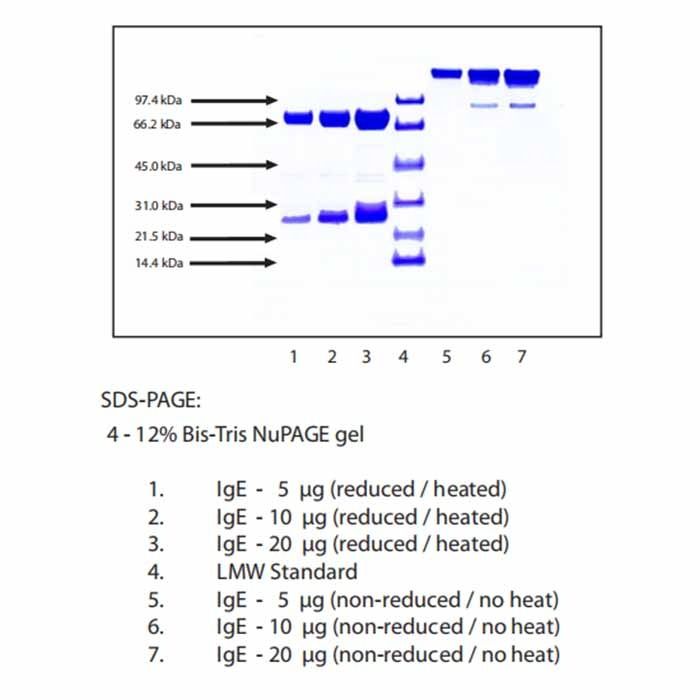
IgE is the least abundant immunoglobulin in plasma, found at a concentration of less that 0.6 micrograms/ml of normal plasma. Elevated IgE levels are found in patients experiencing severe allergic reactions and parasitic infections. In a myeloma condition, IgE is produced by a single clone of plasma cells. The structure of myeloma IgE, however, is normal, and the immunoglobulin purified from a myeloma source is a useful protein for studying immunoglobulin behavior.
Prepared from plasma shown to be non reactive for HBsAg, anti-HCV, anti-HBc, and negative for anti-HIV 1 & 2 by FDA approved tests.
Constant region of immunoglobulin heavy chains. Immunoglobulins, also known as antibodies, are membrane-bound or secreted glycoproteins produced by B lymphocytes. In the recognition phase of humoral immunity, the membrane-bound immunoglobulins serve as receptors which, upon binding of a specific antigen, trigger the clonal expansion and differentiation of B lymphocytes into immunoglobulins-secreting plasma cells. Secreted immunoglobulins mediate the effector phase of humoral immunity, which results in the elimination of bound antigens. The antigen binding site is formed by the variable domain of one heavy chain, together with that of its associated light chain. Thus, each immunoglobulin has two antigen binding sites with remarkable affinity for a particular antigen. The variable domains are assembled by a process called V-(D)-J rearrangement and can then be subjected to somatic hypermutations which, after exposure to antigen and selection, allow affinity maturation for a particular antigen.
种属
人(Human)
来源
天然
预测分子量
200 kDa
分子类型
蛋白质
产品线
生物产品
储存与运输
物理形态
液体
储存缓冲液
100 mM Tris, 200 mM NaCl, 0.05% Sodium azide, pH 7.5.

 ZJ26F0332933


 危险品化学品经营许可证(带存储)