
 G2623361
计算溶液所需的质量、体积或浓度。
为什么选择此级别
,适用于对基线干扰要求严格的色谱和分析工作流程。
储存与运输
室温。常规运输 。请查阅批次 COA 获取详细规格。
质量文档
SDS、COA、产品数据表及规格说明书均可下载。可通过批号查询获取批次 COA。
文献证明
在色谱分析、有机合成和交叉偶联反应领域已被 1121 篇同行评审文献引用。
概述
聚偏氟乙烯(PVDF)是一种具有压电、热电、铁电性质的半晶非中心对称聚合物。它是一种线性聚合物,表现出垂直于分子链方向的永久性电偶极子。这些偶极子是由于氢和氟原子对碳的电负性不同而产生的。根据工艺条件,PVDF呈现出不同的结晶相(α,β,γ,δ)。PVDF的β相表现出最佳的铁电和压电性能。
应用
聚偏氟乙烯(PVDF)用于纳米孔电极。它可用于合成嵌有碳纳米管的PVDF超细纤维复合材料。此外,它还可用于传感器、驱动器、储能、血压计、压力传感器、纳米发电机、锂离子电池等。此外,它还可作为聚偏氟乙烯-纳米粘土纳米复合材料和聚偏氟乙烯-丙烯酸橡胶/粘土纳米复合材料的基质。
Poly(vinylidene fluoride) PVDF is a semi crystalline non-centrosymmetric polymer which exhibits piezo-, pyro- and ferroelectric properties. It is a linear polymer that shows permanent electric dipoles perpendicular to the direction of the molecular chain. These dipoles result from the difference in electronegativity between the atoms of hydrogen and fluorine with respect to carbon. Depending on the processing conditions, PVDF exhibits several different crystalline phases (α,β,γ,δ). The β phase of PVDF is the phase that exhibits the best ferroelectric and piezoelectric properties.
Application
Poly(vinylidene fluoride) (PVDF) is used in nanoporous electrodes. It is used to synthesize composites comprising of ultrafine fibers of PVDF embedded with carbon nanotubes. It can be used in sensors, actuators, for energy storage, sphygmomanometers, pressure sensors and nanogenerators, lithium ion batteries. Additionally, it may find application as matrix for PVDF-nanoclay nanocomposites and PVDF acrylic rubber/clay nanocomposite hybrid.
规格
规格或纯度
熔体粘度(K Poise): 23.5~29.5,粉末
英文名称
Poly(vinylidene fluoride)(PVDF)
储存条件
室温
运输条件
常规运输
名称和识别符
EC号
607-458-6
分子类型
未知
IUPAC Name
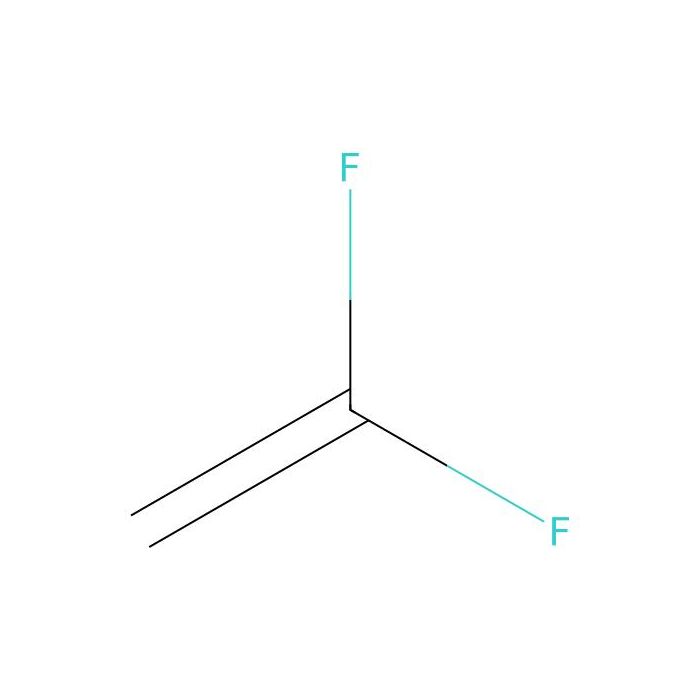
1,1-difluoroethene
INCHI
1S/C2H2F2/c1-2(3)4/h1H2
InChi Key
BQCIDUSAKPWEOX-UHFFFAOYSA-N
Smiles
FC(F)=C
Isomeric SMILES
C=C(F)F
技术文档
高级数据
系统学分类
分类树(Taxonomy Tree)
| 界(kingdom) | 有机化合物 |
|---|---|
| 超类(Superclass) | 有机氧化合物 |
| 类(Class) | 有机氧化合物 |
| 亚类(Subclass) | 乙烯酮缩醛 |
| 中间层级节点(Intermediate Tree Nodes) | 暂无 |
| 直接上位类(Direct Parent) | 乙烯酮缩醛 |
| 其他上位类(Alternative Parents) | 氟乙烯 氟烯烃 有机氟化物 氢氟碳化物 碳氢化合物衍生物 |
| 分子骨架(Molecular Framework) | 脂肪族无环化合物 |
| 取代基(Substituents) | 脂肪族非环化合物 - 氟萘 - 卤代乙烯 - 烃衍生物 - 氟碳化合物 - 酮烯缩醛或衍生物 - 有机氟化物 - 有机卤化物 - 乙烯基氟化物 - 乙烯基卤化物 |
| 描述(Description) | 该化合物属于酮烯缩醛类有机化合物。这类有机化合物含有酮烯缩醛官能团,其通式为XC(Y)=C(R3)R4(R1,R2=H、烷基、芳基;X,Y=任意杂原子)。 |
| 外部描述符(External Descriptors) | acetal |
三维结构
交互式化学结构模型
化学和物理性质
密度
1.74g/mLat 25°C
熔点
155-165°C
分子量
64.030 g/mol
XLogP3
1.300
氢键供体数Hydrogen Bond Donor Count
0
氢键受体数Hydrogen Bond Acceptor Count
2
可旋转键计数Rotatable Bond Count
0
精确质量Exact Mass
64.0125 Da
单同位素质量Monoisotopic Mass
64.0125 Da
拓扑极表面积Topological Polar Surface Area
0.000 Ų
重原子数Heavy Atom Count
4
形式电荷Formal Charge
0
复杂度Complexity
27.000
同位素原子数Isotope Atom Count
0
定义的原子立体中心计数Defined Atom Stereocenter Count
0
未定义的原子立体中心计数Undefined Atom Stereocenter Count
0
定义的键立体中心计数Defined Bond Stereocenter Count
0
未定义的键立体中心计数Undefined Bond Stereocenter Count
0
所有立体化学键的总数The total count of all stereochemical bonds
0
共价键合单元计数Covalently-Bonded Unit Count
1
质检证书(CoA,COO,BSE/TSE 和分析图谱)
技术文档和文章
How to Choose a Hydrogen Evolution (HER) Catalyst: Kinetic Barriers in Water Electrolysis, AWE/PEM/AEM Pathways, and a Materials-Family Roadmap (with a Product Map)
目录: 技术文章
Panorama Guide to Lithium-Ion Battery Electrode Materials: Working Principles, Materials Map, and Selection Navigation (incl. Tables 1–4)
目录: 技术文章
A Panorama Guide to Synthetic Resins: Definitions & Polymerization Mechanisms, Classification Frameworks, Common Resins and Applications, Packaging Codes, and a Selection Roadmap (Tables 1–3)
目录: 技术文章
Optical & Optoelectronic Materials Selection Guide:Positioning materials, key metrics, and validation paths along “Generation → Guiding → Control → Readout” (with product navigation and Tables 1–4)
目录: 技术文章
uide to Hydrophobic Polymers and Hydrophobic Surfaces: Wetting Models, Evaluation Metrics, and Task-Oriented Material Selection (including Tables 1–3)
目录: 技术文章
Research Value of Polyelectrolyte Multilayers: Layer-by-Layer Design of Interfacial Composition, Mass Transport, and Function
目录: 技术文章
Why Fluorocarbon Resins Are Weatherable: Structural Stability, Low Surface Energy, and Coating Film Appearance Retention
目录: 技术文章
PVDF, FEVE and Functional Fluororesins: System Differences and Application Selection in Fluorocarbon Coatings
目录: 技术文章
Fluorocarbon Resin Coating Formulation Design: Resin Selection, Supporting Systems, and Key Application Control Points
目录: 技术文章
此产品的引用文献
溶液计算器
产品仅提供给经过验证的企业、机构和合格的专业人员用于研发。不适用于人类、动物、诊断或治疗。
Copyright © 2023至今 上海阿拉丁生化科技股份有限公司 保留所有权利。


 危险品化学品经营许可证(带存储)