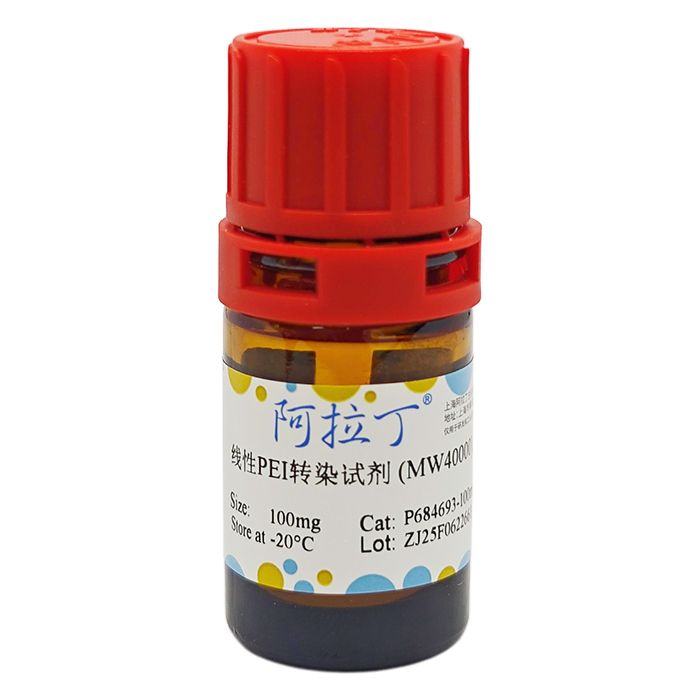
Linear Polyethylenimine Hydrochloride (MW 40,000)转染试剂(PEI 40,000)是一种高性能阳离子聚合物转染试剂,适 用于常见贴壁或悬浮的多种细胞的质粒DNA转染,包括HEK293,MCF-7,RAW 264.7,HUVEC,HBE,THP-1,PC 3,A549,Hela,BJ,U-87 MG,Caco-2 等。PEI 40,000 结构明确、分子量均一,可实现高效、高重复性的细胞转 染。其兼具优异的阳离子聚合物/DNA 复合物形成能力和转染到细胞内 DNA 的快速释放能力,保证了优异的转染性 能和极低的细胞毒性。
使用说明:
操作前注意事项:
① 1g 转染试剂与DNA核酸用量最优比例根据不同实验需要摸索。对大多数细胞来而言,最优比例范围为:每1μg DNA 使用1.5~4 μL 体积的PEI 40,000 转染试剂。
② 本产品仅用于科研。
所需物料:
高压灭菌去离子水/注射用水(WFI)或级别相当的生物用水、1 mol/L氢氧化钠(NaOH)、一次性0.1~0.2 μm PES无 菌过滤器、无菌储存瓶。
操作时间:
① 细胞准备:根据不同细胞的传代时间将细胞培养至合适的细胞代次,一般提前18-24 h对细胞进行处理使细胞密 度达到第2天实验时的要求。
② 试剂准备:~10-20 mins
③ 转染操作:~10-30 mins
不同培养皿/瓶推荐试剂用量:
培养器皿
| 表面积(cm²)
| DNA用量(μg)
| 转染试剂用量(μL)
| 稀释液体积(μL)
| 培养基用量(mL)
|
96 well
| 0.3
| 0.1
| 0.1
| 10 | 0.1
|
48 well
| 0.7
| 0.2
| 0.3
| 20 | 0.2
|
24 well
| 1.9
| 0.5
| 1 | 50 | 0.5
|
12 well
| 3.8
| 1 | 2 | 50 | 1 |
6 well
| 10
| 2 | 4 | 100 | 2 |
25 cm² Flask
| 21
| 4 | 8 | 200 | 4 |
75 cm² Flask
| 58
| 10 | 20
| 500 | 10 |
试剂用量:
Cat#P684693-100MG:~100,000次,1 μL/well,24 wells
Cat#P684693-1G:~1000,000次,1 μL/well,24 wells
操作步骤:
配置储存液(通常1 mg/mL):
① 于100mL玻璃烧杯,将100 mg PEI 40000粉末加入90 mL 高压灭菌去离子水/注射用水(WFI)或级别相当的 生物用水中,并搅拌均匀;
② 待PEI粉末完全溶解后,用1 mol/L氢氧化钠 (NaOH)溶液调节pH为6.80 - 6.90;
③ 将溶液转入量筒内,并加水定容到100 mL;
④ 用无菌0.1~0.2 µm PES真空过滤器过滤除菌,即得到1 mg/mL的储存液。可依据使用条件进行分装,并于2-8 °C 条件下存储,建议存储时间不长于3个月。
转染操作(以6孔板贴壁细胞为例):
① 接种细胞:转染时细胞密度在70%~80%为宜。
② 配制转染试剂复合物
1) 对于每孔细胞,使用100 μL无血清培养基(如Opti-MEM等)或高压灭菌去离子水稀释2 μg目的DNA,充 分混匀成DNA稀释液;
2) 立刻向100 μL的DNA稀释液中加入4 μL的PEI 40,000转染试剂,轻轻混匀;
3) 在室温下孵育10~15 min,使得形成DNA-PEI转染试剂复合物。
③ 细胞转染
1) 在形成复合物过程中,移除细胞生长培养基,每孔中加入2 mL新鲜预热的完全培养基;
2) 直接将100 μL DNA-PEI复合物加入细胞中,摇动培养板,轻轻混匀;
3) 在37℃,5% CO2条件下进行培养,待合适时间点进行转染结果的检测。
Linear Polyethylenimine Hydrochloride (MW 40,000), also known as PEI 40,000 transfection reagent, is a high-performance cationic polymer transfection reagent. It is applicable for plasmid DNA transfection in a wide range of common adherent and suspension cell lines, including HEK293, MCF-7, RAW 264.7, HUVEC, HBE, THP-1, PC-3, A549, HeLa, BJ, U-87 MG and Caco-2. PEI 40,000 features well-defined chemical structure and uniform molecular weight, enabling highly efficient and reproducible cell transfection. It possesses outstanding capacity to form cationic polymer/DNA complexes and facilitates rapid intracellular release of transfected DNA, delivering superior transfection performance with minimal cytotoxicity.
Instructions for Use:
Pre-operation Precautions:
① The optimal mass ratio between 1 g transfection reagent and DNA must be optimized according to individual experimental requirements. For most cell lines, the recommended working ratio is 1.5-4μL PEI 40,000 transfection reagent per 1μg DNA.
② This product is for research use only.
Required Materials:
Autoclaved deionized water / Water for Injection (WFI) or equivalent biological grade water, 1 mol/L sodium hydroxide (NaOH), disposable sterile PES filter with 0.1–0.2 μm pore size, sterile storage bottles.
Operation Timeline:
① Cell preparation: Culture cells to appropriate passages based on their splitting cycle. Seed cells 18–24 hours in advance to reach the target confluency on the day of transfection.
② Reagent preparation: Approximately 10–20 minutes
③ Transfection procedure: Approximately 10–30 minutes
Recommended Reagent Volumes for Vessels of Different Sizes:
Culture Vessel
| Surface Area (cm²)
| DNA Amount (μg)
| Transfection Reagent Volume (μL)
| Diluent Volume (μL)
| Culture Medium Volume (mL)
|
96 well
| 0.3
| 0.1
| 0.1
| 10 | 0.1
|
48 well
| 0.7
| 0.2
| 0.3
| 20 | 0.2
|
24 well
| 1.9
| 0.5
| 1 | 50 | 0.5
|
12 well
| 3.8
| 1 | 2 | 50 | 1 |
6 well
| 10
| 2 | 4 | 100 | 2 |
25 cm2 Flask
| 21
| 4 | 8 | 200 | 4 |
75 cm2 Flask
| 58
| 10 | 20
| 500 | 10 |
Reagent Usage:
Cat# P684693-100MG: ~100,000 transfections, 1 μL per well (24-well plate format)
Cat# P684693-1G: ~1,000,000 transfections, 1 μL per well (24-well plate format)
Operating Procedures:
Preparation of Stock Solution (Typical concentration: 1 mg/mL)
① In a 100 mL glass beaker, add 100 mg PEI 40000 powder into 90 mL autoclaved deionized water / Water for Injection (WFI) or equivalent biological-grade water, then stir thoroughly until homogeneous.
② After the PEI powder dissolves completely, adjust the pH to 6.80–6.90 with 1 mol/L sodium hydroxide (NaOH) solution.
③ Transfer the liquid to a graduated cylinder and top up to a final volume of 100 mL with water.
④ Perform sterile filtration using a disposable vacuum filter equipped with a 0.1–0.2 µm PES membrane to obtain the 1 mg/mL stock solution. Aliquot the stock solution as needed for routine use, store at 2–8 °C, and complete usage within 3 months for optimal performance.
Transfection Protocol (Adherent cells in 6-well plate as example)
① Cell seeding: Seed cells to reach 70%–80% confluency on the day of transfection.
② Preparation of PEI-DNA transfection complexes
1) For each well, dilute 2 μg target plasmid DNA in 100 μL serum-free medium (e.g., Opti-MEM) or autoclaved deionized water, mix well to prepare the DNA diluent.
2) Immediately add 4 μL PEI 40,000 transfection reagent to the 100 μL DNA diluent, mix gently.
3) Incubate the mixture at room temperature for 10–15 minutes to allow formation of DNA-PEI polyplexes.
③ Cell transfection
1) While polyplexes form, aspirate the spent growth medium, and add 2 mL pre-warmed complete culture medium to each well.
2) Add the entire 100 μL DNA-PEI complex mixture dropwise onto the cells, then rock the culture plate gently for uniform distribution.
3) Incubate the plate at 37 °C under 5% CO₂ atmosphere. Harvest cells and detect transfection outcomes at your designated time points.

 ZJ26F1039673

 危险品化学品经营许可证(带存储)