
计算溶液所需的质量、体积或浓度。
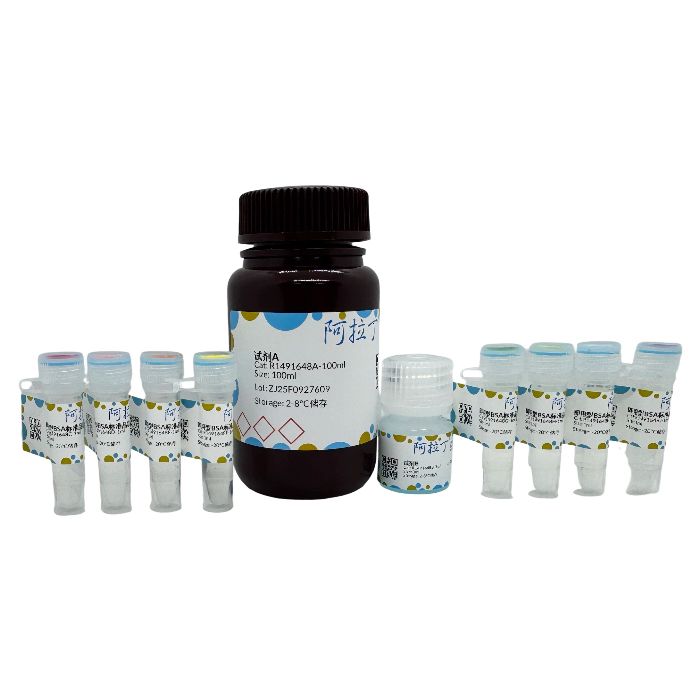
即用型BCA蛋白定量试剂盒
有货
BioReagent,即用型,用于蛋白分析 级 ,适用于对基线干扰要求严格的色谱和分析工作流程。
2-8°C储存,-20°C储存。超低温运输 。请查阅批次 COA 获取详细规格。
SDS、COA、产品数据表及规格说明书均可下载。可通过批号查询获取批次 COA。
在色谱分析、有机合成和交叉偶联反应领域已被 0 篇同行评审文献引用。
BCA 蛋白定量法是目前广泛使用的蛋白定量方法之一。本产品是基于 BCA(Bicin-choninic Acid)法研制而成,实现了对蛋白质进行快速、稳定、灵敏的浓度测定。其原理是在碱性环境下蛋白质分子中的肽链结构能与 Cu²⁺ 结合生成络合物,同时将 Cu²⁺ 还原成 Cu⁺,BCA 试剂可敏感地与 Cu⁺ 结合,形成稳定的有颜色的复合物,其在 562 nm 处有高的光吸收值,颜色的深浅与蛋白质浓度成正比,可根据吸收值的大小来测定蛋白质的含量。本试剂盒含有一系列浓度的蛋白质标准溶液(BSA 溶液),即取即用,无需稀释,方便快捷。
组分表
| R1491648 | Component | 500T | 500T×5 | Storage |
| R1491648A | 试剂A | 100 mL | 100 mL×5 | 2-8℃ |
| R1491648B | 试剂B | 3 mL | 3 mL×5 | 2-8℃ |
| R1491648C | 即用型BSA标准品① (0 μg/mL) | 1 mL | 1 mL×5 | -20℃ |
| R1491648D | 即用型BSA标准品② (125 μg/mL) | 1 mL | 1 mL×5 | -20℃ |
| R1491648E | 即用型BSA标准品③ (250 μg/mL) | 1 mL | 1 mL×5 | -20℃ |
| R1491648F | 即用型BSA标准品④ (500 μg/mL) | 1 mL | 1 mL×5 | -20℃ |
| R1491648G | 即用型BSA标准品⑤ (750 μg/mL) | 1 mL | 1 mL×5 | -20℃ |
| R1491648H | 即用型BSA标准品⑥ (1000 μg/mL) | 1 mL | 1 mL×5 | -20℃ |
| R1491648I | 即用型BSA标准品⑦ (1500 μg/mL) | 1 mL | 1 mL×5 | -20℃ |
| R1491648J | 即用型BSA标准品⑧ (2000 μg/mL) | 1 mL | 1 mL×5 | -20℃ |
方便快捷 — 提供即用型标准品,省去繁琐的稀释步骤;
准确性高 — 变异系数远小于考马斯亮蓝染色法;
线性范围宽 — 灵敏,检测范围:20–2000 μg/mL;
兼容性好 — 与金属离子、还原剂、螯合剂及去污剂兼容性较好。
1、配置显色工作液:
a. 计算显色工作液总量:
工作液总量 = (BSA 标准品样本个数 + 待测样本个数) × 复孔数 × 每个样本显色工作液体积
举例:BSA 标准品样本个数为 8 个,待测样本个数 3 个,复孔数 3 个。
显色工作液总量 = (8 + 3) × 3 × 200 μL = 6.6 mL
b. 根据计算出的所需显色工作液用量,将试剂 A 和试剂 B 按照 50:1 的体积比,配制显色工作液,充分混匀。
注意:
建议多配制 1–2 个孔的量以弥补加样误差;
新配制的 BCA 工作液室温密封条件下可稳定保存 24 h。
2、定量检测:
① 分别取即用型 BSA 标准品①~⑧ 各 20 μL 加到 96 孔板中(使用前须充分溶解摇匀):
| 孔号 | 1 | 2 | 3 | 4 | 5 | 6 | 7 | 8 |
| 添加物 | 标准品① | 标准品② | 标准品③ | 标准品④ | 标准品⑤ | 标准品⑥ | 标准品⑦ | 标准品⑧ |
| 体积(μL) | 20 | 20 | 20 | 20 | 20 | 20 | 20 | 20 |
| BSA终浓度(μg/mL) | 0 | 125 | 250 | 500 | 750 | 1000 | 1500 | 2000 |
② 用 1×PBS 或 0.9% 生理盐水将样品适当稀释(可设多个梯度,如 2 倍、4 倍、8 倍稀释),加 20 μL 到 96 孔板的样品孔中;
③ 各孔加入 200 μL 显色工作液,充分混匀,盖上 96 孔板盖,37°C 孵育 30 min,冷却至室温;
注意:也可室温放置 2 h,或 60°C 放置 30 min。吸光度随时间和温度升高而增加,低浓度样品可延长孵育时间或提高温度。
④ 用酶标仪测定每个样品及 BSA 标准品在 562 nm 或 540–590 nm 范围内的吸光度,注意减去空白对照(标准品① + 工作液)的吸光度;
⑤ 绘制标准曲线,计算样品中的蛋白浓度。
注意:去除明显异常值,待测样品浓度需根据标准曲线计算,并乘以稀释倍数。若使用计算机拟合,可从线性方程直接计算。
本产品适用于酶标仪(微孔法)或分光光度计(试管法)。使用分光光度计时需确保检测体积不小于比色皿最小要求,样品和标准品用量需按比例放大,可能导致检测次数减少;
试剂低温或长期保存出现沉淀时,可搅拌或 37℃ 温育溶解;
每次测定均需绘制标准曲线,以保证准确性;
若样品中含较多干扰物质(见附表),建议选用其它蛋白定量产品;
操作时请穿实验服并佩戴一次性手套;
本产品仅限科研使用。

The BCA method is one of the most widely used techniques for protein quantification. This kit, based on the bicinchoninic acid (BCA) assay, enables rapid, stable, and sensitive measurement of protein concentrations. Its principle relies on the reduction of Cu²⁺ to Cu⁺ by peptide bonds in an alkaline environment, followed by the formation of a purple-colored complex between Cu⁺ and BCA. This complex exhibits strong absorbance at 562 nm, proportional to protein concentration. The kit includes a series of ready-to-use protein standard solutions (BSA), eliminating the need for dilution and simplifying the workflow.
Product Component List:
| R1491648 | Component | 500T | 500T×5 | Storage |
| R1491648A | Reagent A | 100 mL | 100 mL×5 | 2-8℃ |
| R1491648B | Reagent B | 3 mL | 3 mL×5 | 2-8℃ |
| R1491648C | Ready-to-use BSA standard① (0 μg/mL) | 1 mL | 1 mL×5 | -20℃ |
| R1491648D | Ready-to-use BSA standard② (125 μg/mL) | 1 mL | 1 mL×5 | -20℃ |
| R1491648E | Ready-to-use BSA standard③ (250 μg/mL) | 1 mL | 1 mL×5 | -20℃ |
| R1491648F | Ready-to-use BSA standard④ (500 μg/mL) | 1 mL | 1 mL×5 | -20℃ |
| R1491648G | Ready-to-use BSA standard⑤ (750 μg/mL) | 1 mL | 1 mL×5 | -20℃ |
| R1491648H | Ready-to-use BSA standard⑥ (1000 μg/mL) | 1 mL | 1 mL×5 | -20℃ |
| R1491648I | Ready-to-use BSA standard⑦ (1500 μg/mL) | 1 mL | 1 mL×5 | -20℃ |
| R1491648J | Ready-to-use BSA standard⑧ (2000 μg/mL) | 1 mL | 1 mL×5 | -20℃ |
Convenient: Ready-to-use standards avoid tedious dilution steps.
High Accuracy: Lower coefficient of variation than Coomassie Brilliant Blue assays.
Broad Linear Range: Detection range: 20–2000 μg/mL.
Excellent Compatibility: Tolerates metal ions, reducing agents, chelators, and detergents.
Prepare Working Reagent:
a. Calculate the total volume required:
Working reagent volume = (Number of standard samples + Number of test samples) × Replicates × Volume per well
Example: 8 standards + 3 test samples with 3 replicates each at 200 μL/well:
(8 + 3) × 3 × 200 μL = 6.6 mL
b. Mix Reagent A and Reagent B at a 50:1 ratio to prepare the working reagent. Vortex thoroughly.
Note:
Prepare extra volume (1–2 wells) to compensate for pipetting errors.
Freshly prepared working reagent is stable for 24 hours at room temperature (sealed).
Quantification Steps:① Add 20 μL of each ready-to-use BSA standard (①–⑧) to a 96-well plate (mix thoroughly before use):
| Well | 1 | 2 | 3 | 4 | 5 | 6 | 7 | 8 |
| Standard | ① | ② | ③ | ④ | ⑤ | ⑥ | ⑦ | ⑧ |
| Volume (μL) | 20 | 20 | 20 | 20 | 20 | 20 | 20 | 20 |
| BSA (μg/mL) | 0 | 125 | 250 | 500 | 750 | 1000 | 1500 | 2000 |
② Dilute test samples in 1× PBS or 0.9% saline (e.g., 2×, 4×, 8× serial dilutions). Add 20 μL to wells.
③ Add 200 μL working reagent to each well. Mix thoroughly, cover the plate, and incubate at 37°C for 30 min. Cool to room temperature.
Note: Incubation alternatives:
Room temperature: 2 hours
60°C: 30 minutes
Absorbance increases with time/temperature. Extend incubation for low-concentration samples.
④ Measure absorbance at 562 nm (or 540–590 nm) using a microplate reader. Subtract the blank control (Standard ① + working reagent) absorbance.
⑤ Plot a standard curve and calculate sample protein concentrations.
Note:
Exclude obvious outliers.
Multiply calculated concentrations by dilution factors.
Use linear regression for computer-based fitting.
Compatible with microplate readers (microplate method) or spectrophotometers (cuvette method). For cuvettes, ensure the volume meets the minimum requirement (may reduce total number of assays).
If precipitates form during cold/long-term storage, stir or warm to 37°C to dissolve.
Always generate a fresh standard curve for each assay to ensure accuracy.
For samples with high levels of interfering substances (see Appendix), consider alternative protein quantification methods.
Wear a lab coat and disposable gloves during operations.
For research use only.
通过匹配包装上的批号来查找并下载产品的 COA,每批产品都进行了严格的验证,您可放心使用!
| 批号(Lot Number) | 证书类型 | 货号 |
|---|---|---|
 J2616423 |
分析证书 | R1491648 |
| J2615494 |
分析证书 | R1491648 |
| J2615489 |
分析证书 | R1491648 |
| I2624139 |
分析证书 | R1491648 |
| I2620811 |
分析证书 | R1491648 |
| I2617644 |
分析证书 | R1491648 |
| I2616427 |
分析证书 | R1491648 |
| I2615460 |
分析证书 | R1491648 |
| I2610538 |
分析证书 | R1491648 |
| H2629006 |
分析证书 | R1491648 |
| G2629161 |
分析证书 | R1491648 |
| G2628436 |
分析证书 | R1491648 |
| G2617275 |
分析证书 | R1491648 |
| G2617274 |
分析证书 | R1491648 |
| G2615280 |
分析证书 | R1491648 |
| G2614289 |
分析证书 | R1491648 |
| G2601309 |
分析证书 | R1491648 |
| F2627011 |
分析证书 | R1491648 |
| F2624402 |
分析证书 | R1491648 |
| F2613046 |
分析证书 | R1491648 |
| F2612209 |
分析证书 | R1491648 |
| F2611356 |
分析证书 | R1491648 |
| F2603479 |
分析证书 | R1491648 |
| E2626655 |
分析证书 | R1491648 |
| E2623006 |
分析证书 | R1491648 |
| D2622252 |
分析证书 | R1491648 |
| D2622248 |
分析证书 | R1491648 |
| ZJ26F0434306 |
分析证书 | R1491648 |
| D2610583 |
分析证书 | R1491648 |
| D2608532 |
分析证书 | R1491648 |
| D2602388 |
分析证书 | R1491648 |
| C2620425 |
分析证书 | R1491648 |
| C2612457 |
分析证书 | R1491648 |
| C2604313 |
分析证书 | R1491648 |
| C2603398 |
分析证书 | R1491648 |
| ZJ26F0232114 |
分析证书 | R1491648 |
| B2610005 |
分析证书 | R1491648 |
| A2623325 |
分析证书 | R1491648 |
| A2621773 |
分析证书 | R1491648 |
| A2621165 |
分析证书 | R1491648 |
| A2620159 |
分析证书 | R1491648 |
| A2613657 |
分析证书 | R1491648 |
| A2612458 |
分析证书 | R1491648 |
| A2609448 |
分析证书 | R1491648 |
| A2608133 |
分析证书 | R1491648 |
| A2604217 |
分析证书 | R1491648 |
| L2530463 |
分析证书 | R1491648 |
| L2526390 |
分析证书 | R1491648 |
| L2526017 |
分析证书 | R1491648 |
| L2525505 |
分析证书 | R1491648 |
| L2518234 |
分析证书 | R1491648 |
| L2518237 |
分析证书 | R1491648 |
| L2517141 |
分析证书 | R1491648 |
| L2517142 |
分析证书 | R1491648 |
| L2516312 |
分析证书 | R1491648 |
| L2515447 |
分析证书 | R1491648 |
| L2503103 |
分析证书 | R1491648 |
| L2503107 |
分析证书 | R1491648 |
| K2521218 |
分析证书 | R1491648 |
| K2520274 |
分析证书 | R1491648 |
| K2518525 |
分析证书 | R1491648 |
| K2514784 |
分析证书 | R1491648 |
| K2514080 |
分析证书 | R1491648 |
| K2512497 |
分析证书 | R1491648 |
| K2504172 |
分析证书 | R1491648 |
| ZJ25F0927609 |
分析证书 | R1491648 |
我们的级别选择指南涵盖了目录中所有的变体的纯度、稳定剂状态和应用适用性。
查看 BioReagent 级别指南 → 查看 Ready-to-use 级别指南 → 查看 for Protein analysis 级别指南 →

 危险品化学品经营许可证(带存储)