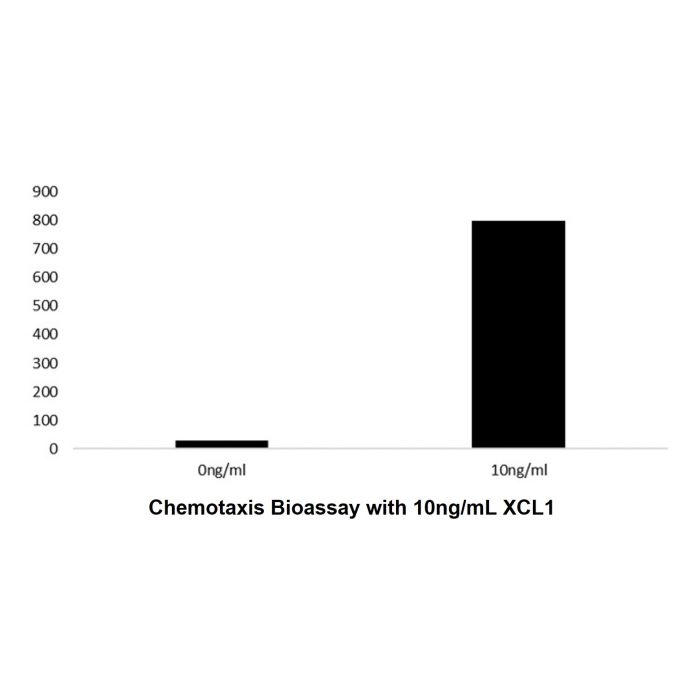
Fully biologically active when compared to standard. The biological activity determined by a chemotaxis bioassay using human T-lymphocytes is in a concentration of 10-100 ng/ml.
Purity >98% SDS-PAGE. purified using conventional chromatography techniques.
Function Chemotactic activity for lymphocytes but not for monocytes or neutrophils.
Chemokine (C motif) ligand (XCL1), as known as lymphotactin, is the only known member of the C-chemokine family and signals through the receptor XCR1, formally known as GPR5. The expression of lymphotactin is abundant in some activated T cells such as activated CD8+ T cells and other class I MHC restricted T cells. It is found in high levels in spleen, thymus, intestine and peripheral blood leukocytes, and at lower levels in lung, prostate gland and ovary. XCL1 induces its chemotactic function by binding to a chemokine receptor called XCR1. Recombinant Human XCL1 which is a single non-glycosylated polypeptide chains containing 92 amino acids and it shares approximately 60 % amino acid sequence homology with the murine and rat protein.
Fully biologically active when compared to standard. The biological activity determined by a chemotaxis bioassay using human T-lymphocytes is in a concentration of 10-100 ng/ml.
Lyophilized from a 0.2 μm filtered concentrated solution in 20 mM PB, pH 7.4, 150 mM NaCl.
复溶
We recommend that this vial be briefly centrifuged prior to opening to bring the contents to the bottom. Reconstitute in sterile distilled water or aqueous buffer containing 0.1 % BSA to a concentration of 0.1-1.0 mg/mL. Stock solutions should be apportioned into working aliquots and stored at ≤ -20 °C. Further dilutions should be made in appropriate buffered solutions.
Recombinant Human XCL1 Protein (rp148449)-Protein Bioactivity Fully biologically active when compared to standard. The biological activity determined by a chemotaxis bioassay using human T-lymphocytes is in a concentration of 10-100 ng/mL.
Recombinant Human XCL1 Protein (rp148449) - SDS-PAGE Recombinant Human XCL1 Protein was resolved with SDS-PAGE under reducing (R) and visualized by Coomassie® Blue staining, showing a single band at 10.2 kDa.


 ZJ23F0600372


 危险品化学品经营许可证(带存储)