Type II interferon produced by immune cells such as T-cells and NK cells that plays crucial roles in antimicrobial, antiviral, and antitumor responses by activating effector immune cells and enhancing antigen presentation. Primarily signals through the JAK-STAT pathway after interaction with its receptor IFNGR1 to affect gene regulation. Upon IFNG binding, IFNGR1 intracellular domain opens out to allow association of downstream signaling components JAK2, JAK1 and STAT1, leading to STAT1 activation, nuclear translocation and transcription of IFNG-regulated genes. Many of the induced genes are transcription factors such as IRF1 that are able to further drive regulation of a next wave of transcription. Plays a role in class I antigen presentation pathway by inducing a replacement of catalytic proteasome subunits with immunoproteasome subunits. In turn, increases the quantity, quality, and repertoire of peptides for class I MHC loading. Increases the efficiency of peptide generation also by inducing the expression of activator PA28 that associates with the proteasome and alters its proteolytic cleavage preference. Up-regulates as well MHC II complexes on the cell surface by promoting expression of several key molecules such as cathepsins B/CTSB, H/CTSH, and L/CTSL. Participates in the regulation of hematopoietic stem cells during development and under homeostatic conditions by affecting their development, quiescence, and differentiation.
生物活性
Measured in antiviral assay using L929 cells infected with vesicular stomatitisvirus (VSV). The ED50 for this effect is typically 0.2-1 ng/mL.
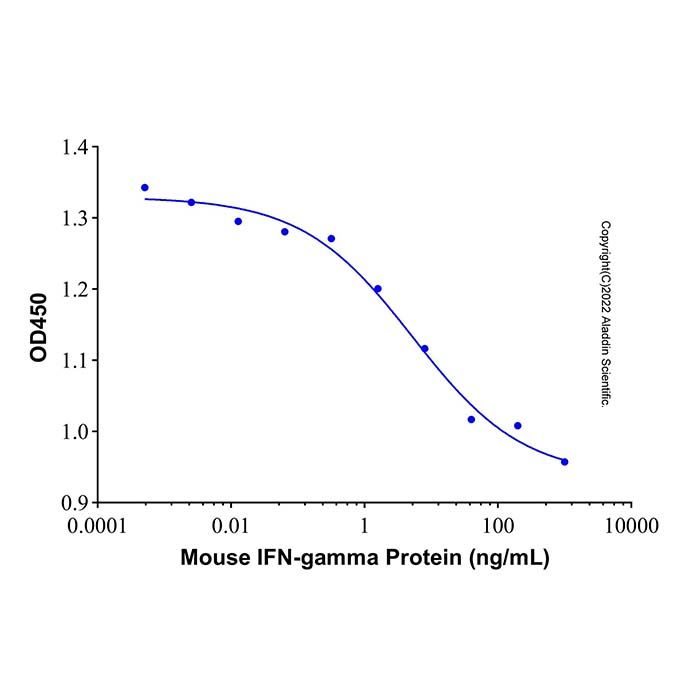
Recombinant Mouse IFN-gamma Protein (rp154254) - Protein Bioactivity Measured by its ability to inhibit the proliferation of HT-29 human colon cancer cells. The ED₅₀ for this effect is 4.8 ng/mL.
Recombinant Mouse IFN-gamma Protein (rp154254) - SDS-PAGE 2 μg/lane of Recombinant Mouse IFN-gamma Protein was resolved with SDS-PAGE under reducing (R) and non-reducing (N) conditions and visualized by Coomassie® Blue staining. As a result of different glycosylation, it migrates as approximately 15 & 18 kDa band in SDS-PAGE under reducing conditions and 15 & 18 & 32 & 36 kDa under non-reducing condition.

 ZJ26F0838720


 危险品化学品经营许可证(带存储)